Here Lies Wilson Matthews – 1 Who Was W.M. Matthews?
But he wanted to get in. He wanted to be urbane and careless. He wanted to wear well-cut clothes. He wanted to be a gentleman.
— Thomas Wolfe, Look Homeward, Angel
Part 1
Who Was W.M. Matthews?
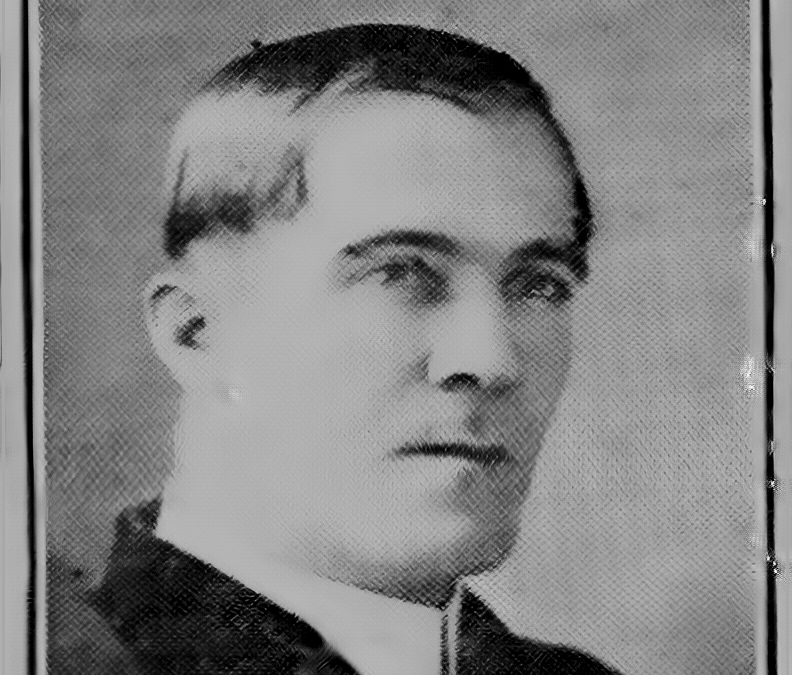
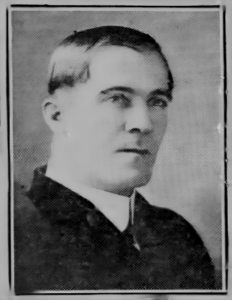
Mississippi State University – then Mississippi A&M College – entered the college football cosmos on November 15, 1895, with a 0-20* loss to Southwestern Baptist. W.M. Matthews captained the team and played quarterback. Matthews also chose the team’s colors, the maroon and white that have represented the school for over a century. Today, every Mississippi State player or fan wearing maroon and white honors the choice of W.M. Matthews. But…who was W.M. Matthews?
W.M. Matthews, usually known as Wilson Matthews, was a pioneer of southern college football, instrumental in initiating the football programs at Texas A&M, Mississippi State, and Baylor. He played baseball at four colleges and in the low minor leagues. He managed two clubs to pennants. He gained his greatest fame as a colorful minor league baseball umpire, one of the best who ever worked the Texas League.
Southern newspapers spilled out streams of ink and hills of Linotype slugs glorifying – and sometimes denigrating – Matthews. “Every baseball fan either knows Wilson Matthews personally or has heard so much about him that they think they know him,” a writer for the San Antonio Gazette said in 1907, eleven years before Matthews’ death. But today, Matthews has been completely forgotten save for a few online references to his role at Mississippi State.
Despite the positive publicity Matthews received in his day, he was not content to be known merely as a trailblazing football player and coach, or as a respected minor league baseball player, manager, and umpire. Matthews was a chronic prevaricator and fabulist who padded his resumé with fantastic tales of his adventures.
Matthews claimed that he was an All-America football player at Princeton, an All-America baseball player, a lieutenant in the US Army, a major league baseball pitcher, and a widely-read war correspondent during the Mexican Revolution. His personal history, as told through contemporary newspaper accounts, is littered with falsehoods, obfuscations, misdirections, fictitious associations, and baseless claims of plans and accomplishments.
But Matthews had a good reason to cloud both his past and his present. His mother was an infamous madam who called herself Blanche Dumont. For decades, well into Matthews’ days as a public figure, she ran a brothel in Guy Town, the notorious red light district in Austin, Texas. Matthews attempted, by means of lies and fabrications, to present himself as a gentleman in a time and place when appearance and breeding counted for everything. He never succeeded.
One journalist who knew Matthews well labeled him “a 10-minute egg,” meaning a hard-boiled type. He could be exceedingly profane, to a degree that shocked even the sportswriters accustomed to the casual obscenities of the ballpark and barroom. He brawled with fans, players, and writers. He was rumored to carry a long knife beneath his umpire’s chest protector.
He found his greatest satisfaction as an umpire in the low minor leagues. In an era when minor league officials worked solo, Matthews ruled the diamond, demanding the respect of every player on the field and dictating even the way they trotted to their positions between innings. He fined or ejected any player who dared question his authority. Players learned to leave the field when Matthews merely crooked a finger in their direction.
Matthews could control his fate within the confines of a ballpark; life outside the lines was another matter. The discrete journalism of his day shielded Matthews’ personal life, and the truth of his upbringing, from the prying eyes of the public, but a few allusions to “off-field issues” seeped into print. Seven years after his passing, an old hack remembered Matthews as “a man who knew how to handle a ball game.” Then he added, “Any old Texas Leaguer will tell you that Matty had his troubles with the rest.” What were his troubles? Was he a gambler, a criminal, a carouser, a drunk, a womanizer?
When researching Matthews, the truth is elusive; facts are chimeras. Even his name is a source of confusion.
Census ledgers recorded his name as W.F. Mathews in 1880, W.M. Mathews in 1900, and Wilson Mathews in 1910.
He is listed in the Texas A&M catalogs as William J. Matthews and W.N. Mathews. Mississippi A&M’s M Book of Athletics shows him as W.M. Matthews. He enrolled in the University of Alabama as Wilson Maurice Mathews. The University of Georgia annual lists him as W.M. Matthews and Stilson Maurice Matthews. He appears in the Georgia Baseball Lettermen archives as S.W. Matthews.
He enlisted in the army as Wilson M. Matthews.
The Baseball Reference database captures his minor league statistics in various seasons under W. Mathews, Wilson N. Matthews, and Wilson Belmont Matthews.
Journalists referred to him as Wilson Maurice Matthews, Wilson C. Matthews, and Wilson Harry Matthews.
The name on his death certificate is Wilson Matthews. He appears in the Family Tree database as Wilbur Mathews.
His friends called him Bill, Billie, or Matty. At the University of Alabama he was known as The Duke.
The year and place of his birth are likewise matters of conjecture.
The June 1880 census recorded his age as 2, implying a birth in 1877 or 1878, and said he was born in Texas. In the 1900 census Matthews claimed he was born in England in July 1877 and came to the US in 1879. In the April 1910 census, Matthews said he was born in New York and was 35, implying a birth year of 1874 or 1875.
The records of the University of Alabama give his birthday as July 13, 1877.
When he enlisted in the army in 1898, he said he was born in Hearne, Texas, and was 22, implying a birth year of 1876.
A 1909 article in the Macon Telegraph said Matthews was born in Brenham, Texas, on July 13, 1875.
His death certificate gives his birth as July 13, 1878, in Austin.
Matthews spent his entire life running, constantly moving between schools, towns, leagues, and jobs. He left behind a litany of lies about where he was going, where he had been, and what he had accomplished. Matthews’ falsehoods amounted to nothing – they harmed no one and brought him no lasting fame. He died penniless and is buried in an unknown location.
One hundred-plus years after his death, it is impossible to fully know the who of W.M. Matthews. But the news reports and references of his day, strung together to trace his wanderings across the south, evoke a man who was perhaps more interesting than the gentleman he desired to portray.
—
*Most modern sources give the game’s date as November 16, and the score as 21-0. A game summary appeared in the morning edition of the Nashville American on November 16. A game played on the afternoon of November 16 could not have been reported in the November 16 morning edition. The article was datelined Jackson – Nov. 15., indicating the story was filed from Jackson on November 15.
The article reported a score of “20 to 0” and said, “Jackson made four touch-downs.” In 1895, a touchdown counted four points, an extra point kick added two, and a drop kick through the uprights scored five. The 20-0 score can easily be obtained by the four reported touchdowns, plus two successful extra point kicks. The 21-0 score requires a more convoluted combination of events: the four reported touchdowns, four unsuccessful extra point kicks, and an unreported drop kick.

Charles Norman is a writer and historian. Email: reverb.raccoon@gmail.com. Or follow on Instagram and Facebook.
Latest Posts
Here Lies Wilson Matthews – 2 Who Was Blanche Dumont?
Here’s what I want. I notice you changed your name. I want you to keep your new name. I guess you made up someplace you came from – well, that’s where you came from… You figure you died and now you’re somebody else and we’ll get along fine. -- John Steinbeck, East of...
Here Lies Wilson Matthews – 3 Guy Town
He was surrounded by a world that was both beautiful and terrifying, a land of secrets and shadows, where the line between civilization and savagery was thin and easily crossed--Joseph Conrad, Lord Jim Part 3Guy Town Miss Blanche Dumont became a sex worker in Austin,...
Here Lies Wilson Matthews – 4 Spaced Flashes
In probing my childhood (which is the next best to probing one’s eternity) I see the awakening of consciousness as a series of spaced flashes, with the intervals between them gradually diminishing until bright blocks of perception are formed, affording memory a...
Here Lies Wilson Matthews – 5 The Austin Athletics of 1893
In this part of the story there are living ghosts as characters, and the story doesn’t come out quite the way either the ghosts or non-ghosts expected. -- Norman MacLean, Young Men and Fire Part 5 The Austin Athletics of 1893 Austin lacked a minor league baseball club...
Contact Reverb Raccoon
 |
 |
 |
 |
Archives