Here Lies Wilson Matthews – 3 Guy Town
He was surrounded by a world that was both beautiful and terrifying, a land of secrets and shadows, where the line between civilization and savagery was thin and easily crossed
—Joseph Conrad, Lord Jim
Part 3
Guy Town
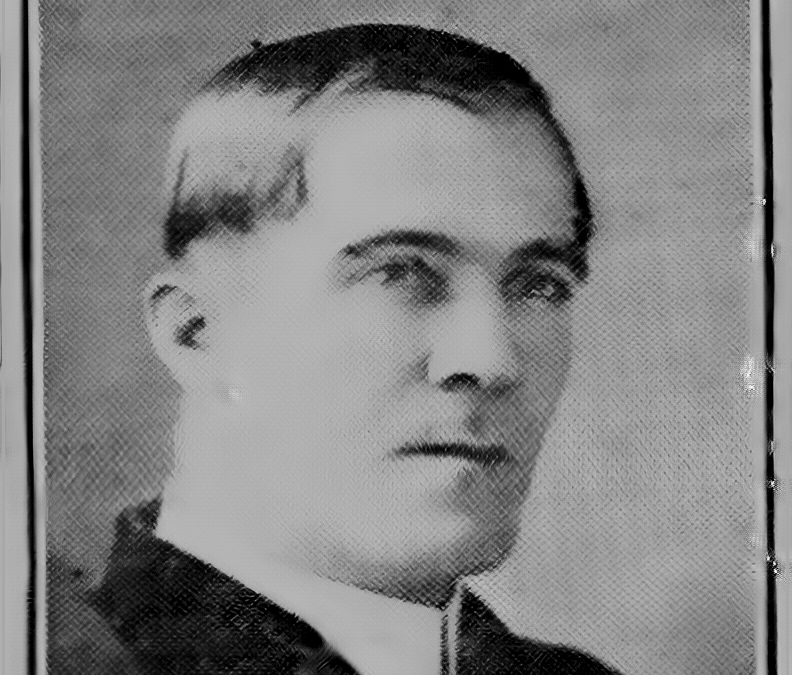
Miss Blanche Dumont became a sex worker in Austin, Texas, before 1870. She probably transitioned to a madam around 1877 when her son, the minor league umpire and ballplayer known as Wilson Matthews, was born or adopted.
The 1880 census shows Dumont boarding four women and her two-year-old son on Live Oak Street (later West 2nd Street). The house was probably located at 200 West Live Oak, at the corner of West Live Oak and Colorado.
Around 1883, Dumont moved her business to 211 West 4th Street, formerly Cedar Street, at the corner of West 4th and Lavaca (Lot 12, Block 28 in the deed records and tax rolls).
The 1881-1882 city directory shows her still on Live Oak Street. In March 1884, she bought $864.52 worth of “household and kitchen furniture” from M. Kreisle Co. to fix up her new home.
Dumont’s brothel at the corner of West 4th and Lavaca became a central feature of Guy Town, Austin’s red light district.
The “Guy Town” name appeared in newspaper reports as early as 1880, but the Austin Statesman usually referred to it more discretely as “the First Ward.”
Guy Town had neither official borders nor official protections. It owed its existence to a city government that gave up attempts to eradicate prostitution. Instead, it sought to confine it to an area roughly defined by Guadalupe, Colorado, and West 5th streets, and the Colorado River.
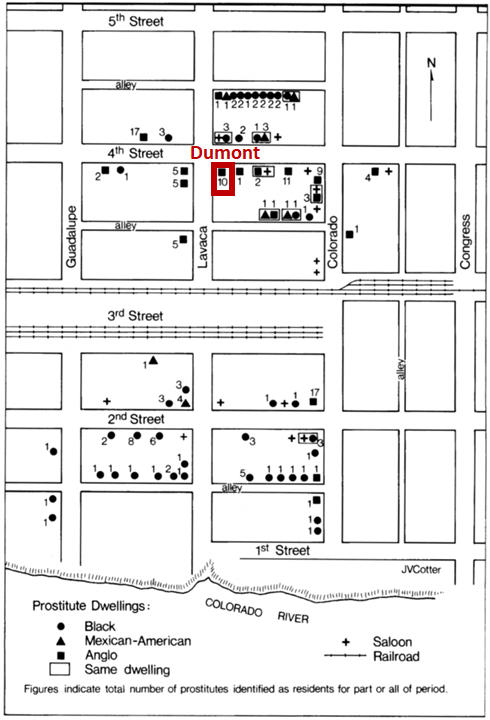 Brothels and saloons in Guy Town. From “Prostitution and Public Policy in Austin, Texas, 1870-1915” by David C. Humphrey, 1983.
Austin’s 45-year struggle to regulate the sex trade is described in David C. Humphrey’s excellent “Prostitution and Public Policy in Austin, Texas, 1870-1915” (The Southwestern Historical Quarterly, April 1983):
The great majority of city fathers condoned prostitution within certain bounds. The accommodation with prostitution that developed in the 1870s and 1880s was not recognized in law, but it was confirmed in discussion. The core of that understanding was Guy Town, within which prostitution was acceptable but outside of which it was generally discouraged. Moreover, even within Guy Town prostitutes were expected to keep a fairly low profile – by meeting customers indoors, not in the streets, and by making some effort to restrain the disruptive noises (ragtime music, “vile talk,” brawling) that issued forth from the houses late at night.
The “accommodation” did not provide blanket immunity. Dumont’s Guy Town rap sheet included arrests for keeping a disorderly house (five), vagrancy (twice), and disturbing the peace. The charges didn’t always stick, but they gave Austin’s citizenry the illusion of an interested police force.
Dumont’s house at 211 West 4th was a rambling 10-room affair. The Sanborn Fire Insurance map for 1889 shows a one-story frame building with a shingled roof, annotated as “Female Boarding,” a euphemism for a brothel. A couple of small outbuildings are in the back.
A smaller brothel was next door at No. 209. A saloon featuring “Drinking and Card Rooms” sprawled across No. 207. A two-story brothel run by Sallie Daggett, another famous Guy Town denizen, occupied No. 205. A two-story saloon stood at No. 201, with a brothel run by Carrie Smith around the corner at 312 Colorado. The Anheuser-Busch and Lone Star breweries rattled away on the West 3rd side of the block, separated from Dumont’s property by a narrow alley.
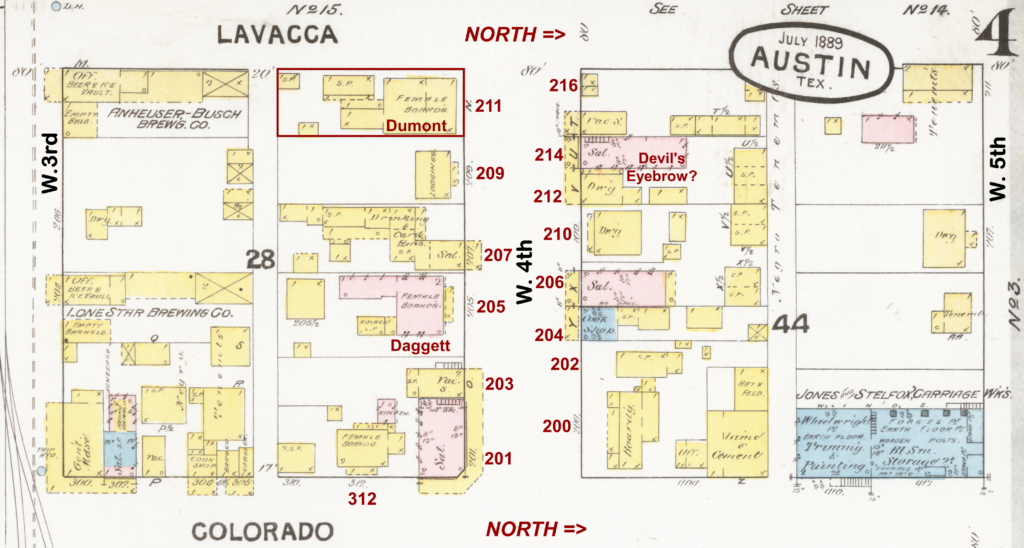 Sanborn Fire Insurance map,1889. House numbers from the 1900 Sanborn map. North is to the right.
Today, there is some confusion regarding the location of Dumont’s establishment. Oil Can Harry’s, a bar, owns Dumont’s old 211 West 4th address, and all modern articles say that Oil Can Harry’s is located on the site of Dumont’s brothel. But many of Austin streets were renumbered in the 1920s. Dumont’s brothel was not located where No. 211 is today.
Historical records leave no doubt that Dumont’s brothel stood at the corner of West 4th and Lavaca. The 1900 Sanborn Fire Insurance map, which annotated each property on the block with its street address, shows No. 211 on the corner. Austin business directories, such as the 1895 directory which lists Blanche Dumont just below State Geologist Edwin T. Dumble, describe her address as “211 W. 4th cor Lavaca.” Older directories place her at the corner of Lavaca and West Cedar, the original name of West 4th Street. Legal filings and tax records describe the property as “Lot 12, Block 28.” The original 1839 plan of Austin places Lot 12 in the northwest corner of Block 28.
 Austin business directory, 1895.
The corner of West 4th and Lavaca is now No. 219, occupied by the Riley Building and Twins Nightclub. Oil Can Harry’s is about halfway between Lavaca and Colorado, closer to where Sallie Daggett’s brothel at No. 205 stood in the Guy Town days.
A basement bar called Dumont’s Down Low, at 214 West 4th, claims to be haunted by the ghost of either Dumont or Daggett – or someone else who traipses around in high heels and appears in mirrors. The property was No. 210 in the Guy Town era, across the street from the brothels of Dumont and Daggett.
The 1889 Sanborn map shows a “Dwelling” fronting 210 West 4th, with “Negro Tenements” lining the alley at the rear of the lot. David Humphrey’s Guy Town map confirms that both the dwelling and the tenements housed Black sex workers.
Humphrey described the Guy Town workers as a racially diverse group. In 1880, about 55% were “Anglo,” 40% were Black, and the remainder were “Mexican-American.” They co-existed in the same neighborhood, sometimes in the same saloons, but in separate dwellings. The white workers tended to inhabit the larger brothels on the main streets; others were more likely to operate alone or in pairs, and often worked housekeeping jobs outside Guy Town.
Blanche Dumont attempted to set herself apart from her competition by creating what the Austin Statesman described as “a high-toned bagnio.” Between 1884 and 1887, she spent $3108 – over $100,000 in today’s money – on improvements, including furniture, carpeting, and a Behr Bros. piano. One day, a young man employed by a local lumber company appeared at Dumont’s to present a bill. A half-century later, he described the experience:
A maid admitted me into a large, elegantly furnished room with plush carpets, velvet hangings, and fine furniture. When the Madam swept into the room she was an impressive looking person dressed in silk and lace with diamond rings and expensive jewelry. She was arrogant, haughty, and unreasonable. She demanded to know what I wanted and when I told her I came to collect a bill she practically ordered me out of the house.
As an umpire, Wilson Matthews adopted his mother’s “arrogant, haughty, and unreasonable” attitude. Any player who questioned his calls would be banished from the field with the same imperious authority that Blanche Dumont employed in ejecting the young bill collector from her abode. Seeing Matthews in action for the first time – and taking exception to his decisions – one reporter asked, “Who is this self-important gentleman with the lordly air and the bum lamps?”
Dumont’s arrogance was real, but her elegant dwelling was a sham, a chimera that gave her clients a false sense of respectability, as if the hours spent within it elevated rather than degraded their lives. Her jewels were likely cut glass. Her furnishings had been bought on credit at local stores, the debts duly recorded in the Travis County ledgers. The lumber company never collected on its bill. It’s unlikely that the other merchants were ever repaid, either.
Nevertheless, Dumont epitomized Guy Town. “Her career in Guy Town spanned the entire period of its existence,” Humphrey wrote. “Blanche Dumont’s place was one of the most noted houses in the district.”
Dumont rented her house for several years. In 1885, she was paying her landlord $50 each month “in advance.” In July 1889, she purchased the property from P.J. Lawless, a ticket agent for the Texas & Pacific Railroad, for $3000. She financed the purchase with six $500 promissory notes, one payable each year with an interest rate of 8% per annum.
During the term of the loan, she would pay more than if she rented, assuming her rent remained constant at $50 per month, but after 1895 she would own the property free and clear. It didn’t work out that way. Dumont never managed to pay off her notes. When she finally sold the house for $5000 in 1914, twenty-five years after buying it, she walked away with less than $900. The rest went to her creditors.
It is easy to romanticize Guy Town, to view it through libertarian lenses as an outpost of freedom unfettered by Victorian strictures, where women determined their own destinies. The perspective is partially true. Blanche Dumont ruled a world of her own design. It was a world of drunkenness, drugs, disease, and death, but she survived and presented the appearance of prosperity. The women lower on the ladder, though, were less likely to see themselves as emancipated.
A woman working in one of the better brothels could charge $3 for a night of her company. Meanwhile, the madam charged her boarder $15 to $20 each week. A grand jury empaneled in Austin in 1893 found that the arrangement “keeps the inmates perpetually indebted to the keepers, forcing such inmates or boarders to continue the this life of shame and prostitution until she or they become a total wreck and many of them end their miserable existence by suicide.”
The Statesman reported two attempted suicides in Guy Town on a single Monday night in 1887. A woman called Toughy, working for Blanche Dumont, “undertook to find surcease for her sorrow by swallowing a dose of arsenic.” On the same night, a woman called Dutch Annie, working in Carrie Smith’s brothel around the corner at 312 Colorado, “sought to rid herself of the coil of life by swallowing a quarter’s worth of morphine.”
“The drugs were purchased openly at drug stores,” the Statesman noted, adding that the drugs’ availability “does not reflect creditably upon the law which so loosely permits the sale of such stuff.”
Both women survived; some were not as lucky. At least three women died in Dumont’s brothel.
Lula Morris passed in 1880 by unreported causes. Her last words: “I want to see mother.” Pearl Block died in 1894 of an accidental morphine overdose. Her real name was Ella. Marguerite Speed, 32, who had begun working in Guy Town when she was 20, died in 1907 of unreported causes. Dumont called her “my most lamented friend.”
Also a victim: a woman in Galveston named Annie Gannon, who likewise called herself Blanche Dumont. Known as a chronic drunk, she died in 1876 by swallowing 20 cents of morphine powder.
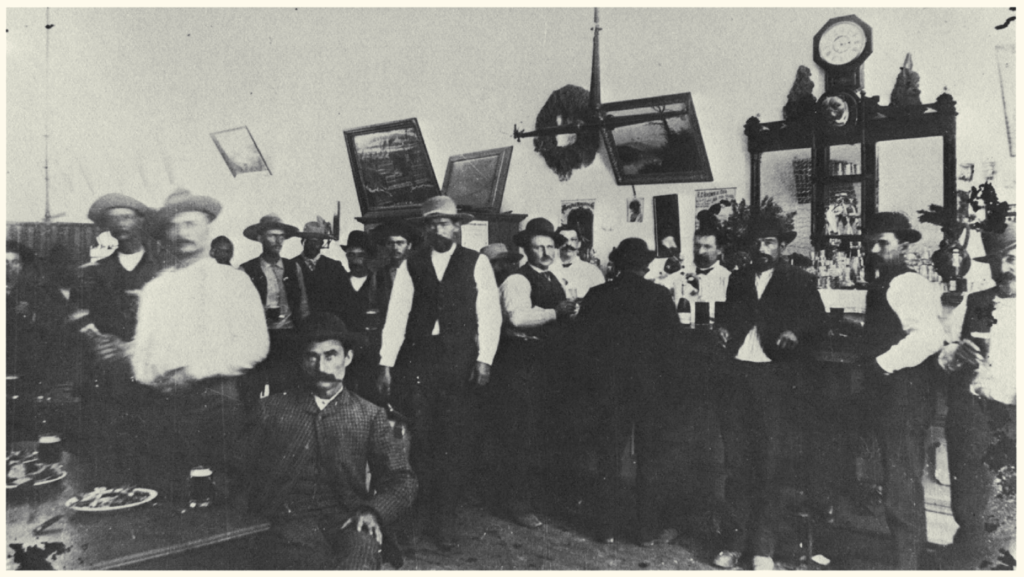 Unidentified saloon in the Guy Town era, decorated for Christmas. From “Prostitution and Public Policy in Austin, Texas, 1870-1915” by David C. Humphrey, 1983. Photo by Hubert Jones.
The Sanborn map shows a two-story brick saloon with a large overhang extending above the sidewalk at 214 West 4th, across the street from Dumont’s house. The mapped structure matches the description of a dive known as the “Devil’s Eyebrow.” On a cold January night in 1889, a writer for the Statesman stepped into the pit. His report captures the unromantic reality of Guy Town in chilling detail:
Standing under the glare of a great arc light the other night in that portion of the city traversed by West Fourth street, an officer said to the STATESMAN reporter: “That’s a hard place over there.”
“Over where?”
“There, where you see that light,” and he pointed to a two-story brick, on the ground floor of which is a saloon. “That is about the hardest place in this city, and it requires constant watching. You had better go over there and take a look at the ranch.”
It was a dreary night with a drizzle and heavy mist filling the atmosphere, while the great arc light cast a baleful glare over the entire neighborhood.
Very few people were out even in that quarter of the city where humanity, ever restless, tirelessly tramps through the brooding darkness or in maddened revelry battle against it in dive or brothel. No sleep for weary eyes; no comforting rest for weary hearts in that quarter of town where the shades of night gather.
The building to which the reporter had been directed is a two-story brick, known in the lingo of the neighborhood as the “Devil’s Eyebrow.” The name is appropriate, for it arches over and shadows eyes that see nothing but iniquity in all its horrid deformity.
In front of the building on the sidewalk a group of men and women stood engaged in conversation in which oaths and slang largely predominated. They gave way as the reporter neared the door, and an ominous hush fell over the crowd. They were sizing up the newcomer to see if there was a chance to rope him in for free drinks.
On the inside the atmosphere was reeking with the fumes of stale beer, whiskey, tobacco smoke, and the odor from damp and dirty clothing. There was a motley crowd of whites and blacks, men and women, in the bar room, while from the rear apartment there were the sounds of many voices.
Thither the reporter wended his way, and looking in he saw a hardened crew of bleary-eyed men and assertive negro and white women of the lowest and most abandoned type. Nearly all were half seas over, and there was a suspicious odor of the fumes of opium permeating the room.
They paid no attention to the reporter. In that room the visitor must make the advances, and woe be unto him if he advances too far. The inmates of the room were scattered here and there, some standing, some sitting and some leaning against the wall. Some were drinking beer and all had been.
The reporter stood by the door and listened to the conversation a few moments. It was horrible. Incomparable, overwhelmingly horrible. Not a word, not a whisper, not a look, not a move that betokened even a faint trace of the higher emotions and feelings that move upon the human heart.
It was hell.
The reporter, tired of the scene, passed out of the building and on the sidewalk met two girls coming from a saloon hard by. “What shall we do?” said one.
“I don’t know,” said the other, and she ripped out an oath or two. “We can’t let her starve. I won’t let her starve. I’m going to take her to my room.”
They were talking about a waif from a far away city who had just reached town penniless and sick. In all this city there was no place for such. No helping hand save that outstretched by her sisters in iniquity. A sad comment on the civilization of the day.
“Will it always be so?” mused the reporter as he thought of this waif and hundreds of thousands like her, who have not where to lay their heads when heart-weary and yearning for a better and holier life.
In this world Wilson Matthews grew up. He was William Mathews back then, known to his friends as Billie.
Perhaps as a means to mentally escape the blighted corporeality of Guy Town, Billie developed a love of literature, poetry, and the dramatic arts.
In the biopic based on this work, a boy sits on a bed in a small room at the back of his mother’s brothel, reading the works of Shakespeare by the light of a kerosene lamp while the walls reverberate with the shouts of drunken men, the forced laughter of women, and the clunky chords of a proto-ragtime piano.
The next day, he rises early and goes into the unpaved street, littered with the refuse of the previous night’s debauchery, to play baseball with his fellow urchins using a plank for a bat and a dirt clod for a ball.
By age 15, Billie was one of the best ballplayers in Austin.
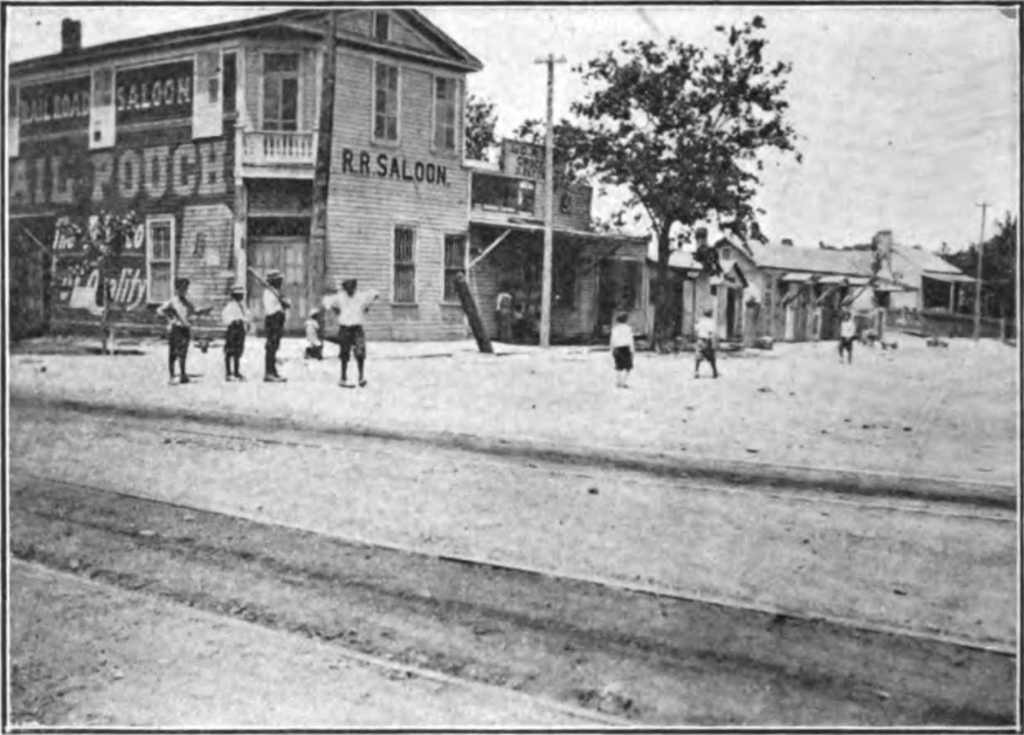 Boys play in a vacant lot between the Railroad Saloon and the streetcar tracks. From “A Social Survey of Austin,” by William Benjamin Hamilton, Bulletin of the University of Texas, issue 273, 1913.

Charles Norman is a writer and historian. Email: reverb.raccoon@gmail.com. Or follow on Instagram and Facebook.
Latest Posts
Here Lies Wilson Matthews – 1 Who Was W.M. Matthews?
But he wanted to get in. He wanted to be urbane and careless. He wanted to wear well-cut clothes. He wanted to be a gentleman.-- Thomas Wolfe, Look Homeward, Angel Part 1Who Was W.M. Matthews? Mississippi State University – then Mississippi A&M College – entered...
Here Lies Wilson Matthews – 2 Who Was Blanche Dumont?
Here’s what I want. I notice you changed your name. I want you to keep your new name. I guess you made up someplace you came from – well, that’s where you came from… You figure you died and now you’re somebody else and we’ll get along fine. -- John Steinbeck, East of...
Here Lies Wilson Matthews – 4 Spaced Flashes
In probing my childhood (which is the next best to probing one’s eternity) I see the awakening of consciousness as a series of spaced flashes, with the intervals between them gradually diminishing until bright blocks of perception are formed, affording memory a...
Here Lies Wilson Matthews – 5 The Austin Athletics of 1893
In this part of the story there are living ghosts as characters, and the story doesn’t come out quite the way either the ghosts or non-ghosts expected. -- Norman MacLean, Young Men and Fire Part 5 The Austin Athletics of 1893 Austin lacked a minor league baseball club...
Contact Reverb Raccoon
 |
 |
 |
 |
Archives