Here Lies Wilson Matthews – 2 Who Was Blanche Dumont?
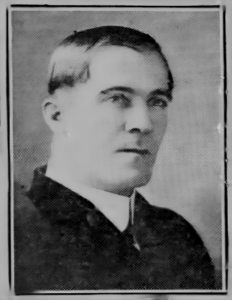
Here’s what I want. I notice you changed your name. I want you to keep your new name. I guess you made up someplace you came from – well, that’s where you came from… You figure you died and now you’re somebody else and we’ll get along fine.
— John Steinbeck, East of Eden
Part 2
Who Was Blanche Dumont?
Miss Blanche Dumont operated a brothel in Guy Town, the red light district of Austin, Texas, for over 30 years. She became one of Austin’s most infamous and best-remembered madams. People still speak of seeing Dumont’s ghost near her former establishment. She was the mother of Wilson Matthews, the legendary Texas League umpire.
The origin and true identity of Blanche Dumont are lost to history. Even Wilson Matthews’ wife, Maude Huyck Matthews, did not know her provenance. When Maude filled out her husband’s death certificate in 1918, she wrote her mother-in-law’s maiden name and place of birth as Unk (unknown).
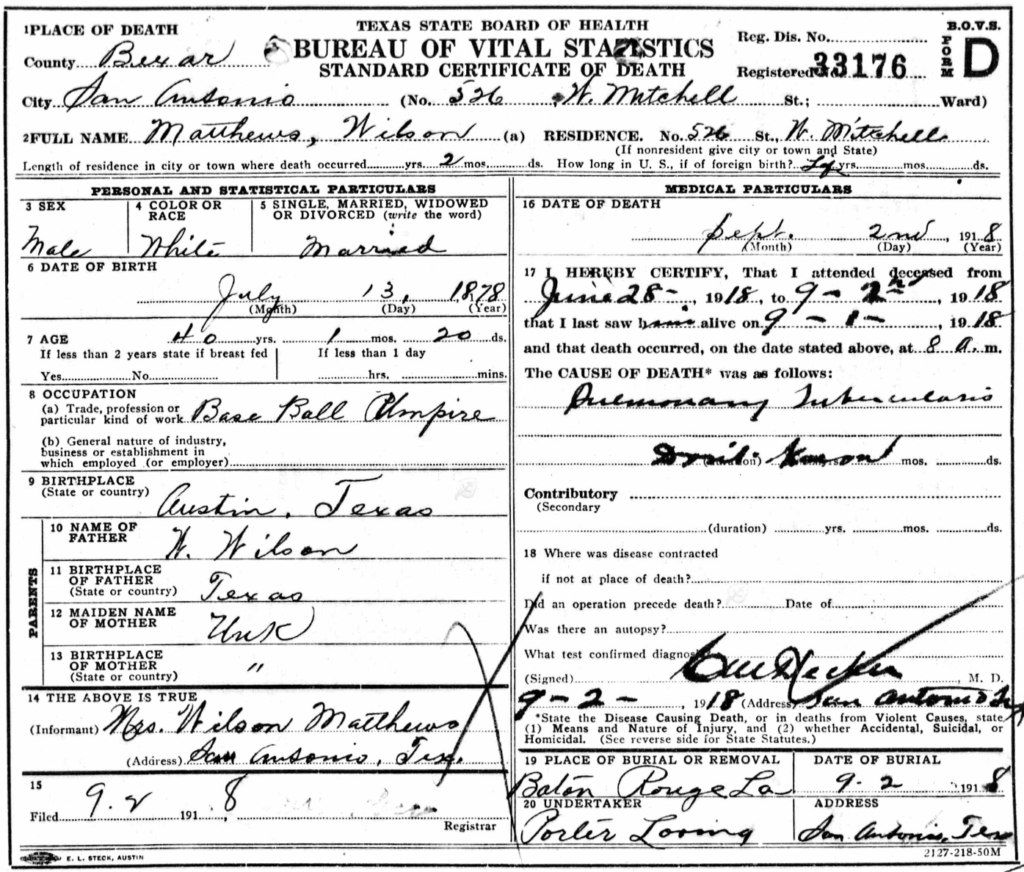 Wilson Matthews’ death certificate, September 2, 1918.
The name Blanche Dumont may have been borrowed from a character in “A Hero of Romance,” a popular play based on the novel Le Roman d’un Jeune Homme Pauvre by Octave Feuillet. Other demimondes chose the same name: newspaper accounts record the arrests of women named Blanche Dumont in Galveston and New Orleans.
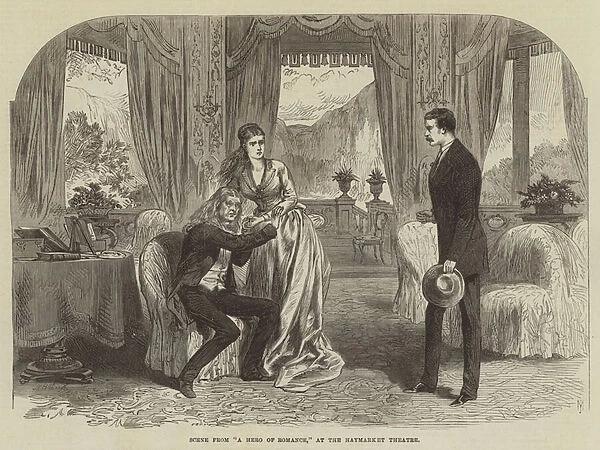 The character of Blanche Dumont (center) in a scene from “A Hero of Romance.” Illustrated London News, 1868.
According to the 1900 census, Dumont was born in November, 1851. Other censuses, which recorded only her age, imply a birth year as early as 1849 and as late as 1865.
Dumont began her career as a sex worker sometime after the Civil War. The 1870 census for Austin records Blanche Dumont, 21, living with two other young women, ages 19 and 22. All three women are working at home.
The oldest woman lists her birthplace as Texas. The entry for Blanche Dumont, on the next row of the ledger, has a faint ditto mark in the Place of Birth column, indicating that she, too, was born in Texas. Dumont does not claim a parent of foreign birth.
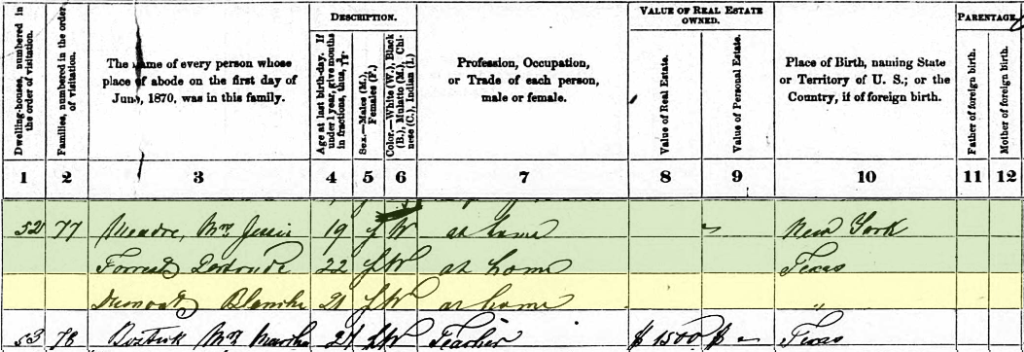 1870 census for Austin, Texas. Headers and relevant entries (intervening rows removed).
After 1870, Dumont began refining her character and invented a fictitious backstory. In the 1880, 1900, and 1910 censuses (the 1890 census records were destroyed in a fire), Dumont claimed to have been born in England.
In the 1920 census, taken after she had abandoned Guy Town and was running a legitimate boarding house in Fort Worth, Dumont again claimed a Texas birth. She gave her father’s birthplace as Texas and her mother’s as Tennessee. Her marital status was marked with a W, meaning widowed.
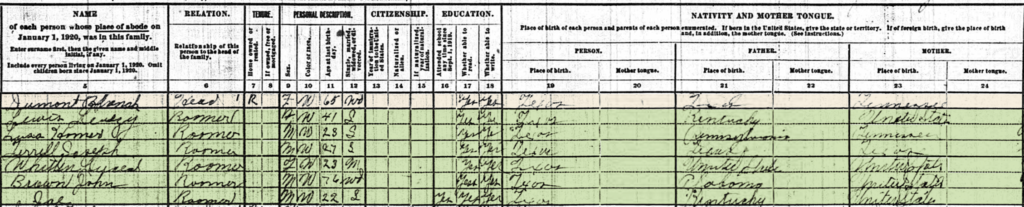 1920 census for Fort Worth, Texas. Headers and relevant entries (intervening rows removed).
By the time Dumont died in 1933, she had yet again changed her origin story. Her death certificate recorded her birthplace as France. The names of her mother and father, and their birthplaces, are Unknown.
One of her obituaries said she was born in France, “coming from France to the United States with her father.”
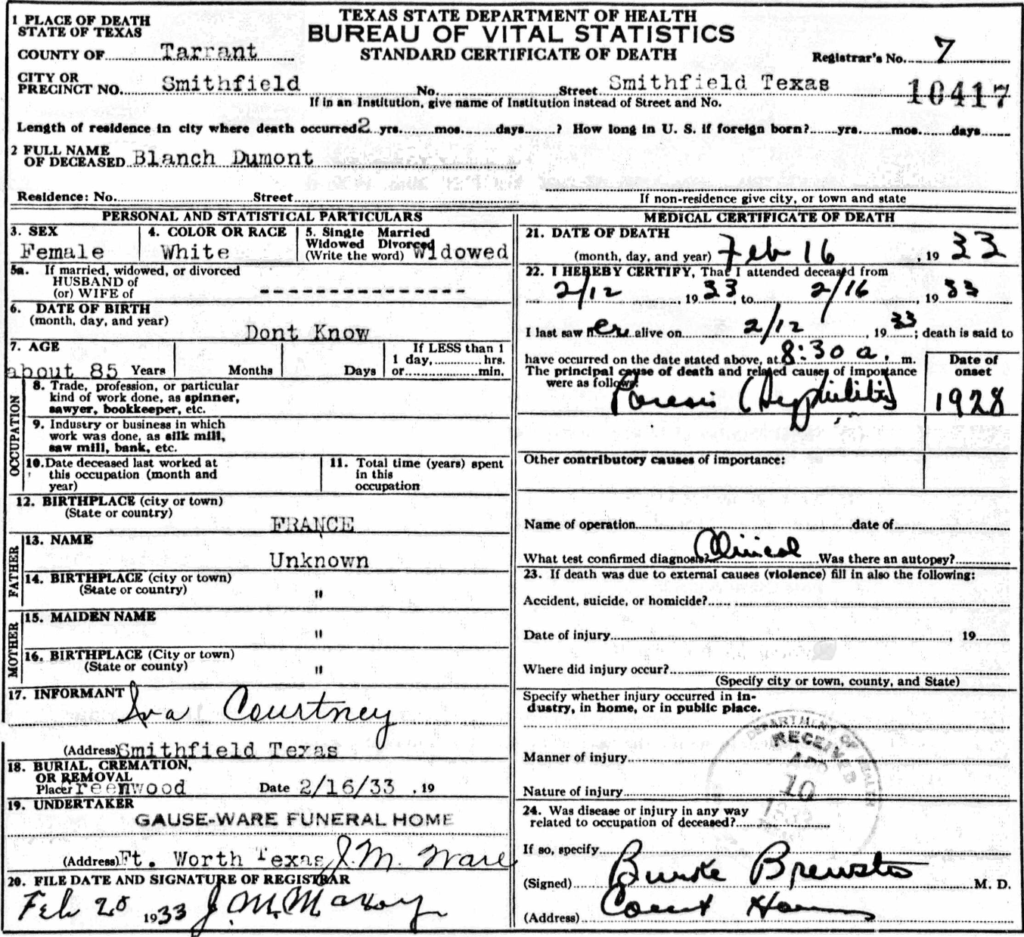 Blanche Dumont’s death certificate, February 20, 1933.
The information in the 1870 and 1920 censuses rings true, and gives us the bare bones of an origin story. She was born in Texas. Her father was born in Texas and her mother was born in Tennessee. She was married early and widowed, leading her to take up sex work in order to survive. She adopted the name Blanche Dumont as an alias.
In the late 1870s, Dumont either gave birth to a son or adopted a boy. It was also around this time that she began operating her own brothel.
The June 1880 census shows Dumont keeping house on Austin’s Live Oak Street. The address was probably 200 West Live Oak (later West Second Street), at the corner of West Live Oak and Colorado. The ledger lists Blanche Dumont, four women, and a two-year-old boy named W.F. Mathews.
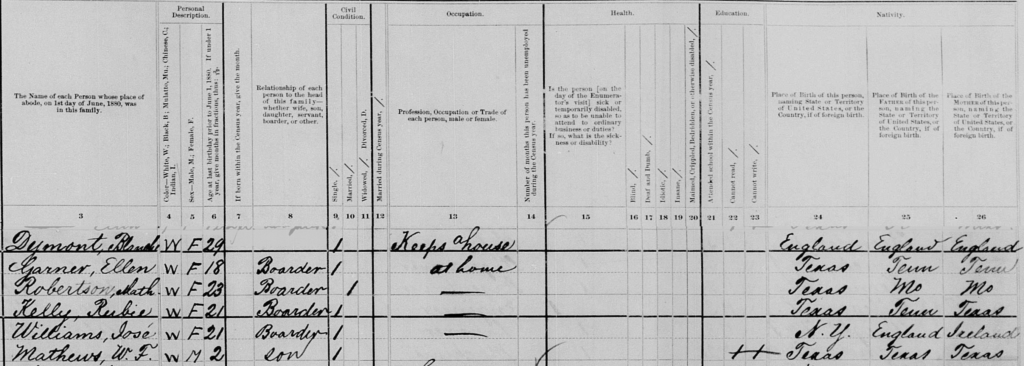 1880 census for Austin, Texas. Headers and relevant entries (intervening rows removed).
The census taker designated Dumont as the head of the household. Under Relationship of each person to the head of this family, W.F. Mathews is described as son.
The census records the boy’s birth location as Texas and states that his mother and father were also born there. Blanche Dumont’s birthplace, however, is given as England. The discrepancies between the surnames and birthplaces add to the mystery of the boy’s origin.
According to Wilson Matthew’s death certificate, his father was W. Wilson. Mathews, then, must have been his mother’s name.
The simplest explanation for Mathews’ provenance is that Dumont was the boy’s adopted, rather than biological, mother. His birth mother, named Mathews, may have worked in Dumont’s brothel. She may have died after giving birth, or she may have abandoned her infant child. Blanche Dumont took the boy in and raised him as her own son.
On the other hand, if Mathews was Dumont’s biological son, then her real name, either married or maiden, must have been Mathews or Matthews. She chose to give the boy her original name, rather than saddle him with the name of a brothel-keeper. On the census form, under Place of Birth of the Mother for W.F. Mathews, she recorded her actual place of birth, Texas, rather than the fictional birthplace of the character she portrayed.
The boy, W.F. Mathews, grew up to be the minor league umpire known as Wilson Matthews.
A few things that we know about Wilson Matthews lead us to believe that Blanche Dumont may have been descended from the Germans who settled in Central Texas in the 1830s and 1840s.
Dumont sent her son to St. Mary’s School for Boys in Austin. St. Mary’s Catholic Church was the religious home of Austin’s German-speaking Catholics. The attached School for Boys emphasized instruction in German, and many of Mathews’ classmates had parents who were born in Germany.
As an adult, umpire Wilson Matthews was said to have an odd manner of speaking. He pronounced OUT! as OOT! He once wrote a newspaper article in which he used the word noot – probably a phonetic spelling of nutte, German for prostitute.
Based on this admittedly sketchy evidence, it is possible that Matthews and his mother spoke with German accents, and may even have spoken the Texasdeutsch dialect that still lingers in a few Texas communities. In the unsophisticated world of Guy Town, Dumont was able to parlay her Prussian manner and accented speech into a character that her clients accepted as a proper Englishwoman.
The relationship between Blanche Dumont and Wilson Matthews must have been known during Matthews’ lifetime. It was probably common knowledge in Austin and a topic of gossip in newsrooms and saloons around the Texas League.
Dumont no doubt counted many sportswriters and players among her clients. Some of the older hacks may have seen the boy trotting about the brothel. Journalists, though, especially in Texas, seemed protective of Matthews and never exposed his heritage until Dumont died, fifteen years after Matthews’ passing.
Dumont’s death made headlines all over Texas. She was memorialized, not as a once-famous madam, but as the mother of the still-famous umpire. Like her son, Dumont passed without a cent to her name and was buried in a grave marked only by a 3, her space in Lot 2, Section 8-H of Fort Worth’s Greenwood Cemetery.
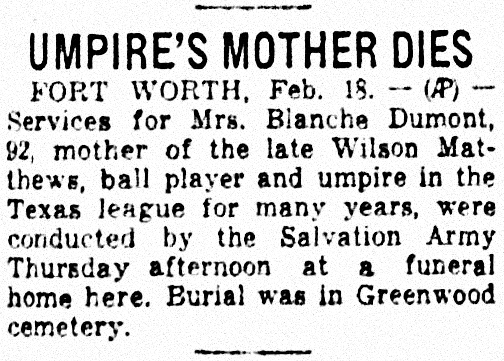 Waco Times-Herald, February 18, 1933.
 Fort Worth Star-Telegram, February 18, 1933.

Charles Norman is a writer and historian. Email: reverb.raccoon@gmail.com. Or follow on Instagram and Facebook.
Latest Posts
Here Lies Wilson Matthews – 1 Who Was W.M. Matthews?
But he wanted to get in. He wanted to be urbane and careless. He wanted to wear well-cut clothes. He wanted to be a gentleman.-- Thomas Wolfe, Look Homeward, Angel Part 1Who Was W.M. Matthews? Mississippi State University – then Mississippi A&M College – entered...
Here Lies Wilson Matthews – 3 Guy Town
He was surrounded by a world that was both beautiful and terrifying, a land of secrets and shadows, where the line between civilization and savagery was thin and easily crossed--Joseph Conrad, Lord Jim Part 3Guy Town Miss Blanche Dumont became a sex worker in Austin,...
Here Lies Wilson Matthews – 4 Spaced Flashes
In probing my childhood (which is the next best to probing one’s eternity) I see the awakening of consciousness as a series of spaced flashes, with the intervals between them gradually diminishing until bright blocks of perception are formed, affording memory a...
Here Lies Wilson Matthews – 5 The Austin Athletics of 1893
In this part of the story there are living ghosts as characters, and the story doesn’t come out quite the way either the ghosts or non-ghosts expected. -- Norman MacLean, Young Men and Fire Part 5 The Austin Athletics of 1893 Austin lacked a minor league baseball club...
Contact Reverb Raccoon
 |
 |
 |
 |
Archives