Here Lies Wilson Matthews – 5 The Austin Athletics of 1893
In this part of the story there are living ghosts as characters, and the story doesn’t come out quite the way either the ghosts or non-ghosts expected.
— Norman MacLean, Young Men and Fire
Part 5
The Austin Athletics of 1893
Austin lacked a minor league baseball club in 1893, and the semi-pro game filled the fans’ need for a baseball fix. The Austin Statesman regularly published accounts of the games, including lists of players and their positions; many articles were graced with a proper box score. The Austin Athletics became one of the town’s best-known teams.
Managed by George Kempen, a barber by trade, the Athletics included first baseman Louis Brueggerhoff, second baseman Calhoun Browne (always recorded as “Cal Brown”), shortstop Percy Leader, infielder Joseph Allison Jack (who played under the name “Al Jacks”), infielder and pitcher Ed Dahlich, right fielder Willie Achilles, left fielder Lee “Sykes” Rundell, catcher Tom Hunter, and pitcher Lemuel M. Mobley (usually recorded as “Mobly”).
In the parlance of the day, the Athletics were a “fast” team. Jacks, who acted as the on-field captain, was a middleweight wrestler from San Antonio who had appeared in 18 Texas League games the previous year. Hunter and Dahlich had played for the St. Edward’s College team. Browne played on the University of Texas team. Achilles pitched for a team of volunteer firemen. Most of the Athletics were well-known in semi-pro circles.
The Athletics were also fast in the socio-economic sense. The players’ names often appeared in the Statesman in accounts of socials, dances, and parties. Willie Achilles, the son of a prominent merchant, was especially popular.
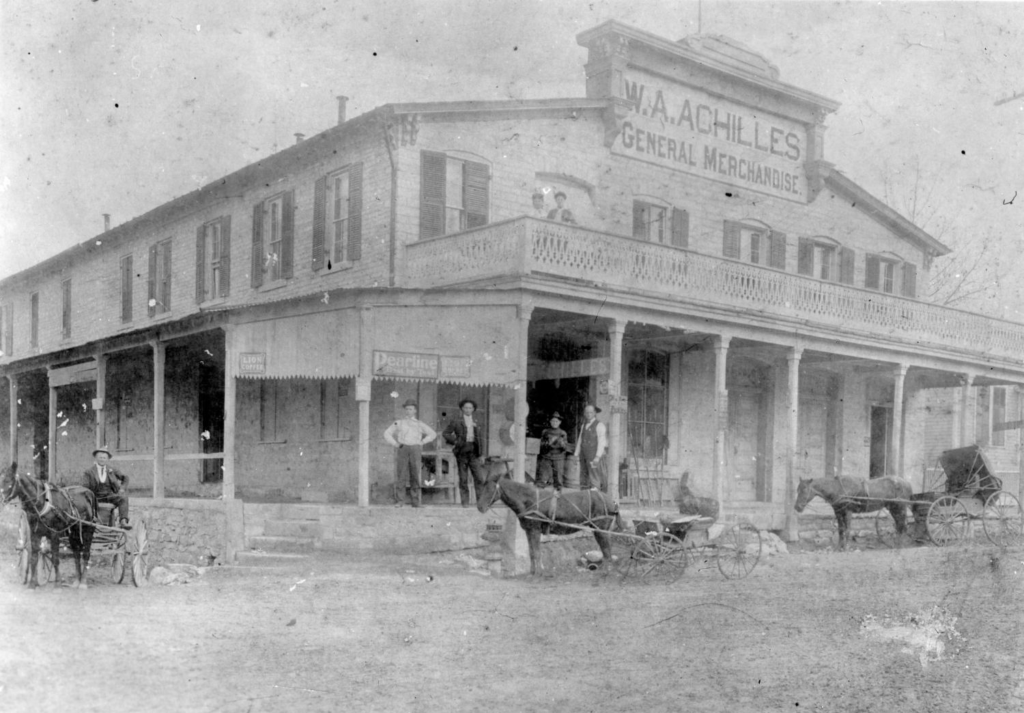 W.A. Achilles General Merchandise, 1895. Austin History Center, Austin Public Library.
Ed Dahlich was the son of a successful furniture dealer. He had transferred from St. Edwards to Texas A&M, where he was a year ahead of Mathews.
Brueggerhoff’s father was one of Austin’s leading citizens. The family name graced a building on Congress Avenue. In 1893, Louis Brueggerhoff was working as a clerk for Dahlich’s father.
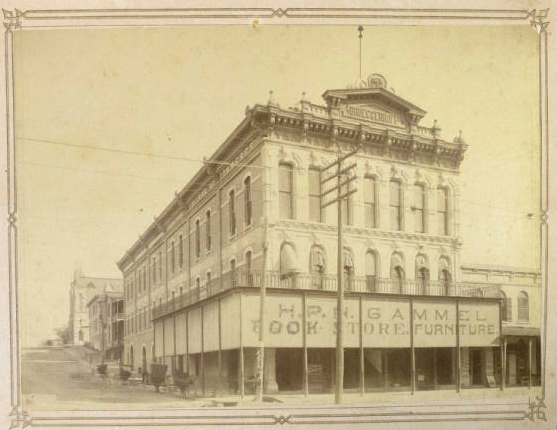 Brueggerhoff Building. Dolph Briscoe Center for American History, University of Texas.
Lee Rundell and Lem Mobley occupied the lower rungs of the social ladder. Rundell’s father was a traveling salesman for a whiskey company. Mobley worked in a laundry.
The Athletics began their season in early April, usually playing on Sunday afternoons on the grounds of St. Edward’s College.
In the first two months, they played several games against the St. Edward’s team, single games against the University of Texas varsity and the State Deaf and Dumb Institution, and an away game in New Braunfels. They won about as many as they lost.
Mathews appeared in the Athletics’ lineup on June 11, five days after A&M’s commencement exercises, playing center field against St. Edward’s. “Smiling” Del Walker took the mound for the college boys. He struck out 20 Athletics and still managed to lose, 1-6. “The special feature of the game was the fielding of Rundell, Achilles, and Mathews of the Athletics,” the Statesman reported.
Mathews remained the Athletics’ starting center fielder throughout the summer, and usually batted in the two-hole. Sykes Rundell batted ahead of Mathews in the leadoff spot, and played beside him in left field. Perhaps because of their outsider status, the madam’s son and the whiskey salesman’s son bonded. They appeared in the same box score multiple times in the coming years.
A month shy of 16 when he joined the team, Mathews held his own in fast company. He was a natural ballplayer, capable of playing any position, including catcher. He was a good fielder, but fancied himself a fine pitcher despite results to the contrary. He never had much power, but he could get on base, steal, and score. He was a smart player and an excellent on-field tactician.
On Sunday, June 25, the Athletics met a South Austin team called the Picked Nine, said to comprise the city’s best amateurs. It was agreed that the winner would travel to San Antonio the following week to play their best team.
The Athletics wore brand new uniforms. Perhaps inspired by their shiny new duds, they trounced the Nine 24-9. Lem Mobley struck out 10, Al Jacks hit a double, and Rundell tripled. With the season less than half over, the Athletics declared themselves City Champions.
The next Sunday morning, July 2, the Athletics rode the International and Great Northern’s excursion train to San Antonio for an afternoon game against the local team.
Around 250 fans turned up in San Pedro Park at 3:30 p.m., including many gamblers who dishonored the Sabbath by openly wagering on the outcome. “The visitors seemed to be the favorites and the betting was in their favor by odds of $10 to $7,” the San Antonio Daily Express reported. The fix was in, though, and the Athletics quit the field in the sixth inning, trailing 7-12.
That evening the Athletics checked into the Maverick Hotel. The register, published the next day in the Daily Express, recorded 10 players, including Bill Mathews, and their manager:
G.J. Kempen, Tom Hunter, L. Mobly, L. Beneggerhoff [sic], Al Jacks, Ed Dahlich, P. Leader, Lee Rundell, Bill Mathews, Cal Brown, William Achilles, Austin Athletic Club.
Louis Brueggerhoff’s presence was surprising, since his father, William Brueggerhoff, had died eight days before.
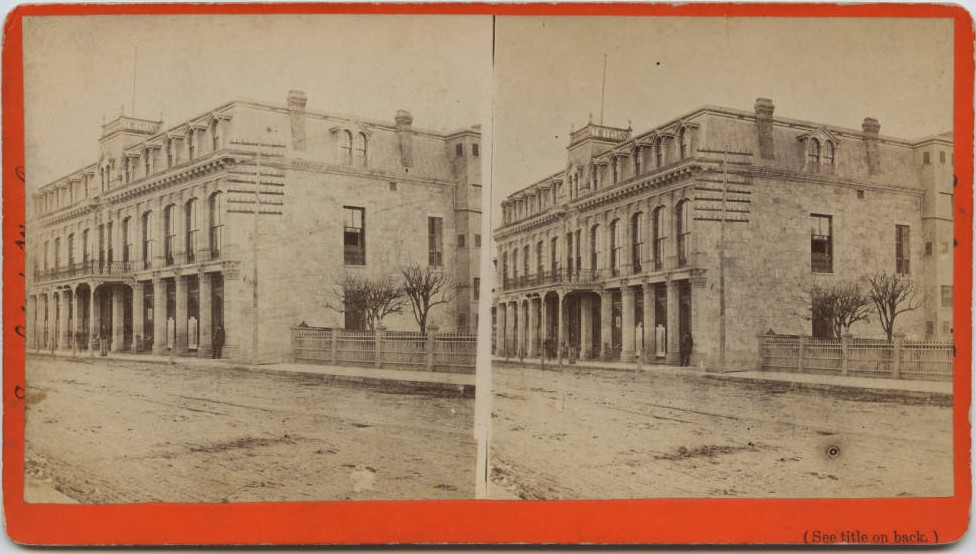 Maverick Hotel, c. 1887. DeGolyer Library, Southern Methodist University.
The boys returned to Austin the next morning, complaining that they had been robbed of the game and had received no expense money to defray the cost of the hotel or the $1.50 round-trip train fares.
The Athletics were back in action on July 4, again playing the Picked Nine on the St. Edward’s grounds. Al Jacks and Willie Achilles were in Palestine, helping Protection Hose Company No. 3 win the holiday hose cart race. Kempen rearranged his lineup to fill the absences, and Mathews ended up at third base.
Mathews had two hits and scored two runs as the Athletics won, 12-5. He showed mixed results at third base, making two putouts, no assists, and two errors. Within a few years, he would be a regular at the position, playing third for the University of Alabama and University of Georgia teams.
Mathews returned to center field the following Sunday for another game against the Picked Nine. The Athletics won again, 2-1. “Mathews fielded a fine game, having four put-outs to his credit and a double,” the Statesman reported. “Sykes Rundell made a fine throw to home plate, keeping the Picked Nine from firing [tying] the score.”
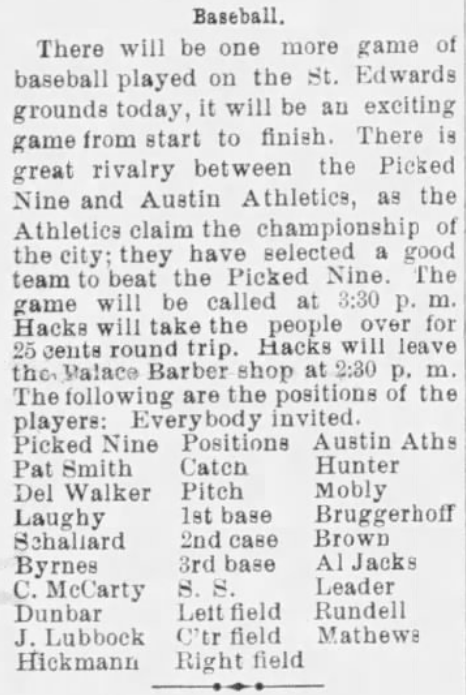 Announcement of a game. Austin Statesman, July 9, 1893.
On the night of Saturday, July 15, two days after Mathews turned 16, the Athletics boarded a train for Waco. The next day they played a doubleheader in Padgitt’s Park against the Waco Base Ball Club.
Wearing new uniforms, the locals trounced the visitors in both matches. They took the 10 a.m. morning game, 13-1, and the 4 p.m. afternoon game, 16-1. The Athletics later complained that they had “run afoul of some professionals up there and got everlastingly snowed under.”
Between games, the Athletics visited the photography studio of Jervis C. Deane, located on the upper floor of a building on Austin Avenue. The resulting team picture now resides in the University of North Texas collection. A penciled note on the back reads, Won 19 straight games in 1891 – Win 12 and lose 5 in 1892.
Eleven young men, nine in uniform, array themselves before the camera. Dapperly clad manager George Kempen sits front and center. Catcher Tom Hunter lounges beside Kempen. A young man in street clothes stands in the back holding a copy of The Sporting News. The boys are well-trimmed; Kempen must have given them each a turn in his barber’s chair.
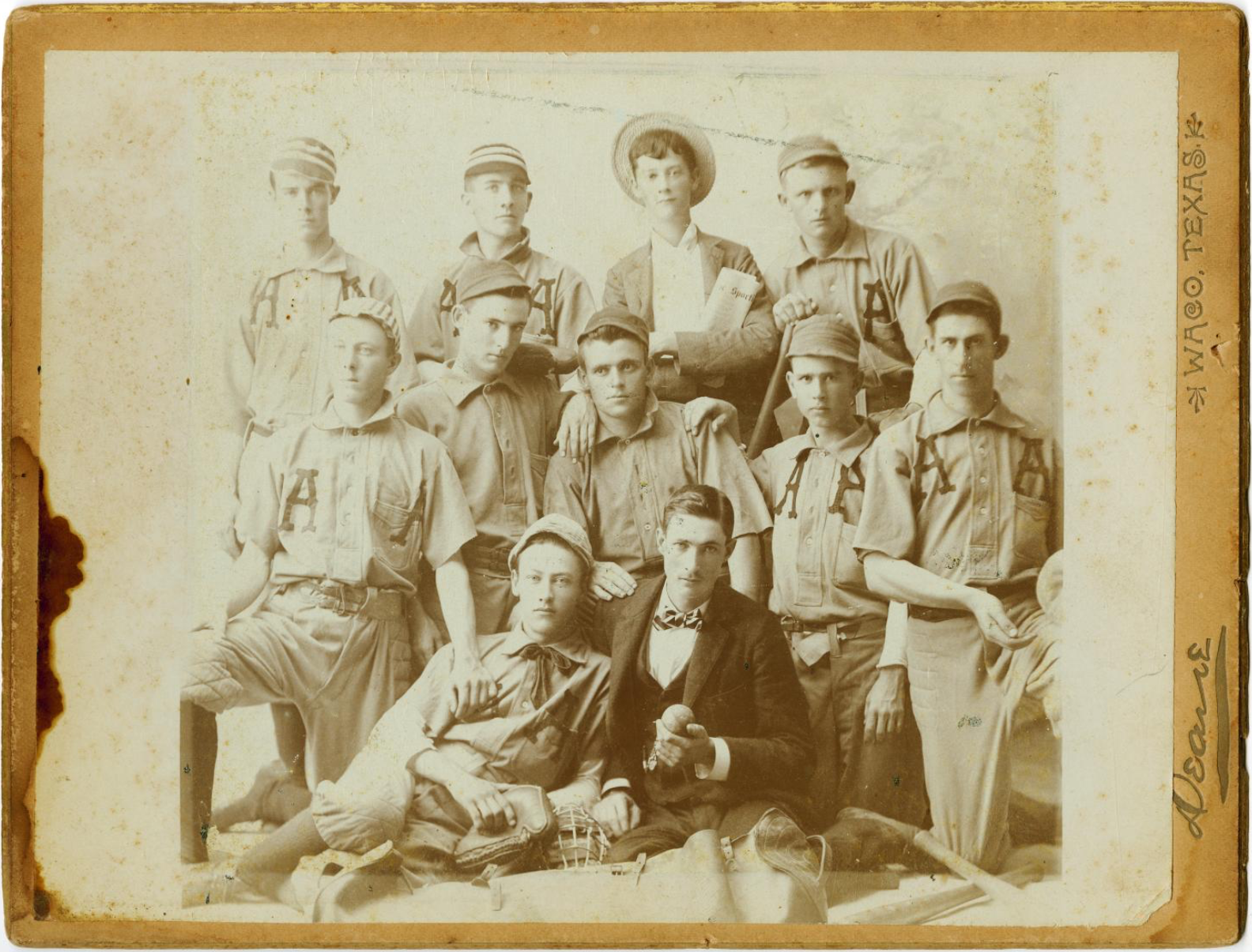 Austin Athletics photographed in Waco by Jervis C. Deane, probably July 16, 1893. Matthews may be on the back row, far left. University of North Texas Digital Library.
We can infer the identities of three players by comparing them with other photographs. The intense player on the far right of the back row is probably Willie Achilles. Al Jacks is probably the big fellow kneeling at the far right of the middle row. Mathews may be the tall gentleman at the left end of the back row. He certainly looks like a center fielder.
One week later, on July 23, the Athletics and the Picked Nine opened the brand-new baseball field in the Austin suburb of Hyde Park. Five hundred fans saw the Picked Nine pull off an 8-6 win. “The Picked Nine played good ball and did not get rattled, while the other boys lost their heads several times,” the Statesman reported. The Athletics “seemed to prefer kicking and scrapping on every point.”
In those days, the first and third base coaches were part of the show. As a player and manager, Wilson Matthews became known for his animated antics in the box. He must have been developing his act at 16. “The coaching of Sykes Rundell and Mathews caught the crowd,” the Statesman noted.
Both Mathews and Rundell exhibited fine “coacher’s” voices. In 1902, a Dallas writer said, “Matthews is as restless as a caged animal when on the coaching line, and has a voice like the bull of Bashan.”
Rundell’s voice was also of the ruminant variety. After observing Rundell on the coaching line late in the 1893 season, the Statesman’s man wrote, “Whenever his face was ajar he emitted a most unearthly noise, a sort of cross between a rattlebox and a goat.” The writer noted that Rundell “always poses for the grandstand.”
The Athletics and the Picked Nine played four games on the Hyde Park grounds in 1893, with the Athletics losing three. A scant two years later, a writer for the Statesman recalled the series as if conjuring ancient history, and referenced the Joplins, a team that had relocated from Missouri in 1888 to represent Austin in the Texas League. The passage of time had greatly enlarged the number of fans who actually attended the games:
Lots of the cranks will remember the days of the Austin Athletics and Picked Nine. When they played out at Hyde Park they drew crowds of 1000 to 1200 people. And what games they put up! Two to three, seven and eight, ten innings and tie games, such as the old Joplins used to play.
On August 12, a Thursday, the Athletics hosted a team from Georgetown called the Kids. “The meeting was a Waterloo for the Athletics by a topheavy score of 23-2 in favor of the Kids,” the Statesman moaned. “They completely knocked out Mobley, who was replaced by Dahlich in the last inning, who fared no better.”
The Athletics traveled to Georgetown the following week for a rematch at Georgetown College. With Dahlich on the mound, the Athletics reversed the previous results, winning 23-12.
The Kids returned to Austin on Friday, August 25, for a rubber match in Hyde Park. Trouble began brewing when the Athletics refused to meet the Kids at the train depot, leaving them to find their way to Hyde Park on their own.
The Kids supplied the umpire, a fellow named Red Johnson, whom the Athletics characterized as “a child of crimson locks from the cornfields of Georgetown.”
“I think Mr. Johnson of Georgetown, the umpire, tried to do the right thing in every particular and that his decisions were made conscientiously,” the Statesman’s writer judged. Unfortunately, Red Johnson’s well-meaning decisions proved “rank and unsatisfactory, engendering hard feelings among the players.”
The Athletics took exception to almost every call. Al Jacks, playing second base, led the attack. “He kicked without cause and without reason until the spectators became disgusted,” the Statesman said. “He may be a good ball player but indeed somebody ought to buy him a muzzle.”
Some spectators came onto the field to register their displeasure with the proceedings. Many more simply packed up and went home. The Athletics followed them, leaving the field in protest after seven innings, and losing by forfeit. Manager Kempen collected a meager $2.25 from the remaining spectators and handed it over to the Kids to help defray their hotel and travel costs.
The Statesman condemned the entire affair: “Such ball playing as was there seen will not only never grow popular in Austin, but it will have the effect of eventually killing amateur ball in our midst if persisted in.”
“Such ball playing,” though, became a trademark of Player Matthews. In later years he kicked and cursed without restraint, to the point of being jailed for disorderly conduct. But Umpire Matthews tolerated no such shenanigans and fined or ejected players for the slightest quibble. The conflicting personalities co-existed for ten years, from 1899 to 1909, as Matthews alternated between playing and umpiring before finally becoming a full-time official.
On Sunday, September 3, the Athletics and the Picked Nine inaugurated the new ballfield at Zoo Park, located adjacent to Austin’s brand new dam on the Colorado River.
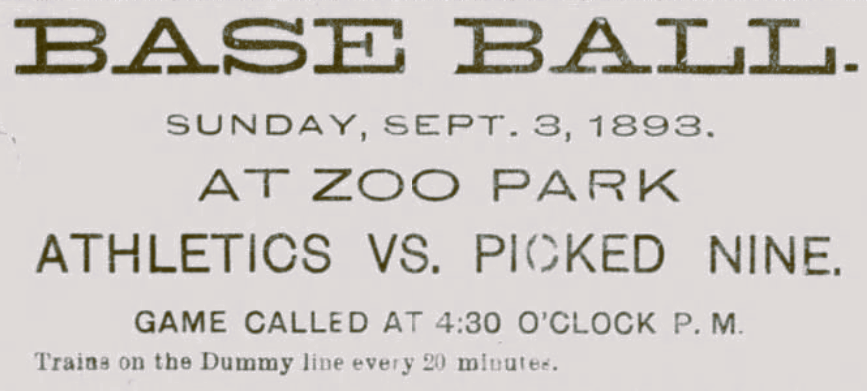 Austin Statesman, September 2, 1893.
It is unclear whether the park actually hosted a zoo, or how many animals resided there. The only creature mentioned in the Statesman was a ten-foot alligator “caught in the Driskell pasture.” The public was invited to watch the creature eat a dog and cat “for lunch.”
The ballfield was in poor condition and fielding suffered from “the uncertain course of the ball after it touched the grounds.” Each team committed six errors.
Smiling Del Walker, pitching for the Picked Nine, mowed down the Athletics, striking out 12 and scattering five hits on the way to a 10-4 win. Mathews made no hits or runs, but tallied two putouts and one assist.
The game was Mathews’ final appearance with the Austin Athletics. Three days later, he was back at Texas A&M, where the fall term began on Wednesday, September 6, 1893.
Mathews achieved a good measure of success in the summer of 1893. He proved his mettle among and against the best amateur ballplayers in the city, including many college boys and some with professional experience.
He left Austin with a great deal of confidence in his baseball abilities and knowledge. Others recognized his talents and leadership: in subsequent years, he would captain the baseball teams at Texas A&M, Mississippi A&M, and the University of Georgia.
What we don’t know is how Austin’s society boys reacted to their low-born center fielder. They must have known that his mother was Blanche Dumont, the infamous madam of Guy Town. Austin was still a small town; the cat could not remain in the bag. One suspects that they peered down their noses at Mathews, or made crude jokes behind his back.
The experience may have hurt Mathews deeply. In coming years, he strained mightily to build himself up into something that would pass muster with Achilles, Brueggerhoff, Dahlich, and the others. He invented a Princeton education, claimed his father was a cattle rancher on the Rio Grande, maintained that he was a major-league pitcher, and claimed he was born in England. He developed a regal bearing that earned him the nickname The Duke.
Perhaps the many lies of Wilson Matthews were sourced in Billie Mathews’ Summer of ’93.
The Athletics soldiered on until the end of September, then played one last game on a cold Sunday in November. They tallied around 30 games in 1893, and won about half of them.
Epilogue – The Mists of Summer
Right fielder Willie Achilles took over the family business and operated a grocery store on Lavaca Street until his retirement. He had three children, but none survived infancy. He died in 1949 at age 75.
Second baseman Calhoun Metz Browne worked as a clerk in the Austin and Travis County courts for 38 years. He was felled by stomach cancer in 1935 at age 61. It was said that, when illness forced him from his job, two men were needed to replace him.
First baseman Louis Brueggerhoff studied in Berlin, then moved to Shreveport, Louisiana, and became the secretary of the Louisiana State Fair. Known for his friendliness, energy, and urbanity, “Brueggy” was one of the most popular men in Shreveport. His death in 1916 at age 40, following an operation for appendicitis, shocked the city. “He was never at a loss of what to do, even in the most trying moments, and he never ‘lost his head’ or his temper,” the Shreveport Times said in tribute. “He was ever courteous and never offensive, either in word or deed.”
Infielder and pitcher Ed Dahlich entered the family furniture business and helped make it into one of Austin’s leading enterprises. The Statesman labeled him “among the best known of the city’s younger business men,” and often reported on his hunting and fishing adventures. He died in 1919 at age 43, suffering from Bright’s disease.
Catcher Tom Hunter became a traveling salesman for a dry goods company. He moved to Wichita Falls and worked over 20 years as an operator in the oil fields. He died in 1944, age 71.
Team captain Joseph Allison Jack, known as “Al Jacks,” continued to appear in the sports pages as a semi-pro ballplayer, umpire, bicycle racer, and as the athletic director of St. Louis College in San Antonio. He served with the Texas Volunteers in the Spanish-American War, played a couple of Texas League games in 1902, and worked as a machinist.
Jack moved to New Orleans and married 19-year-old Florence Heron in 1907. On July 4, 1908, Jack was struck by an errant hammer throw during a track and field competition. The 16-pound ball hit Jack in the back of his head and crushed his skull. He died the next day at age 35. His son, Joseph Allison, was born five months later. He died in 1911, just 30 months old.
Manager George J. Kempen owned a hardware store in Seguin, Texas. He served in the Texas Legislature and was the executive secretary of the Guadalupe County Fair Association. He died in 1949 at age 76.
Shortstop Percy Leader established a sign painting company in Corpus Christi. He started out painting street numbers on houses. When he died in 1950, at age 77, his obituary said, “During his lifetime, he painted most of the signs on downtown Corpus Christi buildings and erected many of the older billboards and signs in this area.”
Left fielder Lee “Sykes” Rundell played parts of seven seasons in the low minors, and several seasons in semi-pro ball. He was a successful pitcher, known as “the Texas Whirlwind.” He once pitched a 15-inning four-hitter, striking out 22 batters. When he was 77, a writer described Rundell as “a wiry, tough little gent who still has his own teeth, needs no eye-glasses, and walks a lot.” He died in Austin in 1960, age 87.
Pitcher Lemuel “Lem” Mobley eludes the researcher’s grasp.
His father was an illiterate Confederate veteran named William H. Mobley, born in Alabama around 1822. Lem Mobley’s mother, Martha, was born in South Carolina and was 20-plus years younger than her husband. She had previously been married to a man named Whittle with whom she had a daughter named Sarah Elizabeth. Martha and William Mobley had two children, Lemuel and Lizzie.
The 1880 census shows the family living in Caldwell County, Texas: W.H. Mobley, 59, a farmer who cannot read or write; Martha, 37, keeping house; Lemuel M., 4; Lizzie, 10 months; and Sarah Whittle, 18.
The 1893 and 1895 Austin directories list Martha, Lemuel, and Lizzie living at 204 East 17th Street. Lemuel is working at the Troy laundry.
In the 1893 directory, Martha is noted as being “wid. Wm.” But directly below her name is “Mobley William H,” a huckster living on the Georgetown Road.
In the 1895 directory, Martha is designated “wid. W.H.” Directly below her name is “Mobley William H.,” a laborer living at the corner of Rio Grande and West 31st.
Martha and William H. Mobley were, apparently, separated or divorced. In the straitlaced Victorian Era, it was better to claim widowhood than to be a divorcee, or a married woman with a missing husband.
Lem Mobley pitched for the Texas League’s Austin Senators in 1897 and 1899. In 1902, he was in Houston, working at the Excelsior laundry as a shirt ironer. The following year he was back in Austin, pitching for a semi-pro team called Miller’s Colts.
William H. Mobley, Lem Mobley’s father, applied for a Confederate Pension in 1903. He said he was 84 years old, had lived in Austin for 30 years, was disabled due to “old age, exposure and wound received in the war,” and was completely indigent with no property or income.
Someone read Mobley the application’s questions and recorded his responses. He was asked, “Have you transferred to others any property of value of any kind for the purpose of becoming a beneficiary under this law?” He replied, “I hope not.” Mobley signed with an X, and the application was approved.
William H. Mobley died on June 27, 1905, in Austin’s Confederate Home, and was buried in the Texas State Cemetery.
Nineteen days later, on Sunday, July 16, Harry Ables, a pitcher with the Texas League’s Dallas Giants, appeared in a game under the name “Mobley.”
Two Sundays later, Ables repeated the oddity, pitching both ends of a doubleheader as “Mobley.”
It was not a ruse or deception; Ables had been with the team all year and everyone, including the fans and sportswriters, knew who he was. A reporter passed it off as Ables using a “Sunday name.”
Ables was a native Texan. In 1905 he was a law student at the University of Texas in Austin. Did he know Lem Mobley or his father? Was his “Sunday name” a bizarre tribute to a friend? Or was it just a coincidental lark?
We last glimpse Lem Mobley in 1906, when the Austin Statesman listed him among the gentlemen with undelivered mail waiting at the post office.
The 1920 census shows Martha Mobley, then age 73, working as a washwoman in Austin. She died six years later and was buried in Austin’s Oakwood Cemetery.
Martha’s obituary said that she was survived by two daughters, Mrs. L.M. Jones (probably Lizzie) and Mrs. Sarah E. Wallace (the former Sarah Elizabeth Whittle). There was no mention of Lemuel, suggesting that he had already passed away.
All further searches proved futile. Thus, Lemuel Mobley, pitcher for the Austin Athletics in 1893, passes into the mists of summer.

Charles Norman is a writer and historian. Email: reverb.raccoon@gmail.com. Or follow on Instagram and Facebook.
Latest Posts
Here Lies Wilson Matthews – 1 Who Was W.M. Matthews?
But he wanted to get in. He wanted to be urbane and careless. He wanted to wear well-cut clothes. He wanted to be a gentleman.-- Thomas Wolfe, Look Homeward, Angel Part 1Who Was W.M. Matthews? Mississippi State University – then Mississippi A&M College – entered...
Here Lies Wilson Matthews – 2 Who Was Blanche Dumont?
Here’s what I want. I notice you changed your name. I want you to keep your new name. I guess you made up someplace you came from – well, that’s where you came from… You figure you died and now you’re somebody else and we’ll get along fine. -- John Steinbeck, East of...
Here Lies Wilson Matthews – 3 Guy Town
He was surrounded by a world that was both beautiful and terrifying, a land of secrets and shadows, where the line between civilization and savagery was thin and easily crossed--Joseph Conrad, Lord Jim Part 3Guy Town Miss Blanche Dumont became a sex worker in Austin,...
Here Lies Wilson Matthews – 4 Spaced Flashes
In probing my childhood (which is the next best to probing one’s eternity) I see the awakening of consciousness as a series of spaced flashes, with the intervals between them gradually diminishing until bright blocks of perception are formed, affording memory a...
Contact Reverb Raccoon
 |
 |
 |
 |
Archives