Here Lies Wilson Matthews – 4 Spaced Flashes
In probing my childhood (which is the next best to probing one’s eternity) I see the awakening of consciousness as a series of spaced flashes, with the intervals between them gradually diminishing until bright blocks of perception are formed, affording memory a slippery hold.
— Vladimir Nabokov, Speak, Memory
Part 4
Spaced Flashes
On June 3, 1880, a census enumerator named Krause visited Blanche Dumont’s brothel on Live Oak Street in Austin, Texas. Krause documented six residents: Dumont, 29, four other women, ages 18 to 23, and a two-year-old boy named W.F. Mathews.
Column 8 of Krause’s ledger was labeled Relationship of each person to the head of this family – whether wife, son, daughter, servant, boarder, or other. On the row with Dumont’s name, Krause left Column 8 blank, meaning she was the head of the family. Each of the four other women was a Boarder. On W.F. Mathews’ row, Krause wrote son.
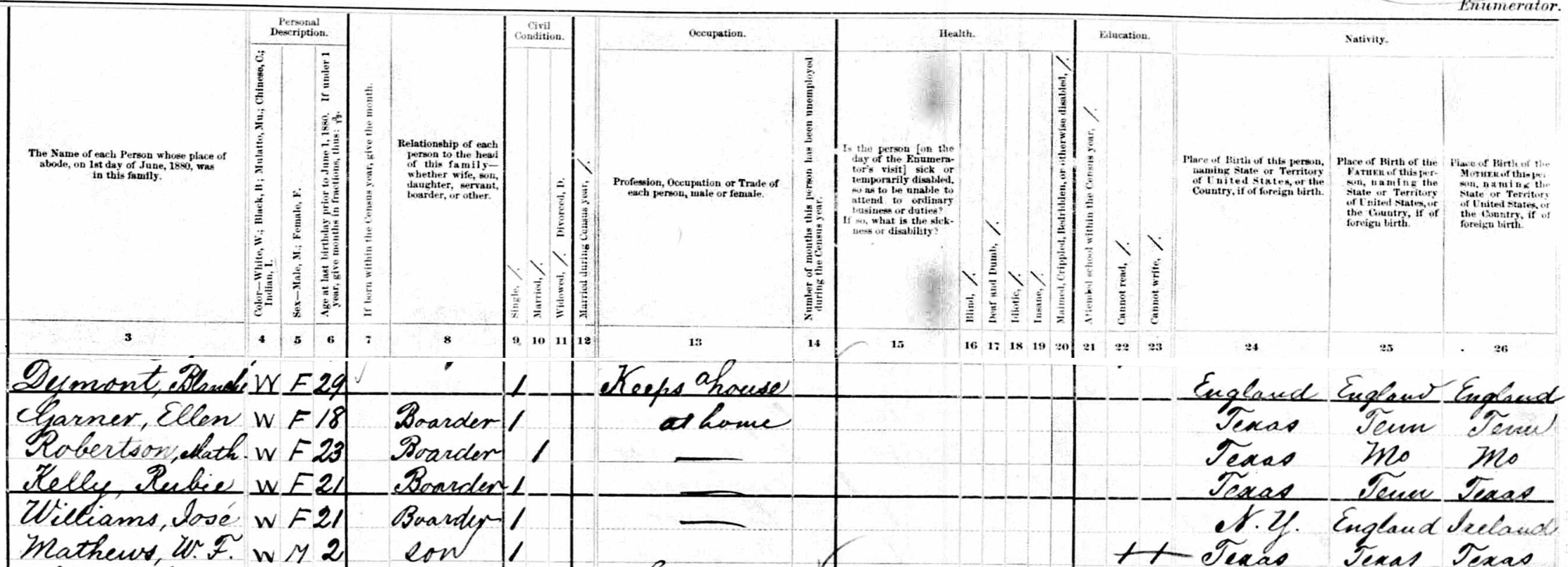 1880 census for Austin, Texas. Headers and relevant entries (intervening rows removed).
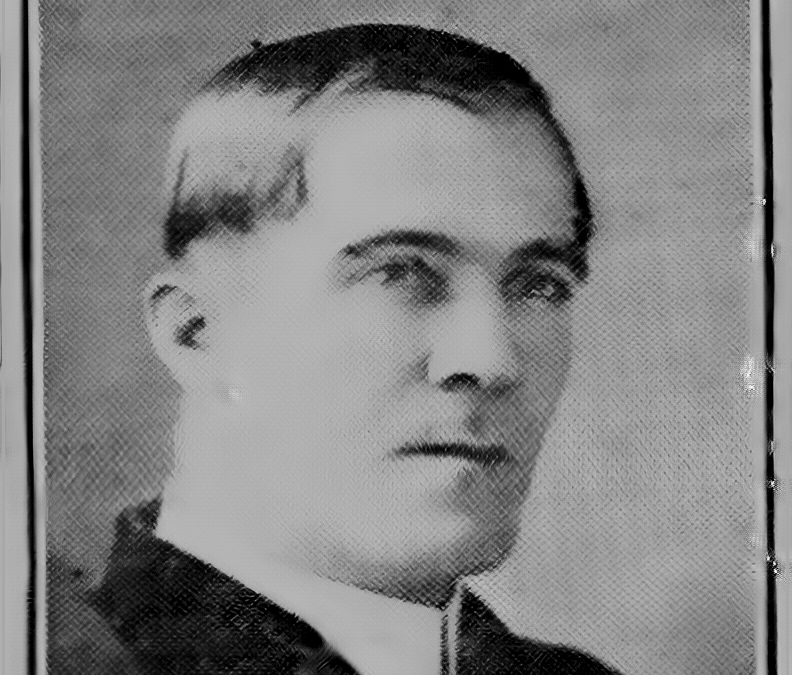
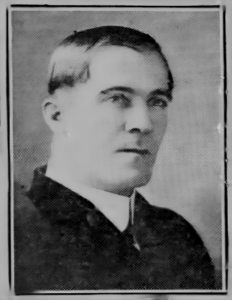
When Blanche Dumont died in 1933, the world learned that she was the mother of Wilson Matthews, the still-famous Texas League umpire who had passed 14 years before.
 Fort Worth Star-Telegram, February 18, 1933.
A poorly marked path leads from Wilson Matthews, in his time one of the best-known baseball men in Texas, back to W.F. Mathews, the toddler living in a Guy Town brothel.
Before 1902, the year Matthews solidified his reputation as a minor league umpire and became a regular feature in the southern sports pages, the trail is littered with qualifiers – probably, possibly, likely, may have, we assume. To compound the problem, as early as 1895, Matthews began dragging red herrings behind him to obscure his origins.
Among the breadcrumbs the researcher follows to retrace Matthews’ early footsteps: a home base in Austin, a love of baseball, participation in oratorical exercises, a lie about Princeton, a pair of musical bones, and a few fortuitous newspaper reports.
After we string together the disparate details from across the south, we find that the person who became Wilson Matthews was a remarkable young man.
He quarterbacked the Texas A&M football team the season before they entered collegiate competition.
He captained the Texas A&M and Mississippi A&M baseball teams.
He quarterbacked and captained the first Mississippi A&M football team, chose the school’s maroon and white colors, and is credited by modern sources as being Mississippi State’s first head football coach.
He captained the University of Georgia baseball team that was the first southern baseball team to defeat an Ivy League school.
He captained a semi-pro baseball team in Eufaula, Alabama, that was recognized as one of the best in the south.
He coached the Baylor football team in its initial season and prepared them for their first matchup with Texas A&M, an annual event now known as the Battle on the Brazos.
Matthews tallied these accomplishments before he turned 23.
Wilson Matthews was probably born on July 13, 1877, in Austin. He may have been born as early as 1875 or as late as 1878. He may not have known when or where he was born.
He began life as William Mathews, known to his friends as Billie. We assume that he inherited his father’s first name and his mother’s last name
His father, according to the death certificate filled out by Wilson Matthews’ wife, was W. Wilson. Was his name William Wilson? Multiple William Wilsons were living in Central Texas in the late 1870s. It’s impossible to pin parentage on anyone.
Blanche Dumont’s real name may have been Mathews; the boy may have been her biological son. Or Dumont may have adopted him after his mother, an unknown woman named Mathews, passed away or abandoned him.
We know very little about the boy’s early years. After W.F. Mathews appears in the 1880 census, our next probable sightings of William Mathews occur nine years later, when he was about to turn 12.
In May 1889, the Austin Statesman printed a brief account of a baseball game, played on the grounds of Austin’s elementary school, between “the Hill nine” and “the Catholics,” a team probably comprising schoolboys who attended St. Mary’s Church. The Statesman’s rudimentary box score shows the Hills winning 21-8 and included “Hit by pitcher – Mathews.”
One month later, Austin’s St. Mary’s School for Boys, a parochial school associated with St. Mary’s Church, held its closing exercises. In those days, such events typically included poetry recitations and oratorical exhibitions.
Wm. Mathews recited “Kearney at Seven Pines,” a poem of the heroic variety by Edmund Clarence Stedman. The poem heralds the actions of Union General Phil Kearney at the Battle of Seven Pines. As Kearney was directing his troops forward to halt a Confederate attack, a regimental commander asked the general where his men should be positioned. In the poem, Kearney answers:
O, anywhere! Forward! ‘Tis all the same, Colonel:
You’ll find lovely fighting along the whole line!
Later in the evening, Wm. Mathews and W. Walsh (who also won medals for Good Conduct and Vocal Music) recited Thomas Moss’s “The Beggar’s Petition,” a staple of the old readers.
In Jane Austen’s Northanger Abbey, Catherine Morland required three months, and her mother’s help, to memorize “The Beggar’s Petition.” And in Charles Dickens’ Nicholas Nickleby, a boy who has received a beating from Schoolmaster Squeers wipes his tears on a handkerchief “with the ‘Beggar’s Petition’ in printed calico.”
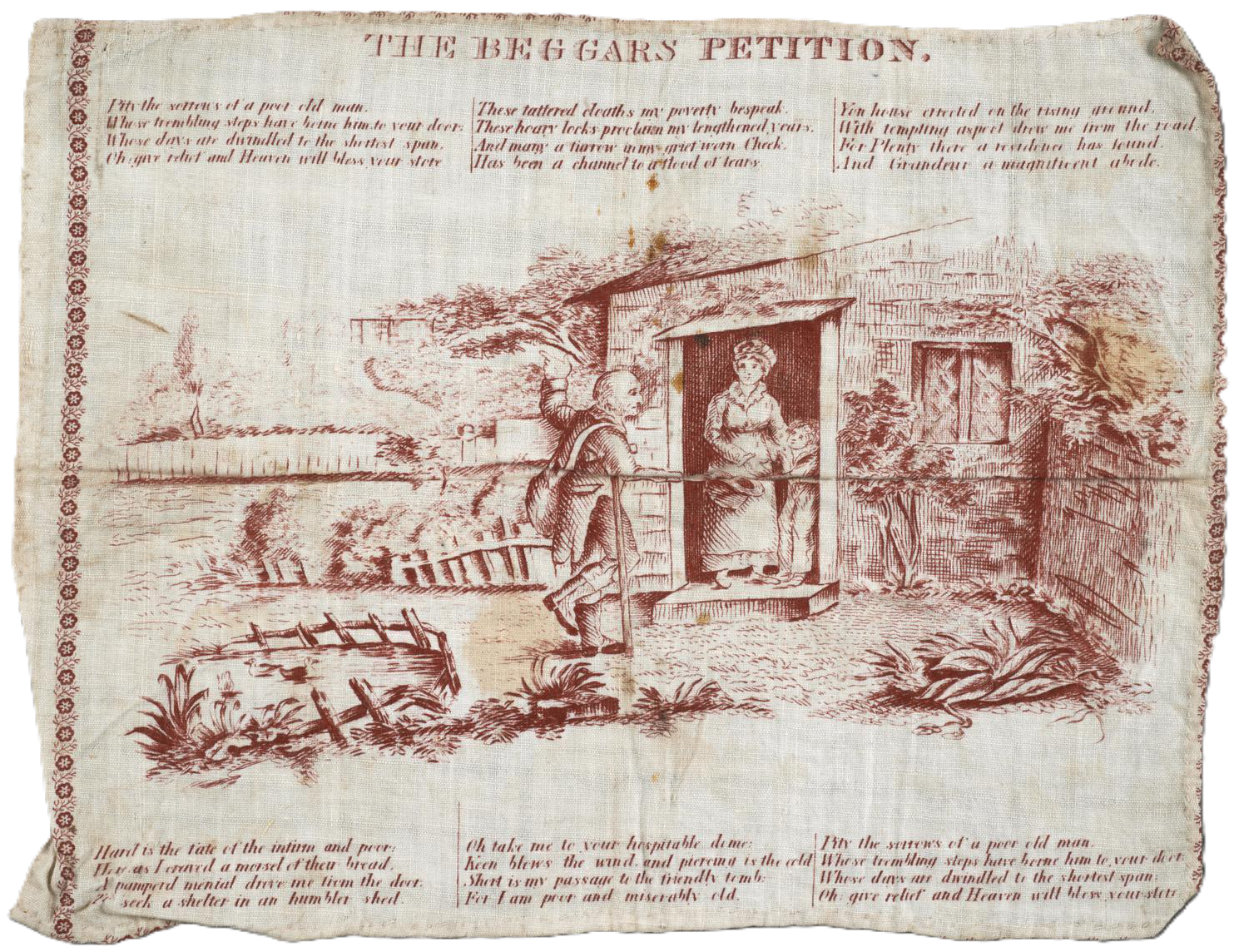 Handkerchief printed with “The Beggar’s Petition,” circa 1800-1825. London Museum Picture Library.
Matthews’ presence at St. Mary’s School for Boys, and on the Catholics baseball team, signals that he and his mother were practicing Catholics. How devout they were is anyone’s guess. In 1905, Wilson Matthews married a Catholic woman in Baton Rouge’s St. Joseph Catholic Church, suggesting at least a minimal adherence to a faith other than Baseball.
Mathews’ attendance at St. Mary’s also supports the theory that Blanche Dumont was descended from Hill Country Germans and may have spoken German or the Texasdeutsch dialect.
The story of St. Mary’s Church began in 1840 when officials in Rome dispatched Father J.M. Odin to investigate the status of the faith in Texas. Finding no Catholic church in Austin, Father Odin resolved to acquire the land on which a church could be built. He purchased the entire north side of Block 28 (lots 7, 8, 9, 10, 11, and 12) for $366.
Father Odin’s real estate venture did not yield a Catholic church, but it later hosted houses of worship nonetheless. The lots he purchased became the heart of Guy Town, occupied by two saloons and four brothels, including Blanche Dumont’s on lot 12 and Sallie Daggett’s on lot 9.
In 1852, Father Michael Sheehan, a native of Ireland, arrived in Austin as the city’s first permanent priest and supervised the construction of St. Patrick’s Church at the corner of Brazos and Ash (later East 9th) streets. The Irish priest and the church named for the patron saint of Ireland reflected the congregation’s dominant demographic: Irish immigrants and their descendants.
A significant number of the Germans who settled in Central Texas were Catholics. In Austin, St. Patrick’s became their spiritual home, and by the mid-1860s, they were the driving force in parish life. Construction of a new church, named for St. Mary, the patron saint of Bavaria, began in 1866 at the corner of Brazos and East 10th streets. The building was completed in 1874.
Brothers Peter, John, and Jacob Lauth served as assistant priests in St. Mary’s early days. The German-speaking Lauths were born in Luxembourg. Peter and John had previously served as professors of German at the University of Notre Dame. Rev. Peter Lauth became the parish priest in 1882. Beginning in 1888, another Lauth, Rev. Michael, assisted his brother.
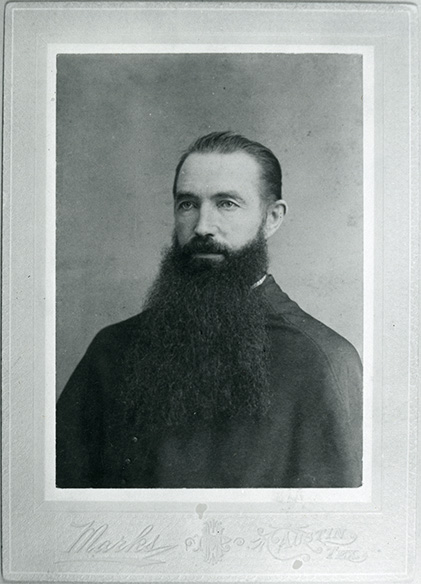 Rev. Father Peter Lauth. C.S.C. Austin History Center Collection.
St. Mary’s School for Boys opened in 1885. The school occupied buildings just east of the church on the south side of East 10th. The grounds had formerly been the home of St. Mary’s Academy, a girls’ boarding school that had relocated to better quarters.
In 1889, about 80 youngsters ages 6 to 15 attended St. Mary’s School for Boys. Brothers Conrad and Matthias of the Congregation of Holy Cross (CSC), overseen by Reverends Peter and Michael Lauth, provided instruction in “all the higher branches, and also German.”
“The teachers of St. Mary’s School for Boys pay especial attention to the German language, and to vocal culture,” a notice in the Stateman said. “Its government is mild but firm,” another blurb promised. Tuition was $1.50 per month.
The German character of St. Mary’s School for Boys is reflected in the program of the 1889 closing exercises. Participants included Henry Bauer, Paul Gueldner, William Hildebrandt, Frank Kuse, Joseph Mayer, William Sylvester Walsh, and E. Achilles – one of the Achilles brothers, William, Herman, or Heinrich, or possibly their sister, Emma — all of whom had at least one parent born in Germany.
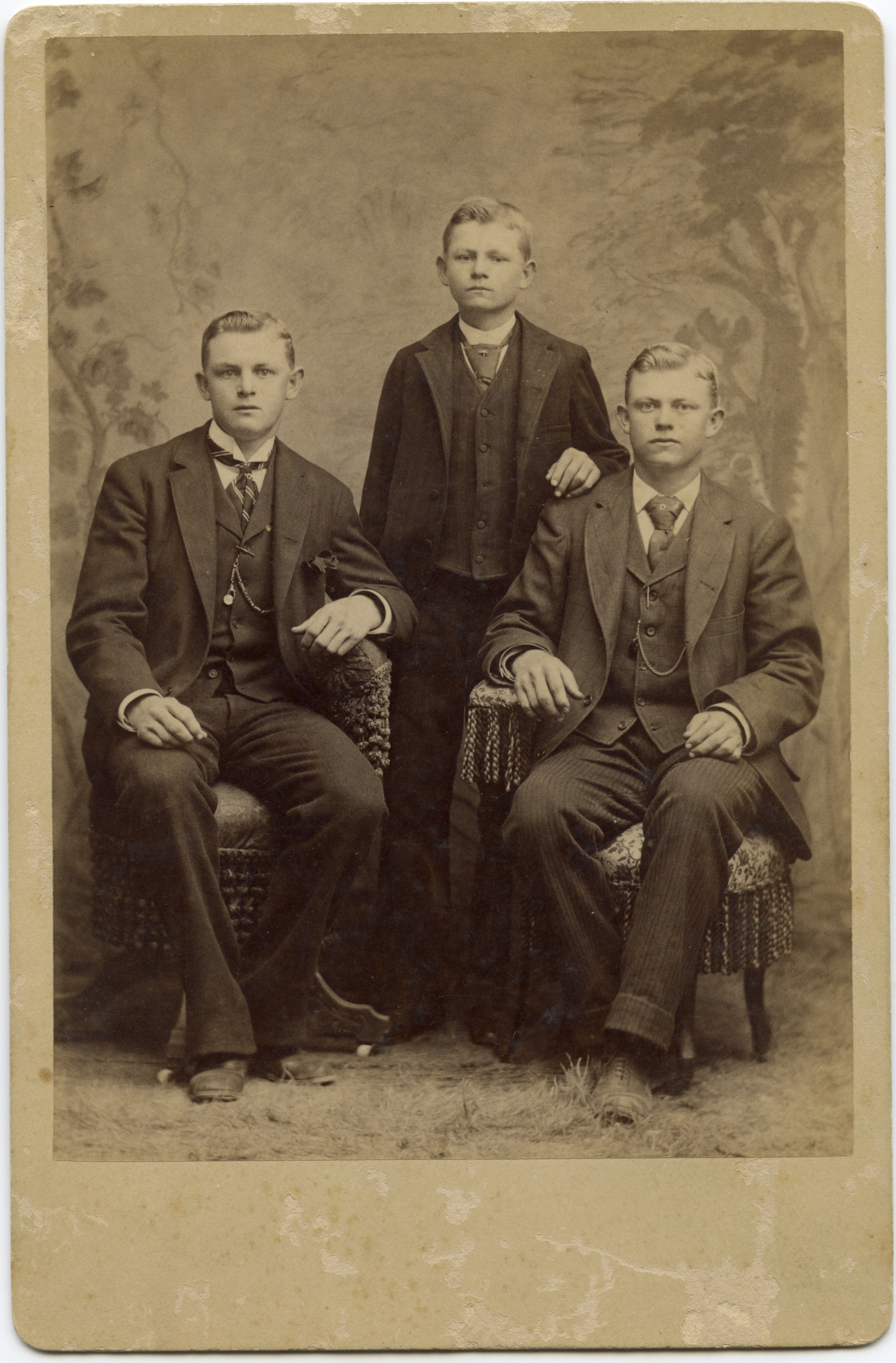 William, Heinrich, and Herman Achilles, 1890.
In April 1890, Mathews again turned up with the Catholics baseball team in what the Statesman called “a hotly contested and interesting game” against the HIX, a team sponsored by the company that made HIX cigars.
The report says Mathews, three months shy of 13, was hit by a pitch and pitched in relief, striking out one.
With the score tied 20-20 in the ninth, the HIX were at bat with two out and two men on. The batter lined the ball over the left fielder’s head to score two runs, and the HIX boys went on to win 24-20. As the relief pitcher, 12-year-old Mathews probably gave up the winning runs.
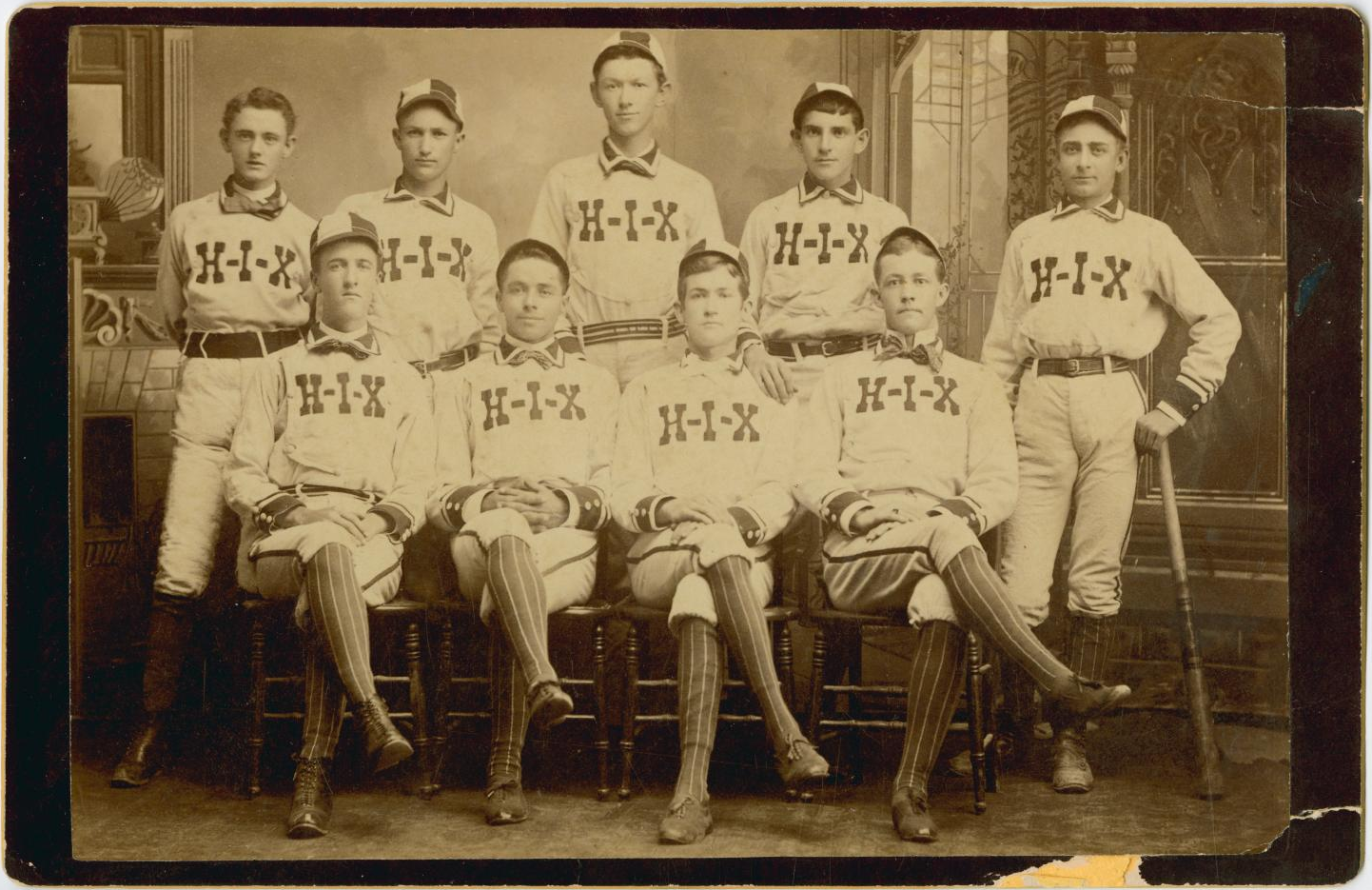 HIX baseball team, 1887-1888. Photo by S.B. Hill.
William Mathews did not participate in St. Mary’s closing exercises in either 1890 or 1891. His grades may have fallen off. He may have gotten crossways with the Brothers. Maybe Brothers Matthias and Conrad got an earful from Miss Blanche Dumont herself. Perhaps other parents objected to the son of a madam appearing on stage with their children.
Our subject eludes the researcher’s scrutiny for the entirety of 1891, save a possible early May sighting in the Marble Falls Gazette: “Messrs. N.E. Lambert, W.M. Mathews, B.N. Daniel of Austin were here the first of the week.” The Austin and Northwestern Railway ran an excursion train to Marble Falls and back each Sunday in the spring and summer. Round-trip fare: $1.50, the cost of a month’s tuition to St. Mary’s.
Young Mathews next turns up in 1892, playing baseball for the Austin Athletics.
The Athletics were the town’s best semi-pro baseball team, winning 19 straight games in 1891 and compiling a 12-5 record in 1892. The Statesman often mentioned the team’s games, but never included a proper box score until the following season. By the summer of 1892, William Mathews, barely 15 years old, had earned a spot on the squad.
On Sunday, July 24, the Athletics took on the farm boys from Bluff Spring in Horst Pasture, a former plantation near today’s Frank Denius Fields of the University of Texas. The Statesman’s brief description of the game included a nod to Mathews:
There was an interesting game of base ball at Bluff Spring yesterday between the Athletic base ball club of Austin and the Bluff Spring boys, in which the former carried off the honors by a score of 10 to 4. The feature of the game was a tripple [sic] play by C. Brown to Mathews, of the Athletic boys, with three men on bases and no outs.
It’s difficult to diagnose the play without a proper box score. An educated guess places Mathews at second base and Brown at shortstop. The batter hits a line drive over second that looks like a sure hit, and the runners take off. Brown ranges behind second and grabs the liner for one out, tosses it to Mathews, who touches the bag to double the runner, then tags the runner from first who comes barreling into the base.
The sequence, as imagined, displayed the baseball smarts that became Wilson Matthews’ trademark. He was known as a heady coach and manager who knew what to do in any situation.
William Mathews probably turned 15 on July 13, 1892. He was now too old to attend St. Mary’s School for Boys. It was an age at which many boys entered college.
St. Edward’s College, located south of the Colorado River on the outskirts of Austin, presented the logical choice for Mathews’ continued education. It was nearby, offered preparatory classes for those not ready for university fare, featured journalism studies (Wilson Matthews worked as a journalist between baseball seasons), and, like St. Mary’s, was run by the Reverends and Brothers of the Congregation of Holy Cross.
The latter may have been Mathews’ reason for avoiding St. Edward’s, which described itself as “thoroughly and uncompromisingly Catholic.” The school’s 1892 catalog reads like an advertisement for everything a spirited youngster finds distasteful:
At a time when temptations of all kinds are abroad, when various inducements to fritter away time meet the student at every turn, when morals are so lightly watched over, the benefits of the discipline and retired location of St. Edward’s College cannot be over-estimated.
Even the careless student, when once interested in his studies by the influence of his associates, learns to appreciate the advantages to be derived from undivided attention to his work. Surrounded by genial companions who have but one object in view, by associations which concur to fix his mind upon his duties, he breathes for a few years an atmosphere of order, of piety, of pleasant companionship which makes virtue agreeable and tends to establish habits that will exert a salutary influence upon his whole life.
Mathews attended four colleges between 1892 and 1897. They were all of the secular, state university variety, and offered a wide range of non-pious activities. His first stop was Texas Agricultural and Mechanical College – Texas A&M – 100 miles northeast of Austin.
We know very little about Mathews’ first year at A&M, save a few salient items: he entered the school in September 1892, as William J. Matthews of Austin, Texas; he completed all three terms – fall, winter, and spring – of the 1892-1893 academic year; and he excelled in English.
At the Commencement Exercises held on June 6, 1893, Mathews was recognized as one of three Fourth Class honor students in English. His fellow awardees were A.M. Hildebrandt, whose parents were German, and Abe Gross, whose German father was born in Poland.
After the spring term ended, Mathews returned to Austin and rejoined the Austin Athletics.
At this point, William Mathews, the future Wilson Matthews, comes into focus. We no longer glimpse him through an intermittent series of widely-spaced flashes, but as a traceable entity that can be followed, with only the occasional inserted question mark, until his death in 1918.

Charles Norman is a writer and historian. Email: reverb.raccoon@gmail.com. Or follow on Instagram and Facebook.
Latest Posts
Here Lies Wilson Matthews – 1 Who Was W.M. Matthews?
But he wanted to get in. He wanted to be urbane and careless. He wanted to wear well-cut clothes. He wanted to be a gentleman.-- Thomas Wolfe, Look Homeward, Angel Part 1Who Was W.M. Matthews? Mississippi State University – then Mississippi A&M College – entered...
Here Lies Wilson Matthews – 2 Who Was Blanche Dumont?
Here’s what I want. I notice you changed your name. I want you to keep your new name. I guess you made up someplace you came from – well, that’s where you came from… You figure you died and now you’re somebody else and we’ll get along fine. -- John Steinbeck, East of...
Here Lies Wilson Matthews – 3 Guy Town
He was surrounded by a world that was both beautiful and terrifying, a land of secrets and shadows, where the line between civilization and savagery was thin and easily crossed--Joseph Conrad, Lord Jim Part 3Guy Town Miss Blanche Dumont became a sex worker in Austin,...
Here Lies Wilson Matthews – 5 The Austin Athletics of 1893
In this part of the story there are living ghosts as characters, and the story doesn’t come out quite the way either the ghosts or non-ghosts expected. -- Norman MacLean, Young Men and Fire Part 5 The Austin Athletics of 1893 Austin lacked a minor league baseball club...
Contact Reverb Raccoon
 |
 |
 |
 |
Archives