Here Lies Wilson Matthews – 6 The Cadet
It had the fine authority of provincialism – the provincialism of an older South. Nothing mattered but the State: the State was a mighty empire, a rich kingdom – there was, beyond, a remote and semi-barbaric world.
— Thomas Wolfe, Look Homeward, Angel
Part 6
The Cadet
The Agricultural and Mechanical College of Texas opened in 1876 in Brazos County. Bryan, the nearest town, lay five miles to the north. The Houston and Texas Central Railroad ran through the grounds, with trains stopping daily at a station 800 yards from the college’s main building. The depot, which included a post office, was dubbed College Station, and the name became synonymous with the school.
Texas A&M eschewed both the “classical” approach to education, which sought to cultivate philosophers, and the “industrial” approach that sought to create workers. The school aimed to develop leaders of the Texas economy through practical instruction in agriculture and mechanical engineering, the twin drivers of the state’s commerce.
The “Requisites of Admission” were straightforward:
To enter the College, an applicant must have attained his fifteenth year, or otherwise must have attained a degree of physical and mental advancement corresponding to that age.
The mental attainments necessary for entering upon the courses of study comprise a fair knowledge of arithmetic as far as proportion, or descriptive geography, and of elementary English grammar and composition.
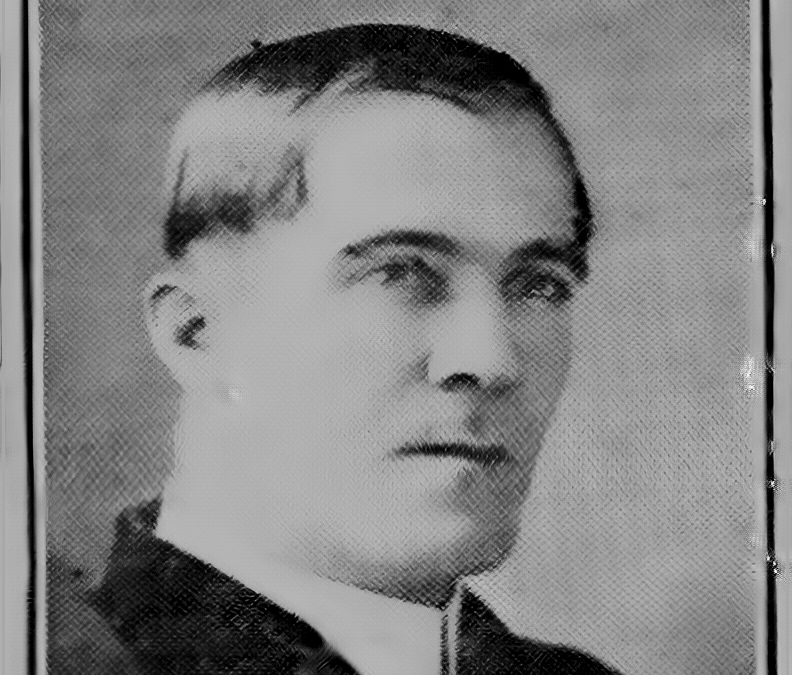
William Mathews entered Texas A&M in September 1892, when he was two months beyond his fifteenth birthday.
The catalog for the 1892-1893 academic year lists Matthews, William J … Austin, among the 103 freshmen, known at A&M as the “Fourth Class.”
For the next several years, his name would appear as both Mathews and Matthews, often both ways at the same institution. The two-T version gradually became the accepted form. For now, we will use the one-T version, as that will dominate for at least another year.
His middle initial had changed from the F recorded in the 1880 census to a J. What the J stood for is anyone’s guess. Over the course of Matthews’ life, his middle name and initial changed several times, seemingly on a whim.
The 293 enrollees at A&M included boys from all over Texas, several from other states (mostly Louisiana), a few from Mexico, and one from Indian Territory. The catalog alluded to the proliferation of German speakers on the campus, and within Texas as a whole:
In view of the great practical importance of the German and Spanish languages for business purposes in our State, special attention is given to these. A large number of students are of German descent, and speak the language fluently. By association with these, young men may have continual practice in conversation out of the class room as well as in it.
The students with German parents included Ed Dahlich, with whom Mathews played on the Austin Athletics. Dahlich, in the “Third Class” ahead of Mathews, had begun his education at St. Edward’s before transferring to A&M.
Besides Mathews and Dahlich, the 1892-1893 catalog lists seven other Austin boys. Someone in the bunch must have known Mathews’ provenance.
Mathews’ first year at A&M is almost entirely undocumented. Most academic records from the period were destroyed in a fire. The school had a newspaper of sorts, the College Journal, but only a single issue from the interval between September 1892 and June 1893 has been preserved. It makes no mention of Mathews. Olio, the A&M yearbook, did not exist until 1895.
Though we have no specific knowledge of Mathews’ day-to-day activities, we can define his life in broad strokes.
As a freshman – a “fish” – he studied arithmetic, algebra, English grammar and composition, declamation, elementary agriculture, domestic animals, Texas history, carpentry, free-hand drawing, and penmanship.
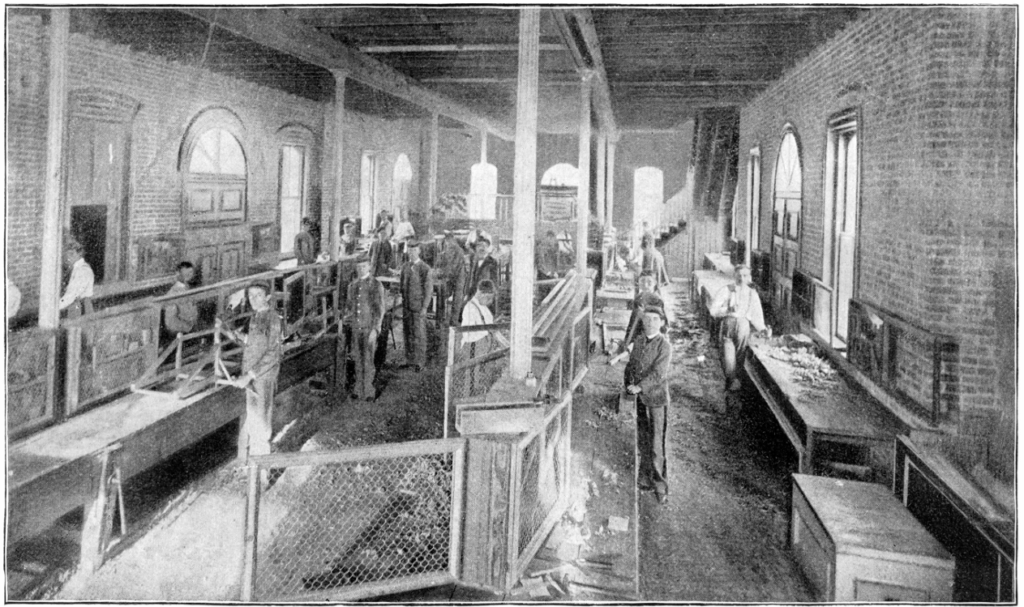 Uniformed cadets in the carpentry shop. Texas A&M catalog, 1893-1894.
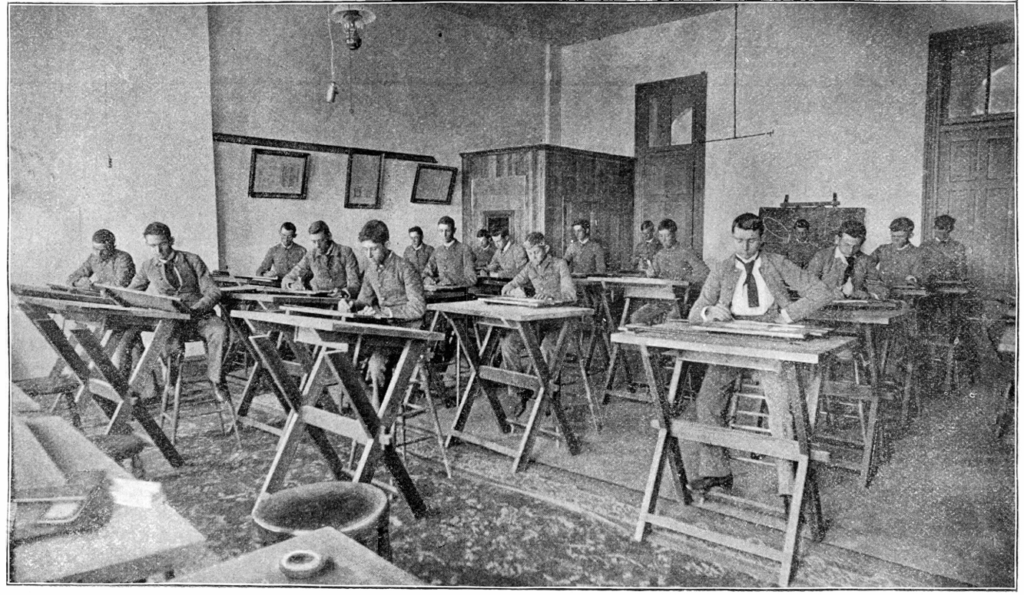 Cadets in Drawing Room No. 2. Texas A&M catalog, 1893-1894.
All students participated in the Corps of Cadets, and Mathews devoted considerable time and energy to military training and drill.
Mention “the Corps of Cadets” – or simply “the Corps” – to a present-day Texan, and they will instantly think of A&M. In Mathews’ day, the term had not yet become ubiquitous. Nevertheless, when Mathews attended College Station, he and his classmates were known statewide as “cadets.”
As described by Henry C. Dethloff in Texas A&M University 1876-1976, the change from “student” to “cadet” took place in the interval from 1891 to 1898, during the administration of A&M President Sullivan “Sul” Ross, a former Confederate general and two-term governor of Texas:
Under Ross, the Corps of Cadets became synonymous with an A&M student; there was no longer any differentiation between a “cadet” and a “student.” The “student” effectively ceased to exist, and in his place for several decades was to stand the “cadet.”
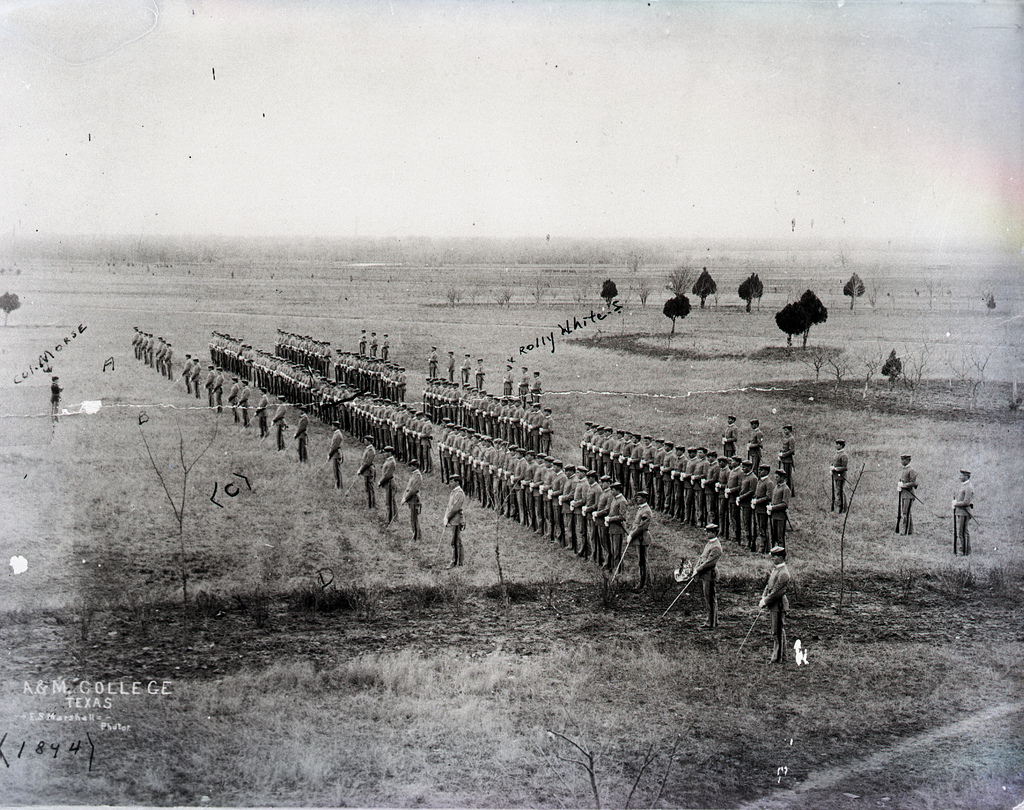 Corps of Cadets, 1894. Texas A&M, Cushing Memorial Library, Historical Images Collection.
The cadets were organized into a four-company battalion under the command of First Lieutenant B.C. Morse, 18th Infantry, US Army.
Each cadet wore a gray uniform purchased from a contract tailor for between $15.50 and $18. The blouse, or tunic, was close-fitting and single-breasted with five buttons down the front. The pants sported a black stripe down the outside seam. The cap resembled the forage cap worn by Civil War soldiers and was adorned with a wreath enclosing the letters AMC. Cadets were required to wear the uniform “at all times when it does not interfere with the practical duties of the Agricultural and Mechanical departments.”
The boys carried 45-caliber Springfield Cadet rifles, a shorter, lighter version of the standard trapdoor Springfield. In May 1893, a US Army inspector reported that the rifles were in excellent condition, but the accoutrements – the belts, slings, ammunition pouches, and bayonet scabbards – were worn and required replacement.
The cadets’ day began with reveille at 6 a.m., followed by roll call and cleaning of their quarters. They then formed up and marched to the mess hall for breakfast. On command, they marched to the chapel for morning services. They marched to classes and marched between classes. After the final class, they marched to the drill field for more marching, then marched to the mess hall for supper, and finally marched back to their quarters to study until taps sounded at 10 p.m.
Round-the-clock sentinels guarded the campus. At the hour, each man called out his post, the time, and “all is well.” As a fish, Mathews pulled his share of guard duty, especially the late-night watches.
In Reminiscences, J.B. Sterns (Class of 1899) described the fish sentry who refused to take it any longer, and chose 1 a.m. as the proper time to rebel. When it came his turn to report, he sang out, “Post number 6, one o’clock, all’s well, kiss my foot and go to hell, you sons of bitches.” He abandoned his post, packed his bags, and caught the 2 a.m. train to freedom.
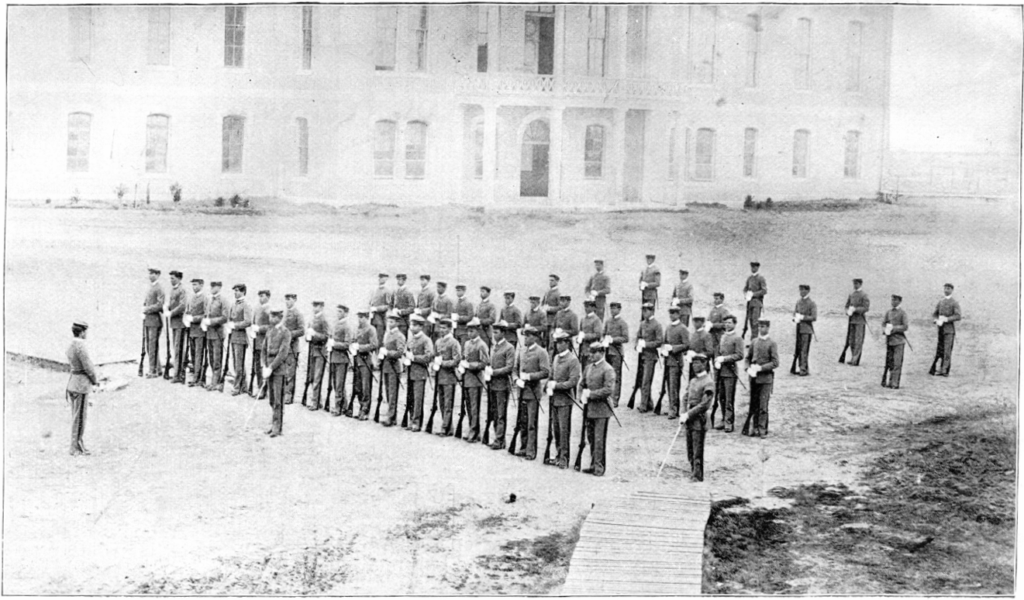 Guard mounting. Texas A&M catalog, 1893-1894.
How did Billy Mathews adapt to the life of a cadet? One suspects that he enjoyed it.
He was away from home, possibly for the first time. He had escaped Austin, where he wore a scarlet letter as Blanche Dumont’s boy, and entered a world in which the gray uniform made everyone look the same. He replaced the chaotic life of a brothel with an orderly existence that allowed him, for at least a few hours each night, to read in peace.
In the A&M library, he could surround himself with literary journals such as Blackwood’s, Cosmopolitan, Harper’s Monthly, Scribner’s, The Nation, and Fortnightly Review. The weekly New York World brought him news of the great football teams of his age, including Yale, which compiled a 13-0 record in 1892, and the Princeton Tigers, who were 12-2 that season.
Mathews may not have measured up in the carpentry shop; he was never much for manual labor. His arithmetic may also have lagged. As a baseball manager and team president, the future Wilson Matthews never produced a balanced budget. But he thrived in the English Department.
The program for the June 1893 commencement exercises includes Mathews as one of the Fourth Class’s three honor students in English. He failed to make the top three in agriculture, drawing, mathematics, or mechanical engineering.
Following the close of the spring term, Mathews returned to Austin, where he played center field for the Austin Athletics on June 11. He made his last appearance with the Athletics on September 3, 1893. Three days later, he began the fall term at College Station.
The Texas A&M catalog for 1893-1894 lists Mathews, W.N., a Mechanical Engineering major from Austin, among the 100 sophomores of the Third Class.
He had appeared in the previous catalog as William J. Matthews. The change in middle initial from the previous year’s J to an N is a mystery. By the end of the school year, he would be using an M.
Thanks to The Battalion, A&M’s newspaper, we know that during his sophomore year he participated enthusiastically in college life, taking on activities that were very on-brand for our subject.
The Battalion commenced publication in October 1893. It was published twice in October, then monthly throughout the fall, winter, and spring terms. Mathews or Matthews cropped up in nearly every issue.
The Battalion, or The Batt as it came to be known, was a joint project of two literary clubs, the Austin Society and the Calliopean Society. Mathews joined both, and became a regular contributor to the newspaper.
In later years, Wilson Matthews spent his off-seasons working as a newspaperman. He probably garnered his first taste of journalism as a 16-year-old correspondent for The Batt.
The literary societies provided an outlet for the oratorical talents Mathews had shown at St. Mary’s when he recited “Keaney at Seven Pines” and “The Beggar’s Petition.”
At an October 1893 meeting of the Austin Society, Mathews read “On the Death of Garfield,” a then-famous oration by James Gillespie Blaine. The Battalion reported that “Mr. Mathews read in a clear and distinct tone, plainly showing that he was master of his undertaking.” It was the same voice he would later use as an umpire, which one observer described as “stentorian.”
At a subsequent meeting of the Austin Society, he took part in a debate. Mathews himself, always his best publicist, glowingly reported his effort in The Battalion:
The first man on debate, Mr. Mathews, attempted to convince the audience “That religion has done more towards civilizing the world than science.” His discussion of the affirmative side of the question was exceedingly thorough and did not fail to make an impression upon the tribunal.
Mr. Reed J. [J.E. Reed, a mere fish] then came forward in defense of the negative and amassed an army of argument which won the decision for his side.
The writer signed his piece M. MATHEWS, suggesting that he had now chosen the middle name Maurice, by which he was known for most of his subsequent days.
In mid-October, Mathews joined 27 other cadets in organizing the Dramatic Club. The club’s advisor, William Bledsoe Philpott, was an associate professor of English and history. His daughter, born in 1899, was Madge Bellamy, a popular silent film star.
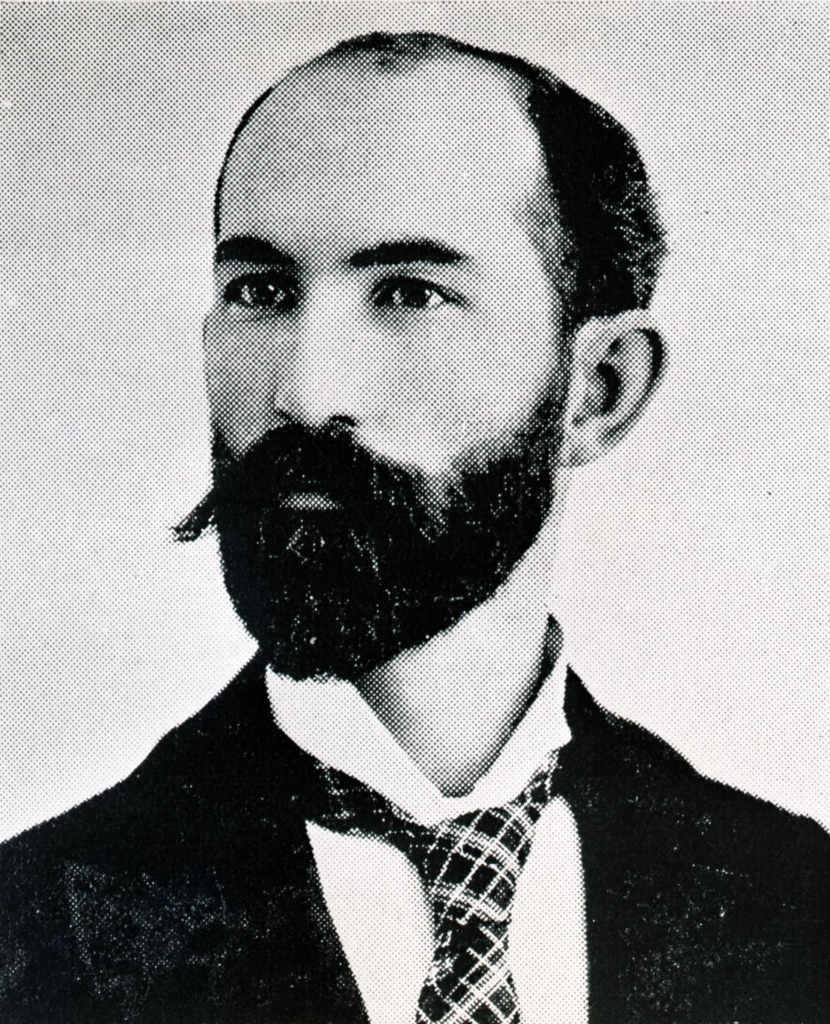 William Bledsoe Philpott, 1908. Texas A&M, Cushing Memorial Library, Historical Images Collection.
The club chose to present Ingomar, the Barbarian, a five-act historical play that had been appearing in theaters for over 40 years, and ordered the play’s script books.
As related in the November issue of The Battalion, under the heading He Played a Strong Part, Cadet Mathews urged Professor Philpott to assign the roles without the benefit of a script. Professor Philpott, agreeing with Mathews, sought candidates suitable for the title role:
Cadet Mathews (at meeting of dramatic club), ̶ “Professor, I think we should know the part each man can take, so we can give him his part when the books arrive.”
Professor P – “All cadets that can take the part of heavy tragedian, hold up your hands.”
Cadet B. – “Professor, I think that part would suit me to perfection.”
Prof. P – “Did you ever take such a part before?”
Cadet B. – “Yes sir.”
Prof. P. – “In what company did you play?”
Cadet B. – “I play the bass violin in the orchestra.”
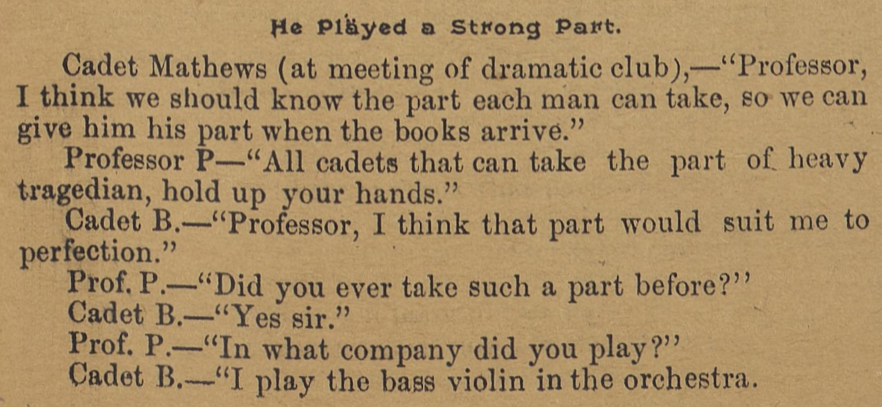 The Battalion, November 1893. Texas A&M University Newspaper Collection.
Cadet B was P.B. Bittle, a junior, who played bass violin in the orchestra and in the College String Band. Mathews joined Bittle in the College String Band. The inaugural issue of The Battalion, published October 1, 1893, lists the members of the band and includes Wm. Matthews, bones.
The bones are an important breadcrumb that allows us to link the Wm. Matthews of Texas A&M to a bones-playing ballplayer named Wilson Maurice Matthews whom we will encounter at the University of Georgia in 1897. How many bones-playing ballplayers named Matthews were wandering the South in the 1890s?
Cadet Mathews’ desire to assign the roles in advance of the books was justified: after the books arrived, the cadets had only a week to practice before their first performance on November 12, 1893, following a meeting of the A&M board of directors.
An account of the event in the Galveston Daily News shows W.M. Mathews in the role of Polydor, described by Mark Twain in a satirical 1863 review as “a wealthy, spindle-shanked, stingy old stockbroker.”
The Daily News awarded the cadets’ performance middling marks, judging it “well-rendered for amateur work.”
The Battalion sometimes published humorous lists of cadets’ desires in a section titled WANTED. One list included To be a tragedian – Matthews. Perhaps he wished to take on roles “heavier” than the spindle-shanked Polydor.
The tragedian may have carried a torch for a young lady.
Working as a sportswriter years later, Matthews sometimes prefaced his reports with a few lines of doggerel. His first published poem appeared in The Battalion. Entitled “Willie,” it is refreshingly normal, sweetly execrable in the way of all love poems written by 16-year-olds:
A winning smile, a graceful style,
A pair of roguish eyes,
A figure neat, two dainty feet,
A cadet girl in disguise.
A slender waist, that’s quite in taste,
A dainty fairy form.
Soft and sweet, that rippling voice
would quell a coming storm.
Soft flowing tresses, voice low and sweet,
None half so handsome, none half so neat.
Pure as a lily, sweet as a rose,
There’s a sunbeam where ever she goes.
Who was Willie? A girl named Wilhelmina? A Bryan girl or one he knew from Austin? A boyhood crush lost to time.
Being in the Third Class, no longer a fish, Mathews may not have been subject to last-night sentry duty, but he remained at the bottom of the Corps’ command ladder. The Battalion of October 15 lists Mathews as a private in Company A, below five corporals, seven sergeants, four lieutenants, a captain, six staff officers, and Commandant Morse. At least he was not below the dog, Reveille, who commanded later iterations of the Corps.
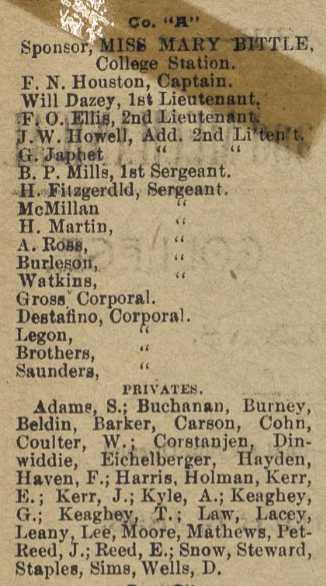 Corps of Cadets Company A, The Battalion, October 15, 1893. Texas A&M University Newspaper Collection.
In later years, Mathews solved his lack of military advancement by simply making up a promotion. He entered the Spanish-American War as a corporal and, after less than a year of mundane non-combat duty, exited the service as a sergeant. On his return to Austin, Mathews passed himself off as a second lieutenant who “fought in the trenches at Santiago,” and left the service “when no more warring seemed in sight.”
Despite his lack of advancement within the Corps, Mathews must have been good at all that marching around. The Battalion lists Matthews as a member of the Ross Volunteers, a special drill team drawn from “the best-drilled cadets of the College.”
Given his later aversion to authority, it is surprising to find Mathews among a well-disciplined outfit like the Ross Volunteers. The selection committee may have been impressed by the 16-year-old’s Prussian demeanor, which mirrored his mother’s. Blanche Dumont, probably a Central Texas German, was described as “arrogant, haughty, and unreasonable.” Mathews adopted a similar manner.
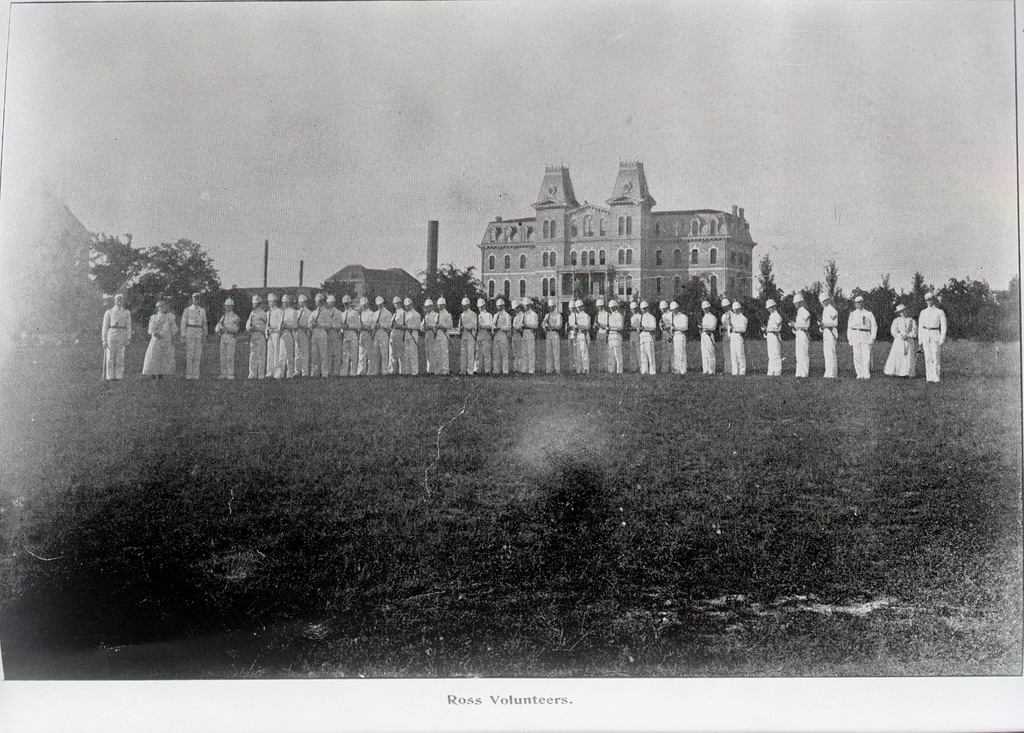 Ross Volunteers, 1895. Texas A&M, Cushing Memorial Library, Historical Images Collection.
In the spring of 1894, Joe Holick, a cobbler and bugler who sounded “Reveille” each morning and “Taps” each night, organized A&M’s first marching band. In a facetious poke at Mathews’ comportment, the WANTED section of The Battalion’s April issue included To be drum major – Mathews.
A few years later at the University of Alabama, Mathews’ regal bearing earned him a memorable nickname: The Duke.
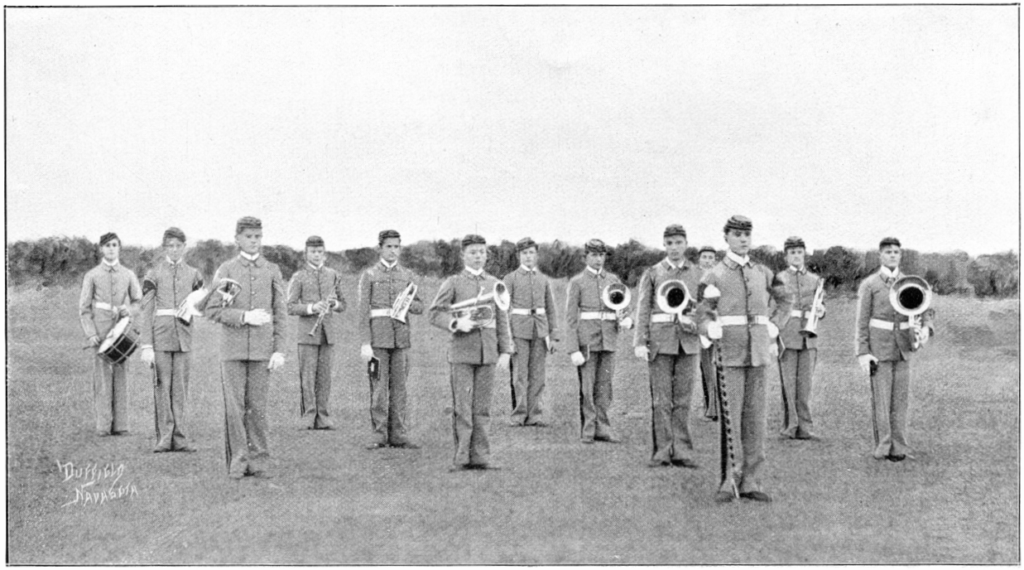 Marching band led by drum major “California” Morse. P.B. Bittle is at the far right on tuba. Texas A&M catalog, 1894-1895.
During A&M’s formative decades, the faculty and cadets struggled to balance sports and academics. Although Ivy League institutions such as Yale and Princeton had proven that sports could coexist with academics as a noble, character-building endeavor, most southern schools had yet to fully embrace the concept.
A cadet-composed paragraph in the February 1893 issue of the College Journal, the predecessor to The Battalion, defined the issue:
Physical culture should accompany mental culture, but should not overshadow it. When a college degenerates into an arena for supremacy in grappling a foot ball, or rowing a boat, and when supreme effort is made in these sports, then it would seem that education is progressing like a crawling fish – backwards. We would not underestimate physical culture. One extreme is as bad as the other, if not worse.
For Mathews, the choice was clear: he was a sportsman. Literature and oratory were interesting diversions, but athletics defined his existence. A&M provided him the opportunity to pursue and develop his “physical culture,” perhaps to the detriment of academic achievement.
The Young Men’s Christian Association set up a gymnasium in a 30×60-foot hall “fairly equipped with modern apparatus.” Any cadet could access the facility for 25 cents each month, or $1.50 for the nine-month term. “The Y.M.C.A. is in flourishing condition now and bids fair to success,” the College Journal reported in February 1893.
The Battalion picked up the narrative the following November, naming Mathews among the “crack sparrers” using the gym to learn the “scientific” sport of boxing. The article included Mathews among “last year’s representatives of the manly art,” indicating that he had also boxed as a fish. As a ballplayer and umpire, he often found occasion to utilize his scientific skills, though not always to good effect.
The YMCA sponsored a Field Day that fall. Mathews tried his hand – and feet – in several events: the one hundred-yard foot race, the best running jump, the three-legged race (shackled to junior Charles Archer Oltorf), the potato race (participants “showed their dexterity and celerity in gathering up and disposing of potatoes”), and the baseball throwing contest.
In the ball-throwing event, Arthur Watts, a future army colonel, had the best single throw, heaving the ball 312.6 feet. Charlie Oltorf won the “best average in three throws” category with a mean toss of 308.1 feet. Mathews finished second behind Oltorf with an average throw of 296.5 feet.
During his days at College Station, Mathews played an important role in developing the Texas A&M football and baseball programs. Today, his contributions have been forgotten – as has almost everything else that Mathews accomplished in his lifetime. But his name should appear among the pioneers of A&M athletics.
The football program probably dates to the fall of 1892. In February 1893, just above the news that “several cadets are in the hospital sick with Pneumonia,” the College Journal happily announced, “The A. & M. College now boasts of a crack foot ball team.”
Another gridiron report followed a few lines down the page: “The College foot ball team will try and arrange a game for the 22nd.” February 22 was George Washington’s birthday, a National Holiday.
On February 20, the Galveston Daily News, which regularly printed reports from colleges around the state, echoed the intelligence of football in College Station with the simple statement, “A football team is being organized by the cadets.”
A week later, the Daily News reported that two teams of cadets, dubbed the “A&Ms” and the “John Carsons,” had faced off on Wednesday, February 22. The A&Ms carried the day, winning 13-4.
Based on articles Mathews later wrote for The Battalion, we can assume that he participated in the game.
“The game was witnessed by quite a number of visitors, and the victors are so elated by their success that they seriously talk of challenging the finest team of high kickers in the state,” the Daily News said.
The Houston Post also covered the match, but their reporter felt that its quality “suffered for the boys’ fun” as some of the better players chose to spend the holiday in Bryan.
Some modern sources have implied that the “John Carsons” represented a nearby school, but the Daily News and the Post made clear that both teams comprised cadets.
The “John Carsons” probably honored, or took a dig at, John M. Carson, a popular Assistant Professor of Agriculture at A&M. John Carson’s twin brother, James W. Carson, also worked at A&M as farm foreman.
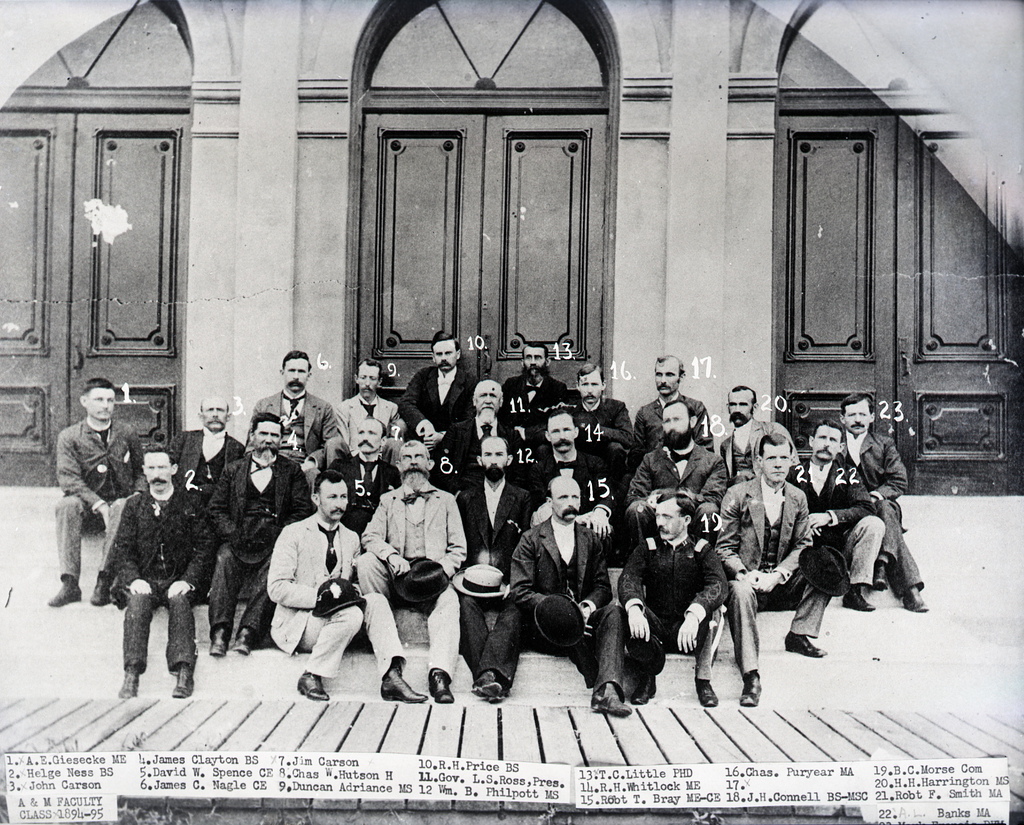 A&M faculty, 1894-1895, including John Carson (3), James Carson (7), Sul Ross (11), W.B. Philpott (12), and B.C. Morse (19). Texas A&M, Cushing Memorial Library, Historical Images Collection.
In those days a touchdown was worth four points, with the extra-point kick adding two. A successful drop kick through the goal posts counted five. The 13-4 score suggests that the A&Ms made two touchdowns and a drop kick, while the John Carsons managed a single TD.
It is a wonder that either team managed to get the ball over the goal line. It’s doubtful that any of the boys had ever played in an actual game. Most of them had probably never even seen a game and possessed only the most rudimentary idea of rules and strategies.
In such a vacuum, someone like Mathews, who had probably immersed himself in a study of the rules and had no problem filling any gaps in his knowledge with a well-placed bluff, could come across as a veritable football savant.
The following fall, a single-paragraph article titled Foot Ball. and signed MATHEWS. appeared in The Battalion of October 15, 1893. The 16-year-old sportswriter mentioned the two teams of the previous winter, discussed the current state of affairs, name-dropped a team captain, and closed with the breezy air of a seasoned alumnus:
It is an assured fact the College will have a splendid foot ball team this season, and on good information it is rumored that the two teams of last year will be united and a few new boys taken in to form the representative foot ball club. Harry Martin is practicing his men daily now and soon will have them down to a fine point. The Battalion wishes both the base ball and foot ball club every success in their line so that the old A. and M. may be well represented in every department of athletics. MATHEWS.
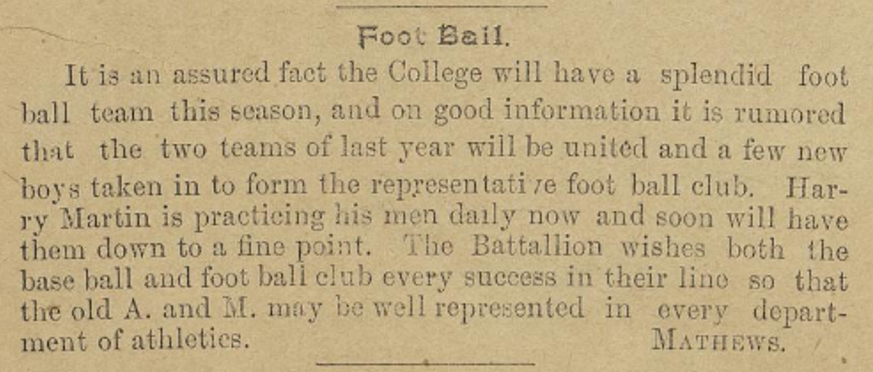 The Battalion, October 15, 1893. Texas A&M University Newspaper Collection.
The newspaper’s next issue reported the progress and plans of the football club. Twenty-six cadets would comprise the “A&M College Foot Ball Team.” They would be split into two 13-member squads “for the purpose of having enthusiastic games regularly.” From these, the best 13 players would be selected to “answer challenges from foreign teams.”
The correspondent also reported that “The uniforms will be here in a few days.”
An article by BILLY MATTHEWS appeared in the December 1893 issue. Under the headline FOOTBALL., the correspondent praised the weather, extolled the crude A&M athletic field, decried the lack of practice time allotted to the team, speculated on arranging games with other schools, and again mentioned the game played the previous February between the A&Ms and the John Carsons:
The weather conditions presented now are most favorable for the foot ball team to practice under. The air is cool and invigorating, also the ground is a trifle soft but not to so much so to prevent good work. That the A. and M. has one of the most splendid fields in the state for all out of door sports is not to be disputed.
We have some superb talent in that line of sport here at present. A few of the new boys have shown themselves to be first-class players in every respect as far as we could judge from the brief practice had so far this year.
No degree of excellency can be attained in “interfering,” “tackling,” and sprinting with the ball, without constant practice.
The time for leisure here is so limited that it seems nearly impossible to get the whole team on the field in body for practice.
The team to represent the College in the state should come to the conclusion that it is time for some match games to be arranged and also that it is a matter of utter impossibility to make a respectable showing without some practice in all the “tact’s” mentioned.
A game will perhaps be arranged with “Austin College” at Sherman or Georgetown. In either case, the “Cadets” will have a “happy” task in attaining victory; but with proper practice should put up a stiff game.
Who will be the ’93-’94 “Center Rush?” Why Davis H., who was the clown in last year’s game between the J.C.’s and the A. and M.’s. The umpire Orltorf and Peden make a fast pair of “half backs.”
BILLY MATTHEWS
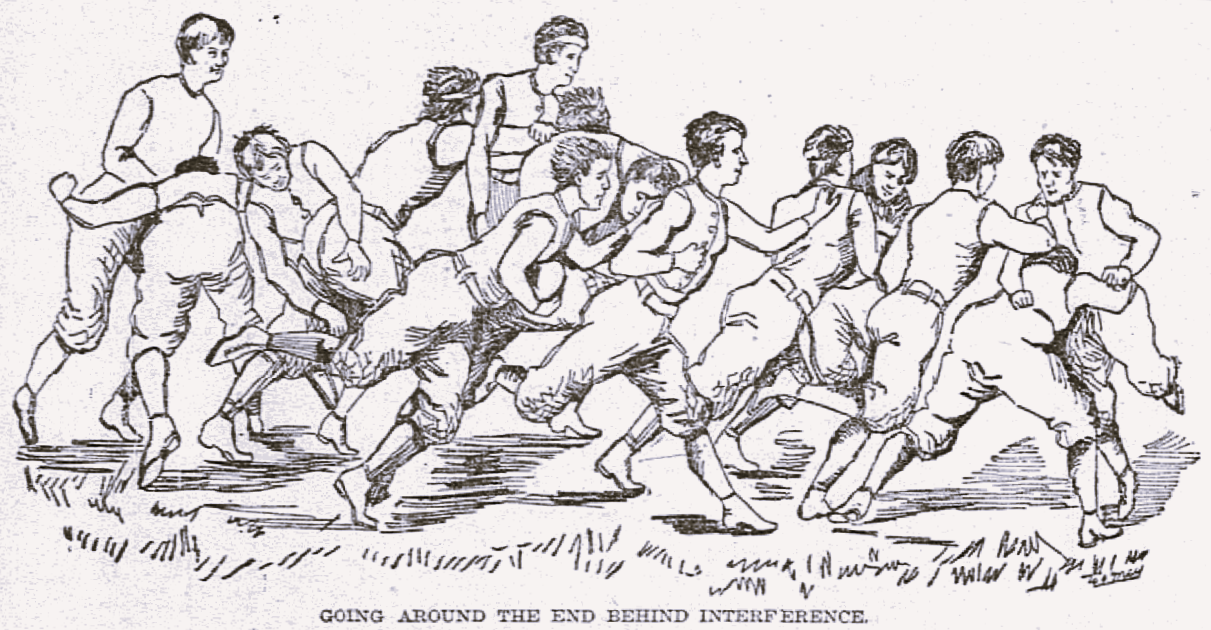 Running behind interference. Dallas Morning News, January 2, 1894.
William Matthews seems to have settled on the two-T spelling of his name, which we will now adopt.
Matthews’ favorable opinion of the A&M football team was informed by first-hand experience: he quarterbacked the team.
In the January 1894 issue of The Battalion, a contributor who dubbed himself ATHLETE reported that the team had posed for a photograph on December 16, 1893:
On the 16th of December last, the members of our College team had their photograph taken, which is admitted by all to be a handsome and hardy appearing “set.” The lads loomed up in respective positions as follows:
Charlie Orltorff, right end;
Milt Sims, Right tackle;
Dick Peden, right guard;
Frank Houston, center;
H. Coulter, left guard;
A. Watts, left tackle;
Massenburg, full-back;
Alf Bloor, left end;
Billie Matthews, quarter-back;
Harvey Morse, left-half;
Harry Martin, right-half;
A.W. Bittle, referee;
T.O. Ellis, umpire.
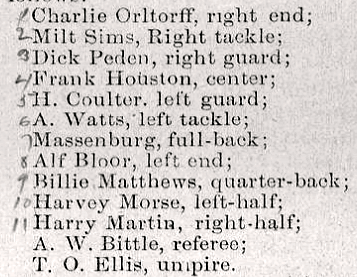 Players and officials shown in the photograph taken December 16, 1893. The Battalion, January 1894. Texas A&M University Newspaper Collection.
The unknown archivist who saved the issue numbered the players from 1 to 11, leaving the officials numberless.
Being a text-only publication, The Battalion did not include the photograph, but Dr. Henry C. Dethloff, Ph.D., published it in Texas A&M University: A Pictorial History, 1876-1996.
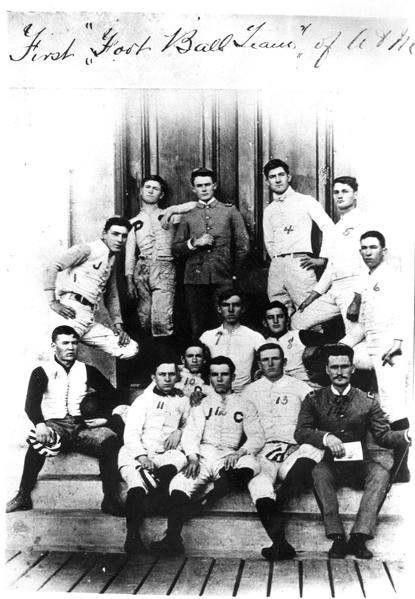 Texas A&M football team, December 16, 1893. Matthews (4) stands in the back. Cushing Memorial Library.
Dr. Dethloff identified the players, confirming that this is the first documented photograph of William Matthews:
Standing, left to right: California (“Callie”) Morse, Arthur P. Watts, Atwood Bittle, Bill Matthews, F.N. Houston, Harry Martin; seated, middle row: John Burney, _____ Altorf, Alfred W. (“Mike”) Bloor, Milton Sims; front: Dick Peden, W.G. Massenburg, Hiram F. Coulter, Fort O. Ellis.
Matthews (4) stands in the back, tall and fit, with a firm jaw and a shock of black hair. If he was born in July 1877, then he was about sixteen and a half years old. He looks older, giving some credence to the 1875 birthday that he sometimes claimed.
The players appear to wear white uniforms with dark red socks, which might explain Matthews’ later choice of colors for the Mississippi A&M football team. Perhaps the Bulldogs of Mississippi State now wear maroon and white only because Wilson Matthews already owned a white uniform and a pair of faded red stockings.
Note that the numbers inked onto the print do not correspond to those penciled onto the newspaper clipping, and that The Battalion article omitted John Burney, who was probably a substitute. Otherwise, the roster listed in The Battalion corresponds to Dethloff’s identifications, including the presence of officials Bittle and Ellis in their cadet uniforms.
Dethloff misleadingly captioned the picture The first Texas A&M football team. 1894. While the 1893-1894 team shown in the photograph was an early, pioneering squad, it was not the first official Texas A&M team.
History tells us that Texas A&M played its first football games in the fall of 1894, taking on the University of Texas and a high school from Galveston. The honor of First Official A&M Team, therefore, is given to the team organized in the 1894-1895 academic year. By then, Matthews and many of the players shown in the December 1893 photo were no longer on the squad.
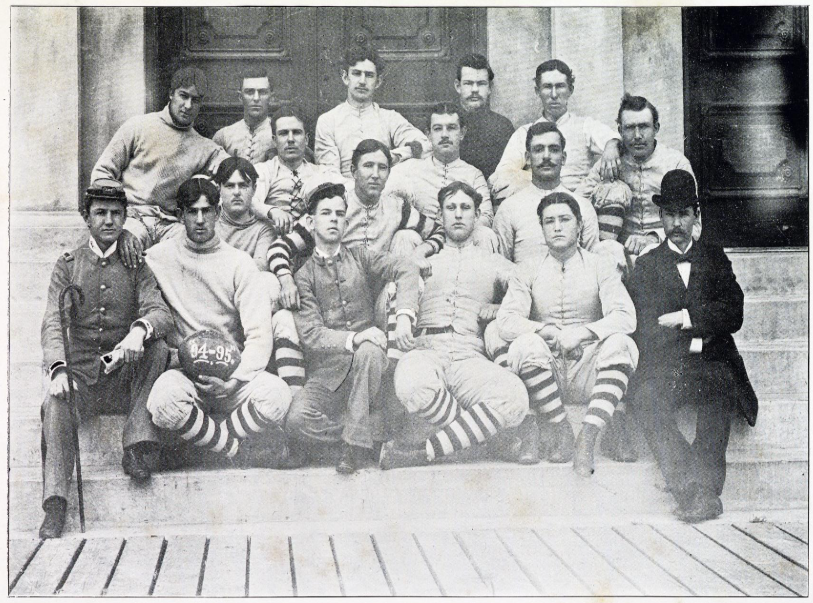 1894-1895 Texas A&M football team. Olio, 1895. Texas A&M University Online Yearbook Collection.
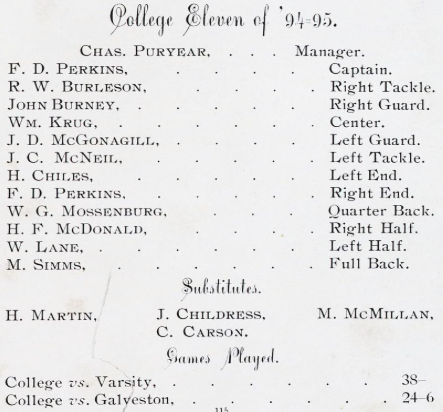 Roster and record of the 1894-1895 team. Olio, 1895. Texas A&M University Online Yearbook Collection.
With a little luck or better planning, though, the 1893-1894 team quarterbacked by Matthews might have been the first A&M team to play against a “foreign” club.
On January 22, 1894, the Galveston Daily News announced plans for a game in College Station on the Washington’s Birthday holiday: “The A. & M. C. football team are now training for a match game with the Y. M. C. A. team of Dallas on February 22.”
One week later, the Daily News reported that the game against Dallas had fallen through, but that the A&M team instead planned to play a team from Galveston. The article indicated that a couple of new faces had joined the team after the December photograph:
The following is the roster of the agricultural and mechanical college football team: President, W. Muller; captains, William Massenburg and A.P. Watts; members, Burney, Littlefield, Martin, Coulter, Sims, Matthews, Valdez, Burleson, McNeil, Krug, Ferguson, S. Smith, Ellis, Peden, Houston, and Morse.
The game against Galveston also fell through, as the islanders chose to play a team called the Resolutes in a game to benefit the Women’s Home.
The cadets finally got a chance to play a real college club when the University of Texas’ second team accepted a challenge to play the A&M boys on Saturday, March 3.
The San Antonio Daily Express reported that the UT players departed Austin for Bryan on Friday night, ready “to tackle the Agricultural and Mechanical pigskin jugglers.”
The cadets were, unfortunately, on break between the winter and spring terms, and may have been unable to muster eleven good players. But the follow-up report in the Daily Express implied that the cadets took one look at the UT second-stringers and chose discretion over valor:
The second University Football team which went over to Bryan yesterday to play the Agricultural and Mechanical College team, did not get the opportunity to show the latter that they did not know anything about the game, as the Agricultural and Mechanical College boys “backed out” and didn’t play.
It was an ignoble end to the cadets’ 1893-1894 football season. With better attention to logistics, the squad may have been able to claim the honor of being the first Texas A&M team to compete against another college, rather than being a miscaptioned historical footnote.
Still, quarterback and chief correspondent Billy Matthews, captains Massenburg and Watts, and the other players deserve some credit for giving the pigskin a decent kick, and sending it bouncing towards the 20th Century.
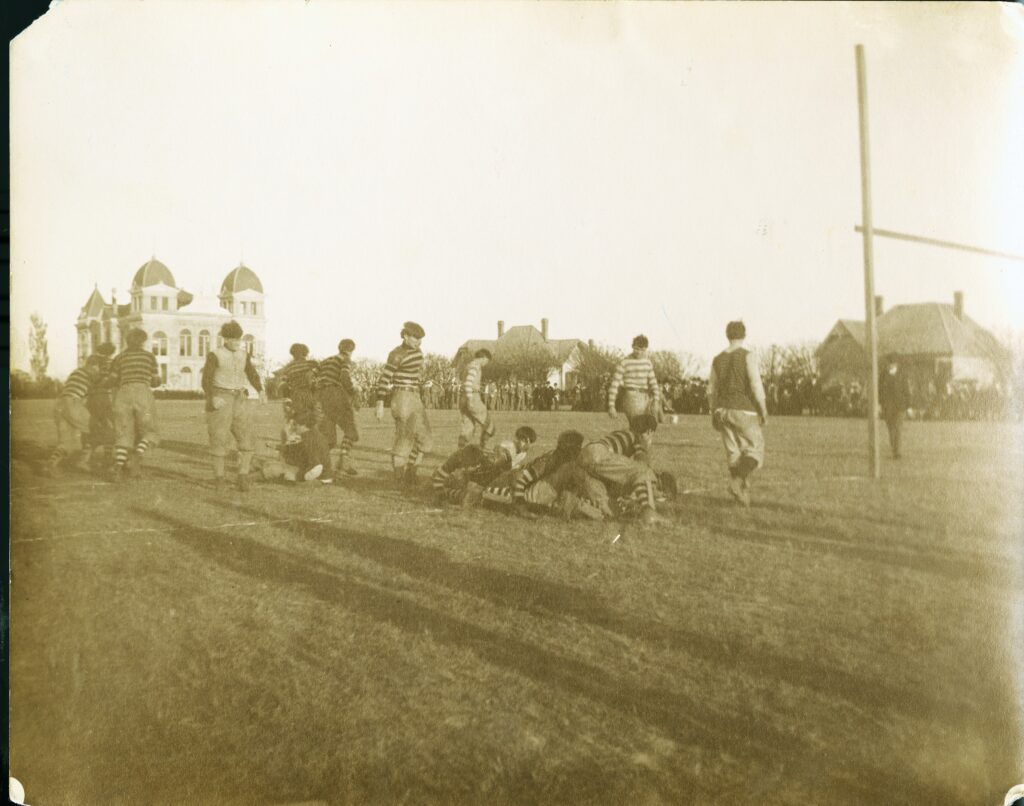 Texas A&M plays LSU on the athletic field, December 2, 1899. The old Assembly Hall is in the background. Cushing Memorial Library, Historical Images Collection.
In the spring of 1894, Matthews utilized the “splendid” A&M athletic field to organize and captain a baseball team.
Baseball had languished in College Station. “The beautiful game of base ball seems to be on the decline at our college,” someone moaned in the first issue of The Battalion. “We have not had an unquestionably good base ball team at the A. and M. for two years.”
Records of past seasons are sketchy, but the evidence leaves little doubt that the anonymous critic at The Battalion was correct.
In 1891, the cadets may have played a single game, against a team of amateurs in Navasota, winning 9-0 by forfeit after a conflict in the sixth inning ended the affair.
The cadets returned to Navasota in 1892 and beat the locals, 21-12, a typical score for those days.
Buoyed by their success, the cadets took on a brand new amateur club in Calvert, 35 miles northeast of College Station. The cadets were confident of victory; the Navasota team they had beaten had recently defeated the Calvert club, 11-3. The confidence was misplaced, as the cadets lost by an unknown score.
In April 1893, the cadets returned to Calvert, probably with Matthews in tow, and suffered a 4-14 trouncing. The Houston Post noted that the Calvert team played in a real, enclosed ballpark and seemed “greatly improved in batting.”
It appears, then, that when Matthews gathered his charges in the spring of 1894, he faced a very low bar for success. He no doubt approached the problem with the confidence and enthusiasm that he brought to every project. A classmate later described Matthews as an “efficient base-ball captain.”
Most online sources, including those on the Texas A&M website, credit the 1894 team with a 3-1 record. But A&M’s 1895 yearbook, The Olio, shows that the cadets accomplished the 3-1 record during the 1894-1895 academic year, meaning the games were played in the spring of 1895.
The team fielded by Matthews in the spring of 1894 probably played only a couple of games, but won both.
On April 21, the cadets traveled to Navasota to take on their old rival.
Never one to quibble about ethics, Matthews sent a ringer to the mound: Lee Rundell, his friend from the Austin Athletics. The day was, appropriately, Rundell’s twenty-first birthday, making him easily the oldest A&M player. Matthews crouched behind the plate at catcher, and the two friends made a day of it.
The “Texas Whirlwind” dominated the Navasota boys, allowing only two hits and striking out 12 as A&M defeated the locals either 12-2 or 11-3.
“The feature of the game was the pitching of L. Rundell and the catching of W. Mathews,” the Austin Statesman reported.
“The College Base Ball club was highly entertained by the boys of Navasota during their stay in that city, and the ball game was very interesting, with a large crowd of on-lookers,” a writer observed in the May 1894 issue of The Battalion.
That same issue of The Battalion also alludes to a game against nearby Bryan, but does not provide details of the contest. The outcome was, apparently, unsatisfying for the Bryan boys. A section titled They Say, a humorous collection of facetious gossip, included:
That College wants a more interesting game of ball than the one between Bryan and College.
That the Bryan base ball team wants a trainer before making another engagement with the College.
That Morse never stopped a ball. [a reference to “California” Morse]
That Dinwiddie is a base ball player. [a reference to Robert L. Dinwiddie]
Matthews and his teammates, then, should be credited with a 2-0 record for the 1893-1894 academic year.
Considering only wins and losses, Matthews’ athletic efforts during Texas A&M’s 1893-1894 academic year were unimpressive. The football team that he quarterbacked did not play any outside schools. Given the opportunity to take on the University of Texas second-stringers, the cadets declined to take the field. The baseball team he captained defeated a couple of town teams.
Matthews’ contributions to the Texas A&M football program should be judged as those of a pioneer. Someone had to pry the pigskin from the primordial ooze. Matthews and his teammates extracted the prolate spheroid and sent it wobbling on its way for others to gather up and carry across the goal line.
Viewed in that light, Matthews and the 1893-1894 team played an important role in the history of A&M football.
On the baseball side, Matthews’ contribution is less memorable; the horsehide was already more-or-less out of the ooze when he took over the team. But Matthews kept the ball in play and established a winning 2-0 record that his successors improved to 3-1.
Matthews’ stay at College Station ended with the close of the spring term in June of 1894.
In later years, Matthews did not even acknowledge his presence at Texas A&M. The fantastic, ever-changing resumés that he crafted entirely deleted his days as a cadet at College Station. Instead, Matthews claimed that he received his early education at St. John’s Military School in Ossining, New York, then known as a feeder school for nearby West Point.
His departure marked the beginning of a journey that carried him across the South and back to Texas. For the rest of his life, Matthews constantly moved between towns, colleges, teams, and leagues, rarely remaining in one residence for more than a couple of seasons, becoming what one writer labeled “a baseball soldier of fortune.”
Matthews next turned up in Houston, where Blanche Dumont had taken refuge from a crusading mayor bent on restoring righteousness to Austin.

Charles Norman is a writer and historian. Email: reverb.raccoon@gmail.com. Or follow on Instagram and Facebook.
Latest Posts
Here Lies Wilson Matthews – 1 Who Was W.M. Matthews?
But he wanted to get in. He wanted to be urbane and careless. He wanted to wear well-cut clothes. He wanted to be a gentleman.-- Thomas Wolfe, Look Homeward, Angel Part 1Who Was W.M. Matthews? Mississippi State University – then Mississippi A&M College – entered...
Here Lies Wilson Matthews – 2 Who Was Blanche Dumont?
Here’s what I want. I notice you changed your name. I want you to keep your new name. I guess you made up someplace you came from – well, that’s where you came from… You figure you died and now you’re somebody else and we’ll get along fine. -- John Steinbeck, East of...
Here Lies Wilson Matthews – 3 Guy Town
He was surrounded by a world that was both beautiful and terrifying, a land of secrets and shadows, where the line between civilization and savagery was thin and easily crossed--Joseph Conrad, Lord Jim Part 3Guy Town Miss Blanche Dumont became a sex worker in Austin,...
Here Lies Wilson Matthews – 4 Spaced Flashes
In probing my childhood (which is the next best to probing one’s eternity) I see the awakening of consciousness as a series of spaced flashes, with the intervals between them gradually diminishing until bright blocks of perception are formed, affording memory a...
Contact Reverb Raccoon
 |
 |
 |
 |
Archives