Here Lies Wilson Matthews – 7 Uncivil Matters
People who don’t know think it is easy to be a madam – just sit in a big chair and drink beer and take half the money the girls make, they think. But it’s not like that at all.
— John Steinbeck, East of Eden
Part 7
Uncivil Matters
As the Gay ‘90s opened, Blanche Dumont’s high-toned bagnio reigned as a centerpiece of Austin’s Guy Town.
Dumont had moved into her rambling, 10-room brothel at the corner of West 4th and Lavaca (Lot 12, Block 28 in the deed records and tax rolls) around 1883. She upgraded it with $3108 worth of furnishings, purchased on credit from Austin merchants, including a Behr Bros. piano valued at $650. In today’s dollars, her credit line topped $100,000.
Dumont rented her house for several years, paying her landlord $50 each month “in advance.” In July 1889, she purchased the property from P.J. Lawless, a ticket agent for the Texas & Pacific Railroad, for $3000. She financed the purchase with six $500 promissory notes, one payable each year, with an interest rate of 8% per annum.
She made her payments in 1890, 1891, and 1892. Then the SS Dumont ran aground on the triple shoals of the Panic of 1893, a kid in college, and Austin Mayor John McDonald.
The Panic had complex causes that are still being debated, but the results were obvious: commodity prices cratered, credit dried up, and actual cash became scarce.
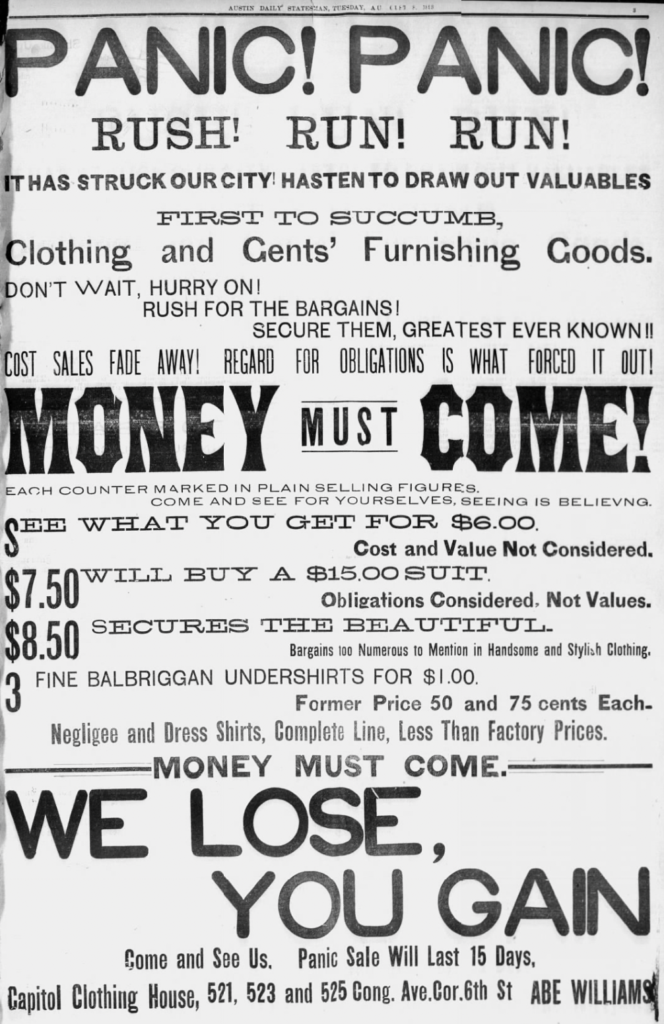 Advertisement for Capital Clothing House. Austin Statesman, August 8, 1893.
Low crop prices and a lack of operating capital devastated the Texas economy, which was still dominated by agriculture. Everyone from the man at the top to the man at the bottom felt the pain.
A letter to the editor of the Galveston Daily News, published the day after Christmas 1893, expressed the predicament: “The farmers are hurt. The land owner is hurt and the tenant is hurt, the hired hand, and in fact all laboring men are hurt more or less.”
For Blanche Dumont, who operated a cash-on-the-nightstand business, a poorer client base with less folding money presented a serious setback.
Then there was the problem of her son, Billy Matthews, attending Texas A&M. As any modern-day parent of a college student can tell you, that sheepskin don’t come cheap.
Tuition was free, and government funds covered most textbook costs, but the parent was on the hook for a trust fund fee, incidental fee, physician’s fee, and maintenance. The latter entailed “board, fuel, washing, lights, room rent, bedsteads, mattresses, pillows, tables, washstands, chairs, wardrobes, buckets, basins and slop cans.” The official bill totaled $140 for a nine-month term.
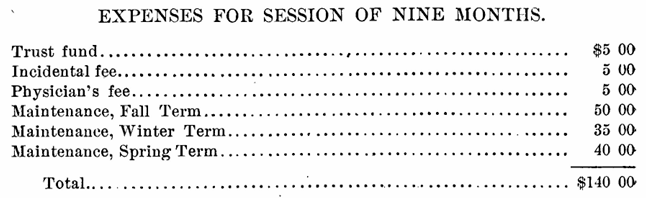 Undergraduate student fees. Texas A&M catalog, 1893-1894.
Then there was the cost of the cadet uniform (“$15.50 to $18”), football and baseball uniforms, YMCA fees, towels, sheets, blankets, writing materials, train fares to and from school, and tips for Uncle Dan, the old fellow who met the boys at the station and carted their luggage to the campus.
And finally, Matthews needed coins for holiday adventures in Bryan, forbidden poker games, carriage rides with “cadet girls,” and all the other amusements young men manage to spend money on. As an adult, Wilson Matthews was known as a profligate spender, “a hail fellow well met” who went through every cent he ever made and died totally broke. There’s no reason to expect his younger self to have been cut from a different bolt of cloth.
All told, Blanche Dumont was shelling out at least $200 each term, maybe as much as $250. It doesn’t seem like a lot, but when we consider that the annual principal on her house payment was $500, her son’s state school education had significantly increased her annual outlay.
It was the beginning of a long, slow financial decline that eventually left Dumont destitute.
Caught in a cash crunch, Blanche Dumont missed her 1893 house payment. She also missed her 1894 and 1895 payments. In fact, after 1892, she never made another payment. Still, she managed to hold onto her house until 1914.
Dumont renewed the unpaid promissory notes with P.J. Lawless from time to time until 1910, when City Commissioner D.B. Gracy stepped in and refinanced the debt with a single promissory note of $2762, due in five years, with an interest rate of 10%.
The intervention of an Austin City Commissioner into the finances of a near-destitute madam shows the extent to which prostitution and public policy made for interesting bedfellows in Austin.
In another sign of ailing financial health, Dumont failed to pay her city property tax in 1894. It was a measly $60.69, but if you’re broke there’s no difference between $60.69 and $6069: they are equally unpayable.
The Panic gave Dumont plenty of company on the delinquent tax roll. The list of nonpayers published annually in the Statesman showed 179 properties in September 1893. A year later, the number jumped to 272 properties.
Dumont did not pay her city property taxes for five years, from 1894 through 1898, accumulating a debt of $273.58. The solution again shows the fishiness that surrounded the city’s dealings with Guy Town in general and Dumont in particular.
In 1900, the District Court ordered the Travis County sheriff to sell Dumont’s property to pay her tax debt. Rather than sell the property to a real estate speculator, the sheriff sold it to the City of Austin. The City owned the property for five years, acting as the landlord of one of Guy Town’s most notorious brothels.
In April 1905, Dumont paid off the debt which, with interest and court costs, now totaled $367.75. The City of Austin then returned Dumont’s property to her, and released her from any further obligations.
Not coincidentally, Wilson Matthews began his first season as a minor league manager in April 1905. He was probably making about $150 each month, and could afford to help his mother get her house out of hock.
Austin’s politicians seemed happy to keep Blanche Dumont and the denizens of Guy Town afloat. The Statesman suggested that the problem would persist until women were allowed to vote. The situation changed when John McDonald became mayor of Austin.
McDonald won the December 1889 election behind a platform of better streets, better drainage, better sewers, better schools, and a dam on the Colorado River to generate hydroelectric power. He ran unopposed two years later.
During his second term, McDonald took a special interest in the “disorderly houses” of Guy Town. He professed to be unaware of what went on there until he encountered a court case in which “there were 30 or 40 young men as witnesses.” McDonald was shocked by the boys’ “familiarity with all the doings of these joints” and vowed to sweep the evil out of town.
As his broom, McDonald wielded an 1889 state law that defined a Disorderly House as “one kept for prostitution or where prostitutes are permitted to resort of reside for the purpose of plying their vocation.” The owner, lessee, or manager of the disorderly house was subject to a $200 fine.
The state law required city mayors and their police forces to “diligently” investigate and enforce possible violations. The law also required grand juries to question police officers regarding their knowledge of violations and the “diligence” of their enforcement.
A grand jury empaneled in Austin in March 1893 summoned and questioned several of the women who worked in the disorderly houses. The jurors’ report provided a shocking characterization of madams such as Blanche Dumont:
From information we obtained we were convinced the majority of them [the workers] were forced to lead this life of shame on account of having been seduced by some treacherous, demoralized wretch and were harbored in houses of ill-repute by so called keepers as boarders. The board which these unfortunate inmates have to pay these keepers, or landladies as they are sometimes called, runs to the enormous sum of $15 to $20 a week, which naturally keeps the inmates perpetually indebted to the keepers, forcing such inmates or boarders to continue this life of shame and prostitution until she or they become a total wretch and many of them end their miserable existence by suicide.
Given that the women in the better houses made $3 for an all-nighter, but paid as much as $20 each week to the “treacherous, demoralized wretch” who ran the establishment, the arrangement smacked of a particularly cruel and cynical brand of exploitation.
The grand jury indicted madams Blanche Dumont, Georgia Fraser, Mollie Smith, Hattie Starr, and Jessie Meade.
Dumont, Fraser, Smith, and Starr appeared before Travis County Judge William von Rosenberg, Jr. on Wednesday, July 5. Their attorneys moved to quash the indictments. Judge von Rosenberg sustained the motions and dismissed the cases. Two days later, he dismissed the charge against Jessie Meade.
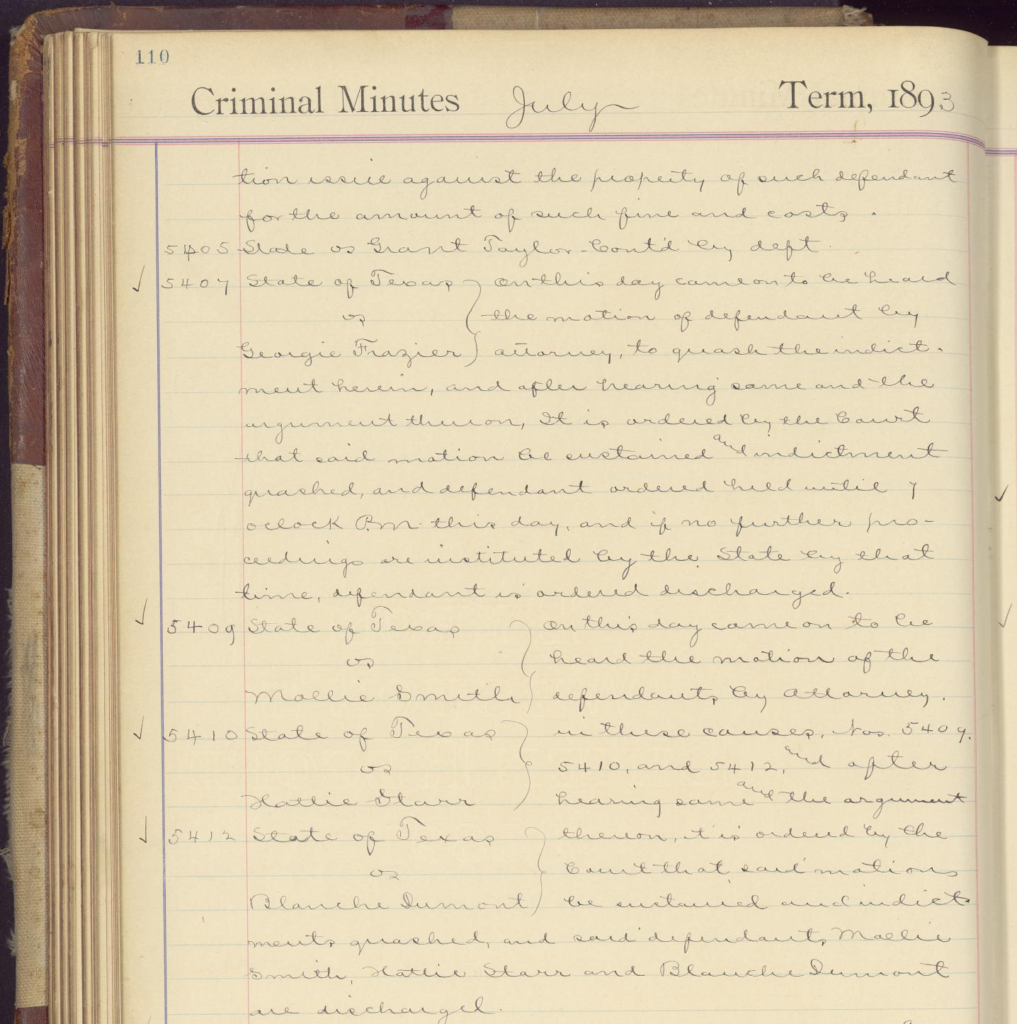 Court appearances of Georgia Fraser, Mollie Smith, Hattie Starr, and Blanche Dumont, July 5, 1893. Travis County Clerk Records, Criminal Minutes Book D (July 1892 to November 1911).
Georgia Fraser appears in the court records as Georgie Frazier. In the Statesman and in the Austin business directories she appears in various combinations of Georgie, Georgia, Fraser, Frasier, and Frazier.
A photograph of her house at 200 West 2nd Street, at the corner of West 2nd and Colorado, appears in most accounts of Guy Town. The photograph shows a stone in the front engraved FRASER, which we assume was the madam’s preferred spelling of her name.
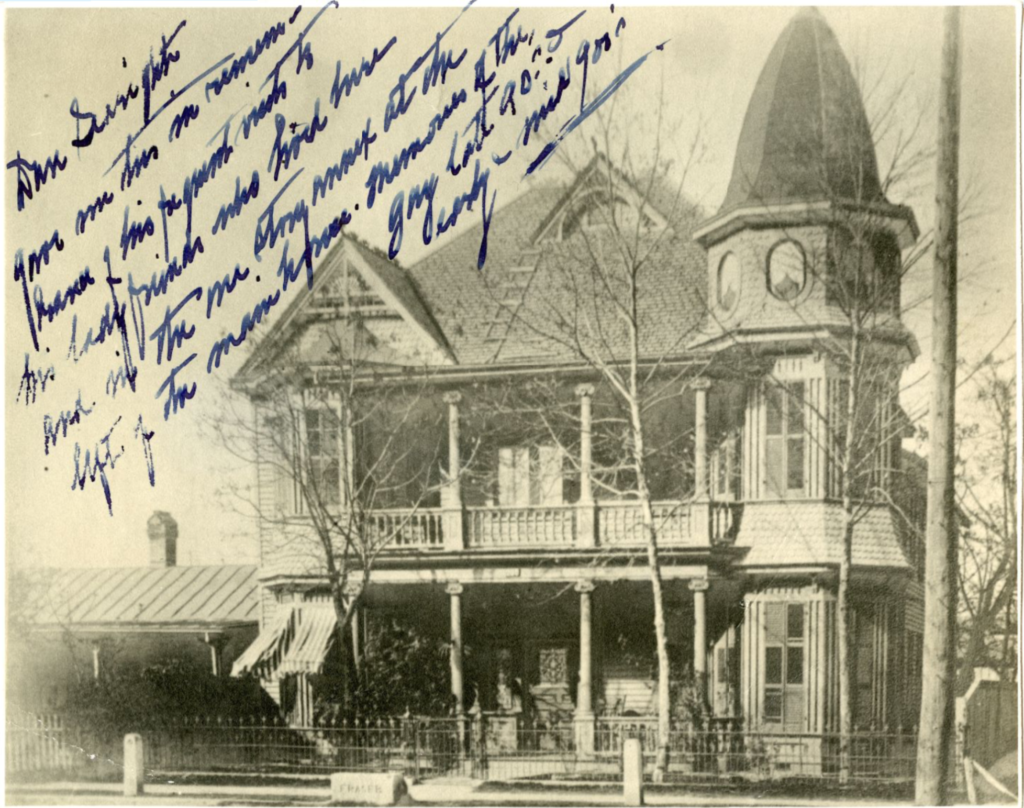 Georgia Fraser’s house at 200 West Second Street after 1894. The stone in front reads FRASER.
The photograph is undated, but it must have been taken some time after 1894. The Sanborn Fire Insurance maps indicate that the house’s elegant upper story was added between 1894 and 1900.
Blanche Dumont had formerly rented the property, when 2nd Street was known as Live Oak. In 1880, a census-taker found the house occupied by Dumont, four boarders, and her two-year-old son, whose name was recorded as W.F. Mathews. She moved to 211 West 4th Street about three years later.
The year 1894 began poorly for the women in Blanche Dumont’s house. On Wednesday night, January 17, 1894, Pearl Block died in her room of a morphine overdose. She had been sick and in great pain for several days, taking morphine for relief. The doctors who attended found her “thoroughly saturated with the drug,”
Pearl had been working in the brothels of Austin for about six years. Her companions said her real name was Ella, but they could not recall her last name. They thought she came from a refined family in Georgia and was married to a saloon-keeper in New Orleans. Someone tried to contact them, without luck. Her remains were laid to rest in the city cemetery on Friday afternoon.
In the spring, another grand jury took on Guy Town, indicting Blanche Dumont, Louis Starr, Hattie Starr, Jessie Meade, Georgia Fraser, S.A. Posey, and Mary Bush. Each was accused of violating the 1889 state law that defined and prohibited disorderly houses.
Mary Bush appeared before Judge von Rosenberg on April 3, 1894, and won an acquittal. Then, in a stunning case of judicial overreach, the county judge declared the state’s 1889 disorderly house law to be unconstitutional, and threw out the indictments against Dumont, the Starrs, Meade, Fraser, and Posey.
Faced with a recalcitrant judiciary, Mayor McDonald fell back on that old chestnut, the executive order. On the morning of September 19, he instructed City Marshall Jim Lucy to close the disorderly houses “lock, stock, and barrel,” and to purge the city of “every known harlot.”
The order’s legality and enforceability were suspect, especially in the cases of madams who owned their houses. “The question now arises, can the city police force them to shut up shop entirely and leave their property,” the Statesman pondered.
Nevertheless, the Guy Town residents took the order seriously. Five days after the mayor ordered them to leave, the Statesman reported that, “Most all the girls of the tenderloin district have left town and their mansions are darkened in accordance with Mayor McDonald’s orders.”
Blanche Dumont, being more prescient than the other madams, or possessing more inside information, had not waited around for the mayor’s order. She and her son relocated to Houston in the summer of 1894, where she opened a new disorderly house.
By the time Mayor McDonald closed the Austin brothels, Billy Matthews was roaming the Bayou City baseball diamonds, and Dumont had been taken to court for stiffing her upholsterer.

Charles Norman is a writer and historian. Email: reverb.raccoon@gmail.com. Or follow on Instagram and Facebook.
Latest Posts
Here Lies Wilson Matthews – 1 Who Was W.M. Matthews?
But he wanted to get in. He wanted to be urbane and careless. He wanted to wear well-cut clothes. He wanted to be a gentleman.-- Thomas Wolfe, Look Homeward, Angel Part 1Who Was W.M. Matthews? Mississippi State University – then Mississippi A&M College – entered...
Here Lies Wilson Matthews – 2 Who Was Blanche Dumont?
Here’s what I want. I notice you changed your name. I want you to keep your new name. I guess you made up someplace you came from – well, that’s where you came from… You figure you died and now you’re somebody else and we’ll get along fine. -- John Steinbeck, East of...
Here Lies Wilson Matthews – 3 Guy Town
He was surrounded by a world that was both beautiful and terrifying, a land of secrets and shadows, where the line between civilization and savagery was thin and easily crossed--Joseph Conrad, Lord Jim Part 3Guy Town Miss Blanche Dumont became a sex worker in Austin,...
Here Lies Wilson Matthews – 4 Spaced Flashes
In probing my childhood (which is the next best to probing one’s eternity) I see the awakening of consciousness as a series of spaced flashes, with the intervals between them gradually diminishing until bright blocks of perception are formed, affording memory a...
Contact Reverb Raccoon
 |
 |
 |
 |
Archives