Here Lies Wilson Matthews – 8 Happy Hollow Meets the Maroon and White
“Abdication! One third of the alphabet!” coldly quipped the King, with the trace of an accent. “The answer is no. I prefer the unknown quantity of exile.”
— Vladimir Nabokov, Pnin
Part 8
Happy Hollow Meets the Maroon and White
Austin Mayor John McDonald ordered City Marshall Jim Lucy to close the Guy Town brothels on September 19, 1894. Blanche Dumont had foreseen the move and had abandoned Austin the previous month. When Lucy shuttered the disorderly houses, Dumont was already plying her trade in the muddy misery of Houston’s Happy Hollow.
Dumont and her son, W.M. Matthews, left Austin for Houston in mid-August. She was in Austin on August 10, and had a load of laundry done on credit by a washerwoman named Patsy Lewis. Two days later, a package awaited her at the Wells Fargo Express office in Houston. On August 26, Matthews was playing semi-pro ball with a Houston team called the Seiberts.
Dumont maintained ownership of her Austin house. She wasn’t making her mortgage payments or paying the property taxes, so keeping the house didn’t cost her anything.
She may have left her house in the care of a woman named Maud Norman. The Austin business directory for 1895 shows Maud Norman at Dumont’s address of 211 West 4th. Her entry is marked with an r, meaning resident. Women who worked in brothels were usually marked as bds, meaning boards.
In Houston, Dumont set up shop at 609 Prairie Avenue in the red-light district known as Happy Hollow. The 1896 Sanborn Fire Insurance maps show 38 brothels within Happy Hollow’s four-block area, giving Houston’s 35,000 residents the luxury of one brothel for every 921 citizens.
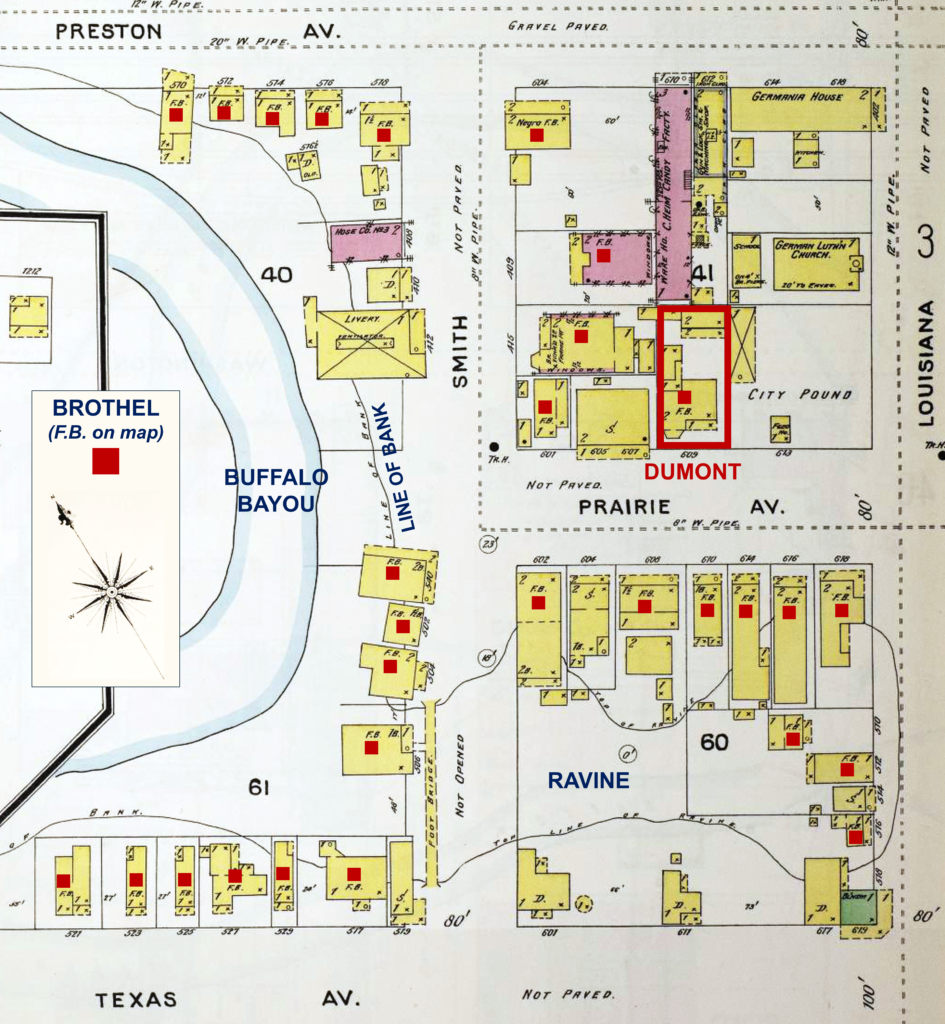 Houston’s Happy Hollow. Red squares are brothels. The red rectangle is Blanche Dumont’s property. Nine more brothels are on the other sides of Texas and Louisiana streets. Sanborn Fire Insurance map, 1896.
Happy Hollow lay hard by Buffalo Bayou. The bank dropped down half a block from Dumont’s brothel, where Smith Street crossed Prairie. A ravine lined with low-rent houses and shanties collected water on the other side of Prairie. The ravine crossed Smith Street between Prairie and Texas Avenue. Pedestrians navigated the gap on a narrow footbridge.
The unpaved streets flooded with each hard rain. Flies, mosquitoes, cockroaches, and rats infested the houses. Indoor plumbing did not exist. Most of Houston’s sewage ended up in Buffalo Bayou. In the heat and humidity of August, the stench must have been unbearable.
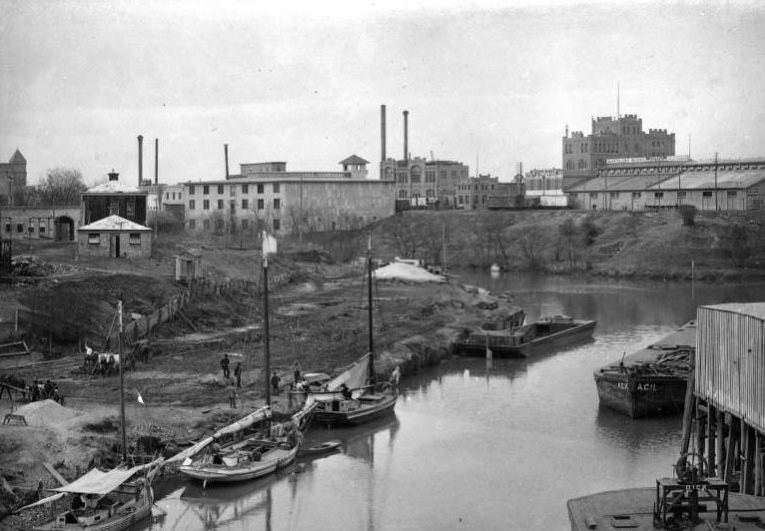 Buffalo Bayou, date unknown. Looking from the San Jacinto Street Bridge towards the junction of Buffalo and White Oak Bayous.
Dumont’s house lay adjacent to the city pound, which incarcerated stray animals of every stripe – dogs, chickens, cows, horses, and mules – adding to the stench, attracting swarms of flies, and providing a cacophonous serenade to the brothel’s activities. A livery stable stood around the corner on Smith Street.
It’s easy to imagine that the misery inside Dumont’s new brothel exceeded anything experienced by her Guy Town inmates.
Houston’s Theater District now occupies Happy Hollow. The prestigious Lyric Tower stands on ground that once hosted five brothels and the stinking city pound. Dumont’s house was halfway between Louisiana and Smith streets, just across Prairie from the entrance to Birraporetti’s restaurant.
Dumont improved her house with $13 of upholstery work from Marius Jantzen, then stiffed him on the bill. Jantzen sued on September 18 and won by default when Dumont failed to show up for the trial. It’s unlikely that he ever saw his money.
Though unwilling or unable to pay her upholsterer, Dumont kept up her personal appearance. She had her hair styled by Auguste Aveline, who lived on Preston Avenue, across the street from the county jail. Reine, Aveline’s wife, manicured Dumont’s nails.
A few years later, Dumont encountered Reine in a room attached to a Guy Town saloon. Mrs. Aveline was deranged, yet recognized Dumont and addressed her as “Miss Blanche.”
William P. Seibert’s Turf Exchange saloon, at the corner of Main and Prairie, was three blocks away from Dumont’s Happy Hollow house. Seibert was well-known within Houston’s German community. He managed a volunteer fire company and sponsored a semi-pro baseball team.
Matthews appeared with the Seiberts on August 26 in a game against the Americans, Houston’s best semi-pro team. Playing shortstop and batting fifth, he made no hits or runs, but recorded six assists and no errors as the Americans won, 7-5
The Seiberts and the Americans met again the following week. Matthews again stood at short but moved up to the leadoff spot. The Seiberts took the rematch 6-2. Matthews had another oh-fer with two assists, a putout, and no errors.
Matthews made his final appearance with the Seiberts on Sunday, September 9, as they trounced the Americans 14-1. Again playing short and leading off, he made no hits but got on base and scored twice. He had an easy day in the field with no putouts, assists, or errors.
Mississippi Agricultural and Mechanical College – later Mississippi State – opened its 1894-1895 academic year on Wednesday, Sept 19. Among the 284 students who arrived in Starkville: W.M. Matthews, a junior majoring in agriculture.
John Wendell Bailey, in The M Book of Athletics, the history of Mississippi State athletics before 1930, labeled Matthews “a student from Harris, Texas.” A town named Harris did not exist in Texas (although a Harris post office, named for its postmaster, served the present-day town of Rocksprings). Bailey must have been referring to Harris County, of which Houston is the county seat.
In They Bled Maroon, a history of Mississippi State athletics from 1895 to 1995, author David Smale labeled Matthews “an agriculture student from Harrisburg, Texas.” Harrisburg was a community southeast of downtown Houston. The Harrisburg Road, which led to the suburb, was an extension of Preston Avenue, which formed Happy Hollow’s northeast border.
Taken together, Bailey and Smale confirm that Matthews now called the Houston area his home, though he probably lived outside the squalid confines of Happy Hollow.
Matthews may have found his way to Starkville via J.H. Connell, a Texas A&M agriculture professor who had previously worked at Mississippi A&M. Connell moved from Starkville to College Station in June 1893.
Like its counterpart in College Station, Mississippi A&M operated as a proper military school. It was, in fact, even more “military” than Texas A&M.
Former Confederate general Stephen D. Lee served as the school’s president. Lee was a West Point graduate who became the youngest lieutenant general in the Confederate Army. He witnessed the Civil War’s first and last days, being on hand for the bombardment of Fort Sumter and for the surrender of Joseph Johnston’s army in North Carolina, seventeen days after Robert E. Lee surrendered at Appomattox.
Reveille roused the Starkville boys at 5:30 a.m. They donned a gray uniform with a black stripe down the front of the tunic, marched to breakfast, marched to chapel, and marched to their classes. They attended classes from 8:00 a.m. until noon, marched to the mess hall for dinner (the Deep South term for the mid-day meal), and studied from 1:00 p.m. until 3:00 p.m.
Afternoons were devoted to compulsory labor: mucking out barns, clearing the fields, improving the grounds. The students were paid for their efforts. Some made as much as eight cents an hour. Those who stayed over for the summer to mind the livestock and crops received $25 per month.
Matthews may have lucked into an athletics-related job such as taking care of the sports equipment, leading the boys in exercises, and organizing intramural teams.
A cadet in College Station received a letter from Matthews that contained an exaggerated description of his job in Starkville. The news appeared in the November 1894 issue of The Battalion:
Mr. W.M. Mathews, our last year’s efficient base-ball captain, is attending the A. & M. College of Mississippi this year, and occupies the position of Professor of Physical Culture. We congratulate the boys of Mississippi on procuring “Billie,” as he was familiarly called at College, and we know that he will undoubtedly make them a good instructor.
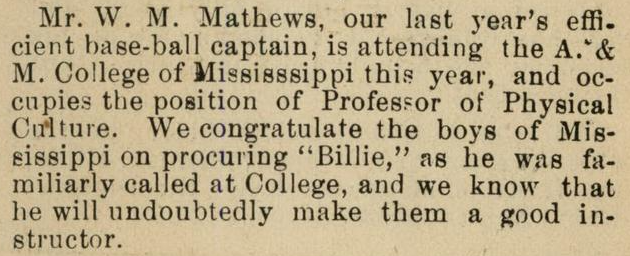 The Battalion, Texas A&M University, November 1894. Portal to Texas History.
In those days, an instructor of physical culture was a trainer or coach, a role well within Matthews’ qualifications. As a 17-year-old junior, Matthews would not have joined the Mississippi A&M faculty as a “professor.” The trustees’ records and General Lee’s letters make no mention of his hiring.
The self-promotion from student instructor to professor may be our first documented Matthews Lie, but he caught on quickly. The following June, he transformed Starkville into Oxford, telling friends in Austin that he was an assistant professor of physical culture at the University of Mississippi. By the close of 1895, he was telling people that he had played football at Princeton.
Matthews evidently sent his friend in College Station a clipping from the College Reflector, Mississippi A&M’s student newspaper. The article reported an interaction between Matthews and a “prep” – a youngster in the preparatory department – who had pulled morning guard duty.
Prep. (on guard) – “Mathews, what did they have for breakfast this morning?”
Mathews – “Why, thirteen kinds of meat.”
Prep. – “What!”
Mathews – “Yes hash. See?”
The conversation must have seemed very funny to the cadets in College Station and Starkville who, we should remember, were between 15 and 18 years old. The Battalion reprinted the exchange, along with a bit of doggerel that Matthews himself probably penned:
Why startle the preps
And lead them astray,
By placing on the table
Catsup the first day.
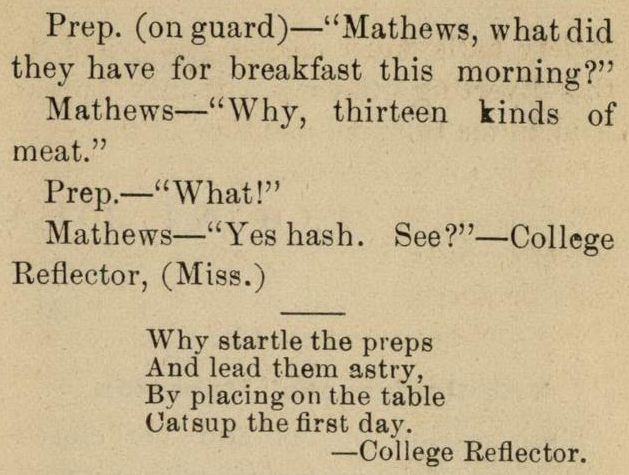 The Battalion, November 1894. University of North Texas, Portal to Texas History.
Perhaps as part of his job as a “professor of physical culture,” Matthews organized a Thanksgiving Day football game between the freshmen and the sophomores. The game took place after Thanksgiving dinner, on the parade ground in front of the main academic building. The parade ground was a cut below the crude athletic field at Texas A&M, and featured a decided slope with a railroad track at the base.
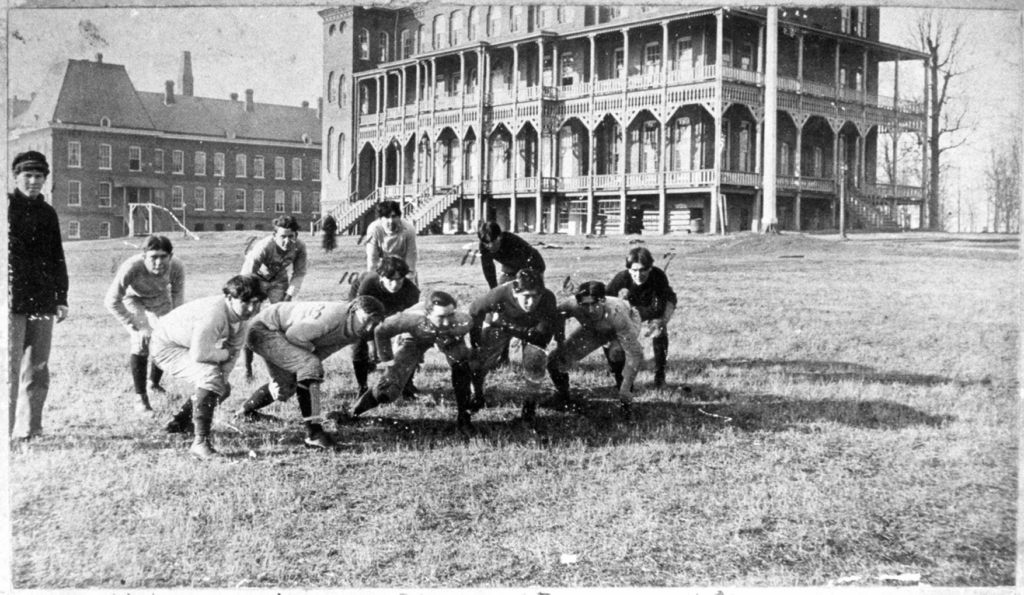 Mississippi A&M’s 1897 football team on the parade ground. University Archives Photograph Collection, Special Collections Department, Mississippi State University Libraries.
Matthews coached both teams, with the sophomores coming out on top 20-0.
Throughout his early life, Matthews consistently and enthusiastically gathered inexperienced players, some who had never seen a football game, and managed to put actual teams on the field. The results were not Hollywood-worthy – he never molded a group of novices into a championship squad – but the fact that Matthews at least got his charges into a formation and pulled off some simple plays speaks to his confidence and forceful personality.
In the spring of 1895, Matthews organized Mississippi A&M’s baseball team. He played left field and acted as the team’s captain. In those days, the “captain” of a baseball team was not a symbolic role. The captain chose the lineup, made all of the in-game decisions, and usually acted as the third base coach.
According to John Wendell Bailey’s M Book of Athletics, George Christie Creelman coached the Mississippi A&M baseball team in 1895. Creelman was a biology professor with an agricultural science degree from Canada’s Ontario Agricultural College. He was probably more of a faculty advisor than an actual baseball coach. Nothing in his background suggests any expertise in baseball.
A hilariously indignant, handwritten letter from Creelman to A&M President Stephen D. Lee, dated June 1, 1895, has been preserved in the school’s archives.
Tasked with improving the college grounds, Creelman complains that he lacks a team of mules to haul dirt, manure, and leaves. He asks to be relieved of his job of tending the campus greenhouse, which detracts from his classroom and laboratory work, and points out that “the Professor of Horticulture has so admirably arranged his class-room duties that he is free entirely from class duties eight months and a half out of the twelve.”
The previous fall, Creelman had written to the Board of Trustees and complained about the size of his four-room, university-assigned house. Creelman, his wife, and their child shared one bedroom, while his mother-in-law occupied the other bedroom and their “white nurse girl” slept in the hall on a cot. Creelman found the arrangement “somewhat crowded” and asked for two additional 10-by-16-foot rooms.
In the June letter to Lee, Creelman again asks for better housing, whining that he has no space for a library or study. He closes by applying for the job of college librarian and brags, “I believe myself to be as well versed in literature as most men of my age who have not made English a specialty.”
Nowhere in the five-page screed does Creelman mention the baseball team.
With or without Creelman’s help, Matthews and the Mississippi A&M team compiled a 1-0-1 record in 1895.
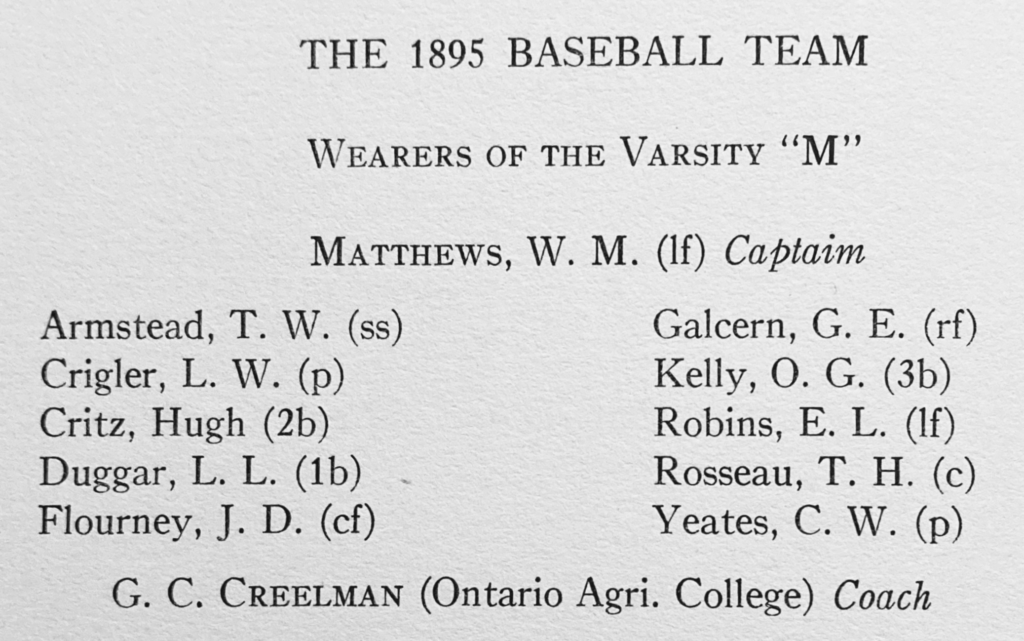 Mississippi A&M’s 1895 baseball team. John Wendell Bailey, The M Book of Athletics, 1930.
On Friday evening, April 19, Matthews and his team took on the University of Mississippi boys in Oxford. “The Starkville boys presented a finer appearance than the University boys, but the faces of the latter bore a hopeful expression,” the Oxford Eagle reported.
Some confusion around the game stains the historical record. John Wendell Bailey misreported the game as taking place May 11. The Oxford Eagle placed the game on April 18. The Eagle’s Linotype operator also missed a w and spelled the left fielder’s name in the box score as Mathes.
Fortunately, we have a first-hand, if slightly biased, report of the game: Mississippi A&M third baseman O.G. Kelly described the circumstances in a letter to the Yazoo Herald, published May 3.
According to Kelly, the game took place in Oxford on the afternoon of April 19, and was called due to darkness at the beginning of the eleventh inning with the score tied 5-5. “The game was close, interesting, and exciting throughout,” he wrote.
It was understood that the game would involve only undergraduates of the two schools, and that the Starkville boys would be reimbursed for their travel expenses. The Oxford team, however, brought in a couple of ringers, labeled “imported men” by Kelly. When the Starkville boys objected, they were told that they would not receive their expense money if they didn’t play.
Kelly closed with a gentle poke at his opponents: “Oxford, if you want to gain the championship, you had better import a few more men and give your own members some extra practice.”
A&M finished up the 1895 season by derailing the Yazoo and Mississippi Valley Railroad team, 13-8, in Starkville.
We may have a photograph of the 1895 baseball team. A photo in Mississippi State University: The First One Hundred Years (1978, text by Lin H. Wright, photos edited by Mrs. Hilda Scholte) is identified as the 1892 baseball team. But the Mississippi State University library’s Flickr page contains the same image, captioned 1895.
If the image is the 1895 team, then Matthews is probably the tall fellow on the far right. Professor Creelman stands in the center of the back row.
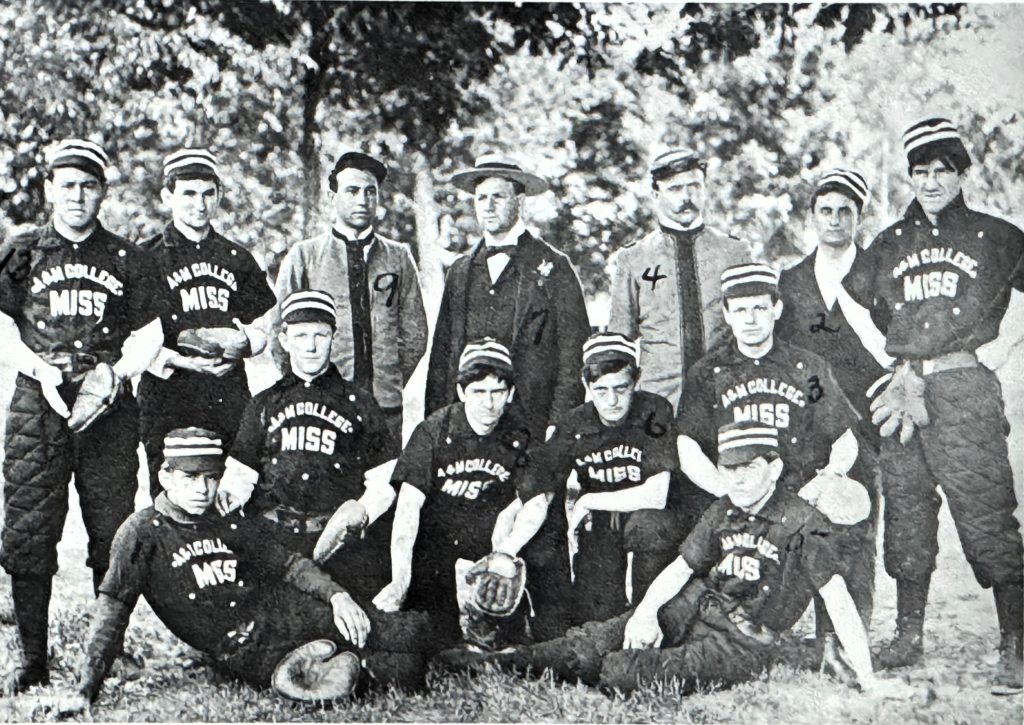 Either the 1892 or 1895 Mississippi A&M baseball team. The player at the far right may be W.M. Matthews. From Mississippi State University, The First One Hundred Years (1978).
Meanwhile, Blanche Dumont was finding the Houston business climate to be more challenging than what she had experienced in Austin, probably because she had not accumulated 25 years’ worth of dirt on the local politicians.
On the night of April 29, a week and three days after Mississippi A&M’s game against Oxford, police raided Happy Hollow and arrested 19 women. Madams Blanche Dumont, Daisy Douglas, and Lula Gray were charged with keeping a disorderly house; the other 16 “for being inmates thereof” the Houston Post noted. The results of the charges were not reported.
In June, Dumont ran afoul of the city’s occupation tax ordinance. The occupation tax was an annual fee charged to anyone who operated a business within Houston. Owners paid a flat rate tied to the nature of their occupation.
The ordinance provided an all-encompassing schedule of fees including: foot peddler ($2), peddler with one horse ($7), peddler with two horses ($15), insurance agent ($7), lightning rod dealer ($18), sleight of hand performer ($5), fortune teller ($87.50), and those who staged fights between dogs and bears ($250).
Blanche Dumont ran a small saloon behind her brothel. Visitors to the house of Daisy Douglass, around the corner at 415 Smith, would reach the saloon by slipping through a gap in the fence at the back of her yard. As a seller of “spiritous, vinous or malt liquors, or medicinal bitters, viz: In quantities less than a quart,” Dumont owed the city $150.
She didn’t pay, but neither did many others. The list of violators published in the Post on June 8, 1895, ran to almost an entire column of closely-spaced linotype.
As the spring term drew to a close, Matthews participated in Mississippi A&M’s commencement exercises. On the evening of June 17, 1895, Matthews and seven other representatives of the junior class delivered original addresses. Matthews spoke on “The Drift of Society and Morals in the United States.”
The summary of the evening published in the Memphis Commercial Appeal praised the addresses as “practical, scholarly, well prepared and ably delivered.” The article did not mention Matthews’ views on his subject, or whether he spoke from personal experience, but it’s safe to assume that he struck the required tone of moral indignation.
Given the subject of his oratory, it is appropriate to ask: What did Matthews think of his mother’s profession?
Matthews probably grew up thinking, as most of us do, that he lived a perfectly normal life. At some point, though, it must have dawned on him that his mother’s life was far from “normal.”
If Matthews failed to regard his mother’s profession as “wrong” or “immoral,” then he was not alone in that judgment. A large portion of Austin’s citizenry – the men, anyway – regarded prostitution and the brothels as just a slightly squeaky cog in the social ecosystem.
“The integral role of prostitution in the life of the town was recognized, and was perpetuated by an ideology of inevitability,” David C. Humphrey wrote in Prostitution and Public Policy in Austin, Texas, 1870-1915. “The city fathers considered prostitution a ‘common nuisance’ – in a class, say, with a foul-smelling tannery or a disorderly crowd in a saloon.”
Humphrey says that the quarrel of certain civic leaders “was not with Austin’s low life but with the intrusion of low life into the world of respectability.”
In the case of Matthews, his quarrel was not with his mother’s morals, but with the restriction Blanche Dumont’s field of endeavor placed on his respectability. As the son of a madam, he could never rise above a certain level of acceptance. Being a well-regarded bush league umpire was the apogee allowed Matthews by society.
While Matthews always maintained an outward appearance of propriety, he must have inwardly wished to emulate Aron Trask in the movie version of Steinbeck’s East of Eden, who, after learning that his mother was a madam in a Salinas brothel, smashed his head through a rail car window. In Matthews’ case, the window was the transparent but impenetrable social barrier that separated him from his desire to be a gentleman.
The lies he told were an attempt to recast himself, not as a more righteous person, but as a member of higher society. He was a professor. He graduated from Princeton. He was an All-America football player. He attended law school. He served as an officer in the war, with a commission signed by President McKinley. He rubbed shoulders with politicians and successful businessmen.
A few days after the commencement exercises, Houston hit Matthews’ mother with another tax. The city passed an ordinance requiring “each inmate of a bawdy house” to be inspected for venereal disease every week. The inspection and certification of results, whether positive or negative, cost one dollar per “inmate” every week, to be paid by “the proprietress.”
If Blanche Dumont boarded four women, then the inspections would cost her $208 each year, a substantial sum, though the cost could easily be passed on to the boarders.
An intrepid reporter for the Houston Post ventured into Happy Hollow and attempted to interview the madams regarding the new law. “They were loath to answer questions at first,” he wrote. “However, they each expressed an opinion, when told that the only object was to learn the light in which the matter was viewed from the standpoint of those most interested.”
The reporter interviewed Lula Gray (515 Louisiana), Lulu Rhodes (609 Louisiana), Jennie Blake (618 Prairie), Lillie Allen (616 Prairie), Mamie Gray (614 Prairie), Blanche Dumont (609 Prairie), Creasy Jones (608 Prairie), Sadie Coman (602 Prairie), and Daisy Douglass (415 Smith).
Blanche Dumont gave a brief, terse statement: “I think it is a good law and every girl in my house will submit to the provisions of the ordinance.”
Most of the other women were more voluble and, as quoted in the Post, came across as open and articulate. All claimed to support the law. To no great surprise, they desired a legalized system of licensed houses, possibly confined to a defined district.
Four of the madams condemned the “assignation houses,” which were their main competition in the realm of extramarital sex.
The proprietor of an assignation house would arrange a meeting between two people and provide a room for their activities. The women were sometimes respectable citizens – wives, mothers, daughters – who wished to engage in illicit affairs. The thought of virtuous women led astray in a den of iniquity horrified the Victorian populace, as expressed by an editorial in the Waco News:
If the legislature desires to protect female virtue – to guard the public morals and to diminish the number of divorces, let it enact a law making it a penitentiary offense to keep and carry on an assignation house. A dozen brazen faced and flaunting brothels are not so corrupting as a single assignation house, frequented by stealth, by women who pass current in a respectable society. The libertine and the seducer entice the victims of their devilish arts into an assignation house. THE NEWS touches on this subject with unfeigned reluctance, and is solely led to do so from an earnest conviction, that the preservation of female chastity and of the sacredness of the marital vows is of paramount importance to the well being of society and should be brought to the attention of the legislature.
Miss Lillie Allen told the Post’s reporter that the assignation houses were a greater source of corruption than the brothels. The brothels, she implied, did not corrupt women because they only employed women who had already been corrupted:
I am of the opinion that the assignation houses deserve the first attention. It is in those places that girls are led to ruin, which finally brings them to the houses of prostitution. No young girl is ever ruined in a public house. They are not admitted, in fact, when they have applied for admission the police officers have been immediately notified.
Daisy Douglass offered the progressive idea of using the certification fees to build a hospital for the “fallen women” who failed the exam. Only 21 years old, Douglass had been in Happy Hollow for two years and had previously boarded with Lillie Allen before opening her own house. She had, presumably, been “ruined” before arriving at Miss Allen’s brothel.
Following the commencement exercises in Starkville, Matthews rejoined his mother in Houston. The June 29 issue of the Houston Post listed W. Marace Matthews, University, Miss., among the guests at the Lawlor, a $ 2.50-a-night hotel about five blocks from Happy Hollow.
In his short life, Matthews’ middle initial had been F, J, N, and M. He seems to have finally settled on the middle name Maurice, which he used for several years until he switched to Belmont, then Harry.
After a brief stay in Houston, Matthews took a turn through Austin and informed a journalist of his status.
The previous November, The Battalion of Texas A&M had reported that Mississippi A&M hired Matthews as a Professor of Physical Culture. When he returned to Austin, he told a journalist that he had been working as an Assistant Professor of Physical Culture at the University of Mississippi in Oxford.
The change from Mississippi A&M in Starkville to the University of Mississippi in Oxford is another early instance of Matthews altering his resumé. But… why? Was employment at Oxford more prestigious? Or was he attempting to conceal his true location?
Throughout his life, Matthews used sportswriters as his publicists. When he entered a town, he would visit a newspaper office and tell a writer where he had been. Before leaving, he would tell the writer where he was going. The sports editor, eager to fill his pages, would print whatever Matthews laid on him.
Unfortunately (for the researcher), he rarely told the truth about either his origin or his destination. One learned that, if Matthews said he was going north, he would invariably turn up somewhere south a few days later. Matthews’ false claims often seem inexplicable, unexplainable, and unnecessary. Sometimes he seemed to lie out of habit, for no reason at all.
Matthews was back in Houston by mid-July. He entered a city that sweated in misery. A wave of illness was sweeping the town, caused by the municipal water company drawing its supply from the fetid Buffalo Bayou. Among the most miserable Houstonians were the Mud Cats of the Class B Texas-Southern League.
In 1895, the Mud Cats played on a tract owned by the International and Great Northern Railroad. It was located about a quarter-mile southeast of the IGNRR passenger depot, across four sets of tracks, on the south side of the Harrisburg Road. Known as “the old Lee grounds,” the lot had been used by local baseball teams, including the R.E. Lee Base Ball Club, for at least twenty years.
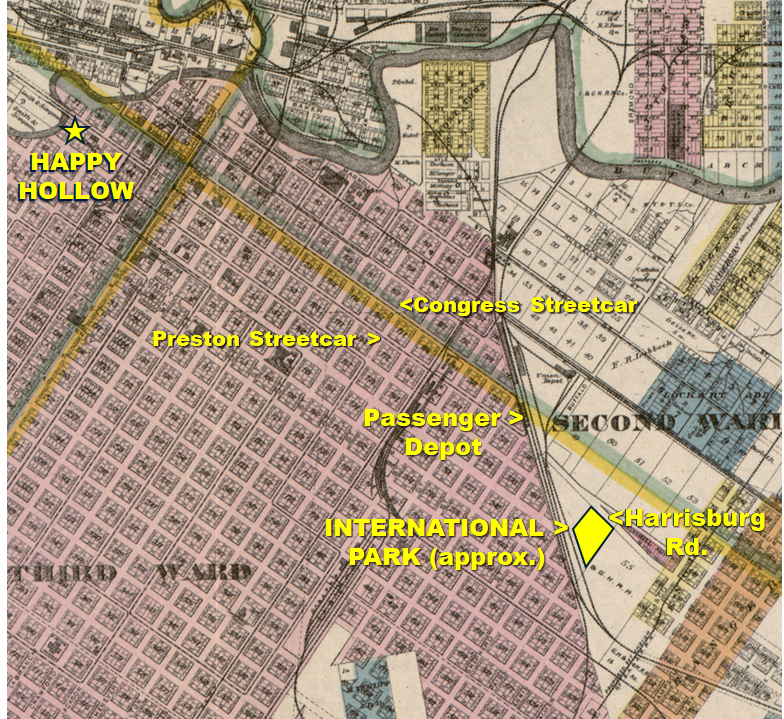 International Park location (approximate). Map by Whitty & Stott, 1895.
The railroad company added a fence, some bleachers, and a wooden grandstand and christened the venue International Park. The bleachers collapsed during the first game. Fortunately, no one was seriously injured.
The Preston-Congress streetcar line turned around at the passenger depot, giving fans a three-block hike to the ballpark. A writer for the Galveston Daily News warned, “The park is a little too far from the street cars, an objection that will be felt before the season is over.”
As any modern-day resident can attest, walking three blocks in the heat and humidity of a Houston summer is an experience not lightly undertaken. Few would willingly walk that length on an unpaved path that crossed four railroad tracks.
Attendance dwindled as temperatures rose and the team wallowed in the league’s cellar. On July 14, the Mud Cats were floundering in last place with a 1-15 record. After a bad loss to the Shreveport Grays, the Daily News writer said, “This afternoon Houstonians did not attend very largely the game of baseball at the International Park, but it was fully as large as the playing of Houston deserved. This aggregation of talent is giving a very poor article of ball playing.”
Life for the Mud Cats grew even worse the next day as a bug – probably something of the intestinal variety caused by drinking the Bayou water – ran through the lineup. Players started dropping, and manager Jack Garson scrambled to find replacements. The Mud Cats borrowed players from opposing teams and brought in local amateurs.
In a home game against the Dallas Steers on July 18, W. Mathews, described by the Houston Post as “an amateur of the city,” took the field for the Mud Cats, playing shortstop and batting cleanup. The W. differentiated him from Pop Mathews, Houston’s regular catcher, who had been waylaid by the bug. Another newcomer named Keefe stood beside Matthews at third base.
The Mud Cats went down 6-16 with Matthews committing three errors, topped by Keefe with five. The writer for the Daily News said, “It was a very poor exhibition so far as Houston’s part figured. Houston had two new men, supposed to be players, but they proved too far short of the average.” Both Matthews and Keefe vanished from the lineup the next day.
Matthews’ humid day in the sun, possibly his first as a true professional player, yielded one hit and one run in four at-bats, with two assists in addition to the three errors.
He spent the remainder of the summer playing shortstop for the Houston Americans, the city’s best semi-pro team. The Americans lost an early game to a team in Brenham, then reeled off nine straight wins before losing to the Galveston Moerleins 9-11 on July 28.
On August 5, the Americans took on the minor league Mud Cats in International Park, the site of Matthews’ poor professional debut.
The Mud Cats sported a pathetic 5-30 record, a winning percentage of .143. Unreasonably confident of victory, the Mud Cats’ manager promised to pay $1 to any American who crossed the plate. He shelled out $8, as the Americans pounded the hapless Mud Cats 8-1. Matthews tallied four assists against a single error, landed two base hits, and filched two simoleons from the Mud Cat manager.
After the game, the Mud Cats, unable to beat even an amateur team, dropped out of the Texas-Southern League and disbanded.
The Americans probably played their last game on September 3, in Cameron, a town nearly smack in the middle of the triangle defined by Austin, College Station, and Waco. The locals pounded the Americans, 18-8, to win bragging rights as the best amateur team in southern Texas.
Matthews returned to Mississippi A&M in mid-September 1895, presumably as a senior.
That fall, Matthews organized Mississippi A&M’s first official football team. He captained the squad and installed himself at quarterback, the same position he played at College Station. No one coached the team; they apparently didn’t even warrant a faculty advisor. Modern sources have bestowed the coach’s crown onto W.M. Matthews.
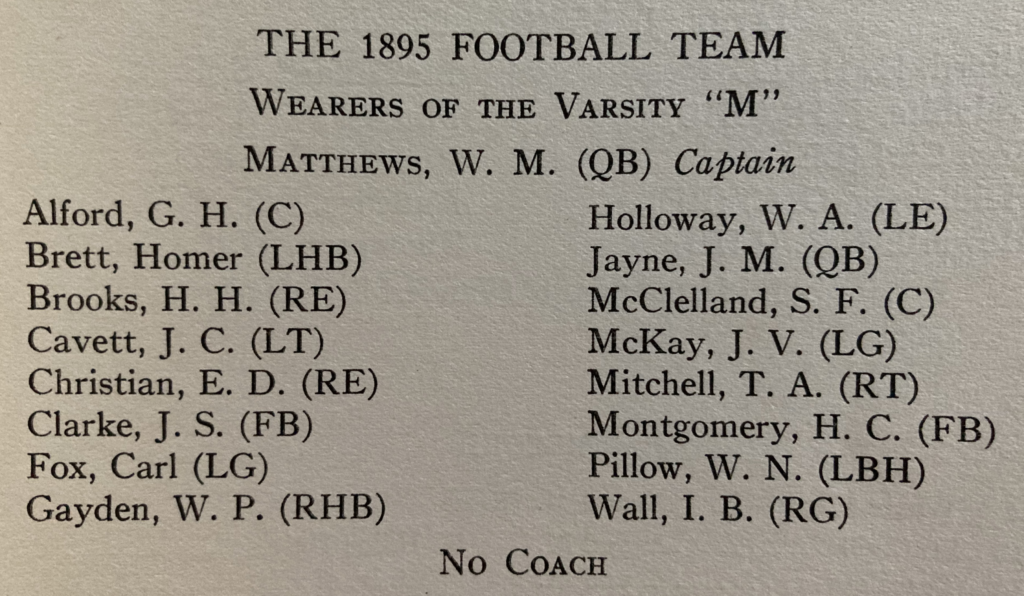 Mississippi A&M’s 1895 football team. John Wendell Bailey, The M Book of Athletics, 1930.
The team somehow managed to wrangle a game against Southwestern Baptist University (now Union University) in Jackson, Tennessee. The match took place in Jackson on Friday afternoon, November 15, 1895. The next day, the morning edition of the Nashville American reported that the Baptists dunked the visitors, 20-0:
Jackson, Nov. 15. – (Special.) – A splendid game of foot ball was played at the Fair Grounds here this afternoon between the Southwestern Baptist University team and the Agricultural and Mechanical College eleven, of Starkville, Miss. The home boys won by the score of 20 to 0. Jackson made four touch-downs.
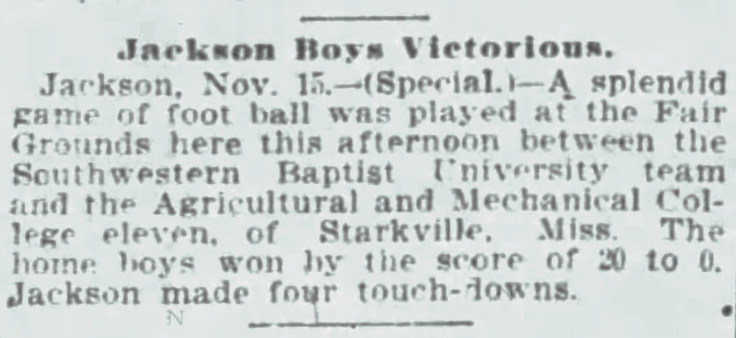 Report of Mississippi A&M’s first football game. Nashville American, morning edition, November 16, 1895.
John Wendell Bailey, in The M Book of Athletics, misreported the game’s date as November 16, altered the opponent to “Southern Baptist,” and ran up the score to 21-0.
In They Bled Maroon, author David Smale declined to place a date on the contest, but repeated Bailey’s 21-0 score.
The Nashville American’s report of the game appeared in its morning edition of November 16. A game played on the afternoon of November 16 could not have been reported in the morning edition of that date. The article was datelined Jackson – Nov. 15., indicating the story was filed from Jackson on November 15.
The article reported a score of “20 to 0” and said, “Jackson made four touch-downs.” In 1895, a touchdown counted four points, an extra point kick added two, and a drop kick through the uprights scored five. The 20-0 score can easily be obtained by the four reported touchdowns, plus two successful extra point kicks. The 21-0 score requires a more convoluted combination of events: the four reported touchdowns, four unsuccessful extra point kicks, and an unreported drop kick.
Fascinating details aside, both Bailey and Smale agree on the game’s most important and most long-lasting feature: the choice of Mississippi A&M’s maroon and white colors by W.M. Matthews.
John Wendell Bailey documented Matthews’ contribution on the first page of The M Book of Athletics:
The team was packing up preparatory to leaving for Jackson, Tennessee, where they were to meet the Southern Baptist University (now Union University) at football the following day. The student body had heard that every college had its colors hence they requested the football team to select a suitable combination. The football team considered such a privilege an honor, which they bestowed upon their captain, W.M. Matthews. Without hesitation Matthews chose the Maroon and White. The first A. and M. football team, therefore, was truly a Maroon and White team.
David Smale offered a similar version of events:
The night before the first game against Southwestern Baptist University (now Union University) in Jackson, Tennessee, the students held a pep rally. One of the orders of the day was to pick school colors. One of the players looked to Matthews, who responded, “Then our banners will be Maroon and White.” His words still ring true as any venture onto campus on game day will attest.
It’s easy to imagine Matthews, the erstwhile tragedian with the stentorian voice, standing on an apple crate and delivering the memorable line, “Then our banners will be Maroon and White!” accompanied by a dramatic flourish. But, why did Matthews choose maroon and white?
A photo of Billie Matthews and the Texas A&M football team, taken on December 16, 1893, shows the players decked out in white jerseys and pants, and dark red stockings. A few clutch red-and-white striped caps. After nearly two years of wear and washing, the socks would have faded to a grayish-red that could pass as maroon.
Matthews probably planned to wear his old uniform, complete with faded stockings, in the Jackson game. Selecting maroon-and-white gave Matthews the cachet of taking the field clad in the “official” college colors.
Matthews’ old stockings never saw intercollegiate action at Texas A&M. The socks almost took the field against the University of Texas second-stringers, but the cadets backed out of the game at the last second, after the Austin boys had traveled all the way to College Station. Now the old duds gained historical significance.
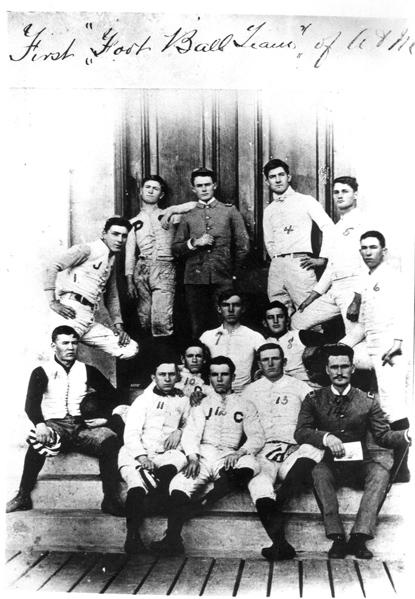 W.M. Matthews (4) with the Texas A&M football team, December 16, 1893. Texas A&M, Cushing Memorial Library.
David Smale reports that Matthews’ plans for a game against Ole Miss fell through: “He claimed Ole Miss backed out after agreeing to play.” Instead, Matthews lined up a game in Memphis against the Memphis Athletic Club. Smale tells us that a strange rumor circulated through Memphis before the game:
A precursor to today’s game, there was a hint of a recruiting scandal for the Memphis game as the Memphis Evening Scimitar claimed the “Mississippi team” was coached by a Princeton man “who might even play with them.”
The “Princeton man” in question could only have been Matthews, who no doubt spread the rumor. He may even have laid it on his own players, bragging that he had previously attended Princeton instead of lowly Texas A&M.
It is the first known use of Matthews’ Princeton fabulism, the tale that he had starred for the Princeton University football team. In future years, the Princeton Man legend loomed large in the Wilson Matthews Story. His alleged role in the school’s athletics became a bizarre fantasy that newspapermen across the South accepted seemingly without question. He repeated it so often that Matthews himself may have come to believe it.
It’s easy to understand why Matthews chose Princeton as his fictitious source of football experience. Ivy League schools dominated American football in those days. When most southern programs were crawling from football’s primordial ooze, Princeton was an already-established powerhouse.
In 1895, Princeton posted a 10-1-1 record. They outscored their opponents 224-28 and held the other team scoreless nine times. Playing for the Princeton Tigers placed one in the upper echelon of college football’s hierarchy.
Matthews’ charges failed to benefit from his chimerical Ivy League acumen: they lost to the Memphians 0-16 on December 7, ending their season with a 0-2 record that modern sources credit to W.M. Matthews as head coach.
Giving Matthews either credit or blame for the loss in Memphis is a stretch. While the Maroon and White were suffering their 0-16 trouncing, Matthews was back in Austin. On December 8, the following blurb appeared in the Galveston Daily News in a section labeled AUSTIN CULLINGS:
Austin, Tex., Dec. 7. – Mr. Wm. Mathews, captain of the football and baseball teams of the University of Mississippi, is here on a pleasure trip.
A photo in Mississippi State University, The First One Hundred Years lends credence to Matthews’ absence. The photo purportedly depicts the 1895 team. The players appear dirty, tired, and unhappy, as if they have just played in a losing effort. The caption notes that W.M. Matthews is “not pictured.”
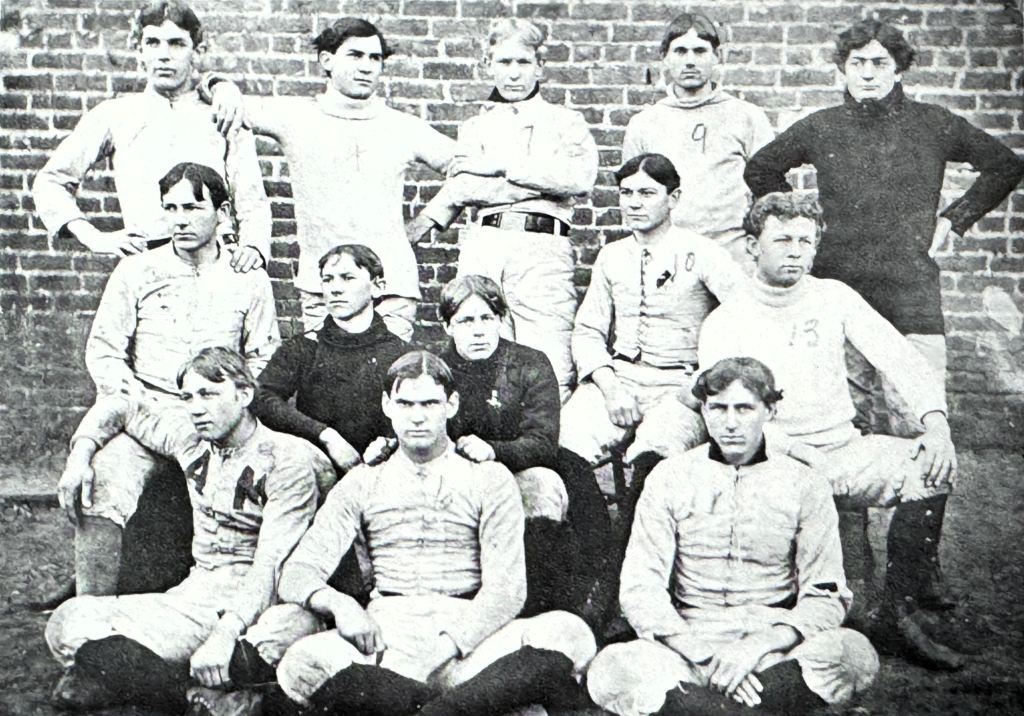 Mississippi A&M football team, 1895. Matthews is absent. From Mississippi State University, The First One Hundred Years, 1978.
Matthews left not only the Mississippi A&M football team; he left the university and the entire state. When the winter term opened in January, Matthews was a student at the University of Alabama in Tuscaloosa.
Why did he leave Starkville? Did he fail academically? Did he have gambling, legal, or woman problems? Perhaps all of the above. Perhaps someone discovered his provenance. Perhaps he felt that the captain of the baseball and football teams deserved more acclaim than he received.
His experience at Starkville must have been unsatisfactory. Mississippi A&M never appeared on a future Matthews resumé. For a few years he maintained that he had coached at the University of Mississippi, then he deleted that school from his resumé, too.
In Austin, Mayor John McDonald declined to run for a third term. On December 7, 1895, the day Mississippi A&M took on the Memphis Athletic Club and the day Matthews visited Austin, Lewis Hancock became Austin’s new mayor.
With McDonald’s campaign against the disorderly houses over, Blanche Dumont and her son returned to Austin. Matthews’ presence in Austin on December 7 was not “a pleasure trip.” It was repatriation. When Matthews entered the University of Alabama the following month, he listed Austin as his home.
W.M. Matthews – Billie to his friends – deserves credit as a pioneer of Mississippi State football. But does W.M Matthews deserve the title of First Mississippi State Football Coach, an honor conferred by the school itself?
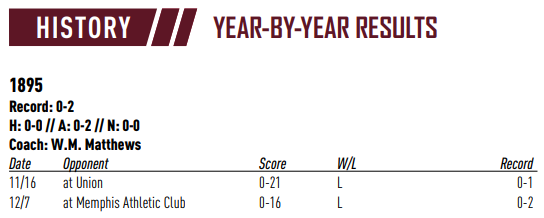 1895 entry in 2025 Mississippi State Football Record Book.
Matthews entered Mississippi A&M in September 1894 when he was 17 years old. Less than three months later, he organized a Thanksgiving Day game between the freshmen and sophomore classes, and coached both teams. The match may have been one of the first football games played on the campus.
In 1895, Matthews captained and quarterbacked Mississippi A&M in its first recorded intercollegiate game, but left the school before its second and final game. We will concede to Matthews the title of First Head Coach. If a name must be entered into the spreadsheet cell, it might as well be W.M. Matthews, though his record should be 0-1.
Matthews’ lasting legacy is the Maroon and White. The colors of Mississippi State were selected by a madam’s son who possessed a pair of well-laundered red stockings, and who abandoned the school after a single game. None of this should detract from the emotional significance attached to the colors by students and alumni for the next 130-plus years.

Charles Norman is a writer and historian. Email: reverb.raccoon@gmail.com. Or follow on Instagram and Facebook.
Latest Posts
Here Lies Wilson Matthews – 1 Who Was W.M. Matthews?
But he wanted to get in. He wanted to be urbane and careless. He wanted to wear well-cut clothes. He wanted to be a gentleman.-- Thomas Wolfe, Look Homeward, Angel Part 1Who Was W.M. Matthews? Mississippi State University – then Mississippi A&M College – entered...
Here Lies Wilson Matthews – 2 Who Was Blanche Dumont?
Here’s what I want. I notice you changed your name. I want you to keep your new name. I guess you made up someplace you came from – well, that’s where you came from… You figure you died and now you’re somebody else and we’ll get along fine. -- John Steinbeck, East of...
Here Lies Wilson Matthews – 3 Guy Town
He was surrounded by a world that was both beautiful and terrifying, a land of secrets and shadows, where the line between civilization and savagery was thin and easily crossed--Joseph Conrad, Lord Jim Part 3Guy Town Miss Blanche Dumont became a sex worker in Austin,...
Here Lies Wilson Matthews – 4 Spaced Flashes
In probing my childhood (which is the next best to probing one’s eternity) I see the awakening of consciousness as a series of spaced flashes, with the intervals between them gradually diminishing until bright blocks of perception are formed, affording memory a...
Contact Reverb Raccoon
 |
 |
 |
 |
Archives