Here Lies Wilson Matthews – 9 The Duke
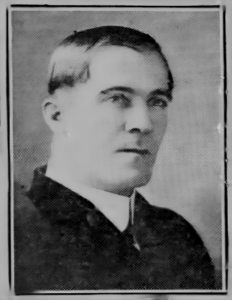
The traveller is looked upon as a bird of passage, whose visit is short, and which the vanity of the visited wishes to make agreeable. All is show, all false, and all made up.
— Benjamin Disraeli, The Young Duke
Part 9
The Duke
The man who became Wilson Matthews, one of the most well-known minor league umpires of the early 20th Century, was probably born in Austin, Texas, around 1877.
His mother was a madam in Austin’s notorious Guy Town district who called herself Blanche Dumont. She claimed to be English, but she was probably descended from the Germans who settled in the Texas Hill Country. Matthews may have been adopted.
In 1880, he was living with Blanche Dumont in an Austin brothel. A census-taker registered his name as W.F. Mathews.
Nine years later, the Austin Statesman listed his name as Wm. Mathews after he recited “Kearney at Seven Pines” and “The Beggar’s Petition” at a parochial school oratorical event.
He entered Texas A&M in 1892 as William J. Matthews. One year later, the school recorded his name as W.N. Mathews. His friends in College Station called him Billie.
At Texas A&M, Matthews captained the baseball team, and quarterbacked the football team the season before it entered intercollegiate competition.
In 1894, he enrolled in Mississippi A&M – now Mississippi State – as W.M. Matthews. He captained the baseball team, and quarterbacked and captained the football team in its first intercollegiate game. He is credited as being the school’s first head football coach.
Before the first game, he conjured his only lasting legacy by selecting maroon and white as the school’s colors. He may have selected those colors because he planned to wear his old Texas A&M uniform.
Having attended schools in Texas and Mississippi, Matthews migrated east again. Wilson Maurice Mathews appeared at the University of Alabama in January 1896.
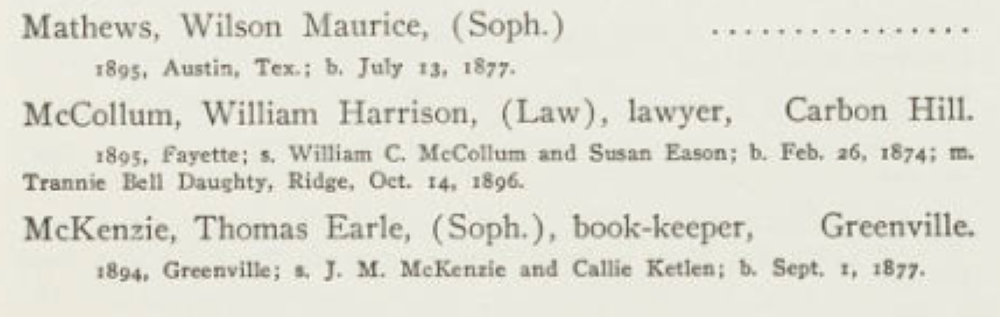 A Register of the Officers and Students of the University of Alabama, 1831-1901.
He had changed his first name from William to Wilson, presumably in homage to his father, known to us only as W. Wilson. He probably selected Maurice as a fitting name for the son of an alleged Englishwoman.
The registry displays the students’ parents. Some entries list only the father; most show both parents, including the mother’s maiden name. Matthews’ entry is one of the few that lists neither a father nor a mother.
He gave his birthday as July 13, 1877. His death certificate stated his birthday as July 13, 1878. At least one census recorded a birth year of 1875. He may not have known his birth year.
The registry indicates that he “matriculated” – enrolled in the University – in 1895. Matthews was attending Mississippi A&M as late as November 15, 1895, the date of the school’s first intercollegiate football game. He must have enrolled in the University of Alabama in December, probably around the time he appeared in Austin on the “pleasure trip” reported by the Galveston Daily News on December 8.
At Mississippi A&M, Matthews’ hometown was recorded as either Harrisburg, a community in the Houston area, or Harris, probably Harris County, whose county seat is Houston. Matthews’ presence in Houston corresponds to the year Blanche Dumont ran a brothel in Houston’s Happy Hollow, after the temporary closure of the Austin brothels in September 1894.
When Matthews entered the University of Alabama, his hometown was listed as Austin, suggesting that Blanche Dumont had ended her exile in Houston and returned to Guy Town.
Matthews may have been lured to Tuscaloosa by Eli Abbott, Alabama’s baseball and football coach. Unlike G.C. Creelman, the biology professor who supposedly coached Mississippi A&M’s baseball team, Abbott was a legitimate athlete with solid credits in both baseball and football.
According to John Wendell Bailey’s M Book of Athletics, Abbott attended Mississippi A&M and played first base for the baseball team in five seasons, 1885 through 1889, lettering each year.
He enrolled in the University of Alabama and played on the football team in 1892, their first season of intercollegiate competition. E.B. Beaumont coached the team, but when Abbott died in 1943, he was remembered as the school’s first football coach.
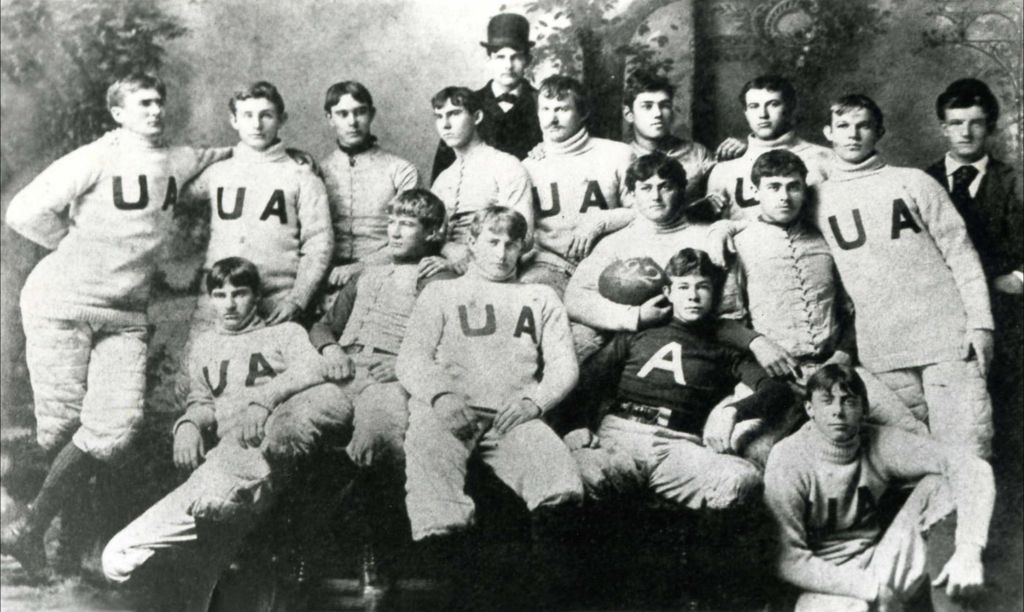 University of Alabama football team, 1892. E.B. Beaumont is in the back. Abbott is to the right of Beaumont.
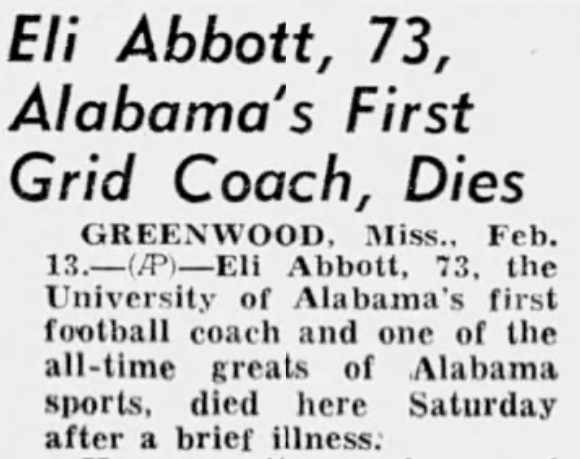 Atlanta Journal, February 14, 1943.
In the spring of 1893, Abbott entered the University of Pennsylvania as a sophomore engineering major. He played amateur baseball with a team of Penn players that summer, and tried out for the football team in the fall. He had some success as a tackle and end, but lost his position in mid-November.
Abbott returned to Alabama after being replaced on the Penn team. He joined the University football team as a left tackle and took over the coaching duties.
The following spring, Abbott returned to Pennsylvania, where he played baseball and participated in track and field events. After being declared ineligible to play football for “a failure to retain a good standing” in academics, he went back to Alabama and joined the football team for the 1894 season. He served as the head coach and took the field as a fullback.
Abbott was now in his eighth year of college athletics: five at Mississippi A&M, one at Alabama, and two split between Alabama and Penn. Two of Alabama’s four 1894 opponents, Sewanee and Auburn, accused Abbott of being a professional. Sewanee also accused Abbott of “knocking out” two of their best players.
Alabama administrators pooh-pooh’d the allegations. They said Abbott was a “Tuscaloosa boy” and provided a “certificate” which allegedly proved he was a student. As for knocking out the Sewanee players, they maintained that Abbott weighed only 155 pounds and was hardly capable of disabling anyone.
Since Abbott seemed happy to hang around Tuscaloosa, the University hired him as an Instructor of Physical Culture in December 1894. It was a faculty-level position similar to the student job Matthews held at Mississippi A&M, which he advertised as “the position of Professor of Physical Culture.” Abbott coordinated all gym activities and coached the athletic teams, including baseball and football.
Abbott had been born in Mississippi, and he still had relatives around Starkville. In August 1895, Eli and his brother, Charlie, bicycled from Tuscaloosa to Starkville to visit the kinfolk. Charlie returned after a few days, but Eli remained for several weeks.
Abbott likely checked in at his old school and, just before returning to Tuscaloosa in mid-September, probably met W.M. Matthews, his fellow instructor of physical culture. It’s easy to imagine that the two coaches kept in touch, and that Abbott urged Matthews to join him in Tuscaloosa before the next baseball season.
Matthews had previously attended Texas A&M for two full academic years: September 1892 to June 1893, and September 1893 to June 1894. He entered Mississippi A&M as a junior and attended for one full academic year, from September 1894 to June 1895, plus a partial year from September 1895 to December 1895.
Having completed more than three full academic years, Matthews should have entered Alabama as a senior. The academic credits he had accumulated in Texas and Mississippi carried little weight in Tuscaloosa, and Matthews enrolled at the University of Alabama as a sophomore majoring in civil engineering.
Matthews arrived at Tuscaloosa too late to play on the varsity football team, but he joined his class team. Previously a quarterback at College Station and Starkville, he now lined up at right end for the sophomores.
He gave himself a massive promotion the following year, when he told newspapers in Lafayette and New Orleans that, in 1896, he had played end for Princeton, backing up Garrett Cochran, one of the best players in the country. Matthews continued to improve the tale. A couple of years later, he told a Waco reporter that his play at Princeton had earned him All-America honors.
Matthews also played on his class baseball team. He acted as the team captain and hunkered down at catcher, probably because no one else was willing to take on the chore.
Matthews possessed a fine orator’s voice which he used to good effect as an umpire. He was said to employ “stentorian tones,” even when ejecting players.
“His voice is distinct and all his decisions can easily be heard in the Grand Stand,” one reviewer noted.
Another said, “Matthews is one umpire who can speak the English language and pronounce the names of the batteries [the pitcher and catcher] so that they can be understood.”
Matthews immediately impressed the Alabama instructors with his declamatory abilities.
The speakers for the annual Sophomore Exhibition, to be held in April, were announced on February 21. Participants were chosen based on “their standing in Elocution.” Matthews made the list, though he had been enrolled for less than two months.
Varsity baseball tryouts began in late February under the supervision of team captain Gibson Reynolds. The Tuskaloosa Gazette listed Matthews among the “several applicants for each position.” He made the team as the left fielder, the same position he held down at Mississippi A&M.
The team picture in the Corolla gives us a clear image of Matthews, probably a few months shy of 19. Reclining at the left end of the front row, he looks like a big, no-nonsense guy, not one to be messed with. His appearance matches the description written by a Dallas sportswriter in 1902: “He has a big nose and a square jaw and looks like he can take care of himself in time of trouble.”
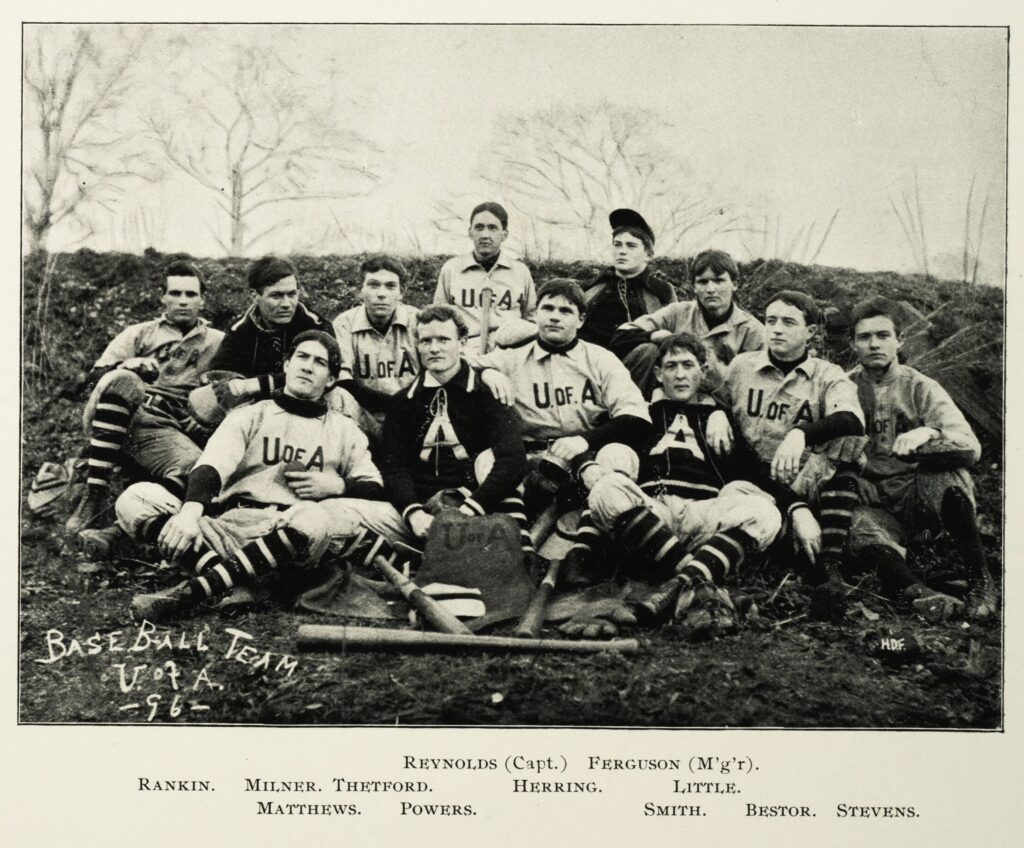 University of Alabama baseball team, 1896. Matthews reclines on the front row, far left. Corolla, 1896.
The 1896 baseball season opened in Birmingham on Friday, April 10, with a game against Howard College (now Samford University).
John Abbott, Eli’s brother, took the mound for Alabama. John had graduated in 1893 and was not even enrolled at UA. Matthews started in left field and batted ninth.
In the eighth inning, with Alabama leading 9-7, Matthews came in to pitch with disastrous results. In the words of the Birmingham State Herald reporter, “Here Matthews went in the box for the University and it was good night for them.”
Howard teed off on Matthews for five runs to take a 12-9 lead. The umpire then called the game due to darkness, to the University boys’ great displeasure.
Matthews continued to appear as a pitcher throughout 1896 and beyond with results ranging from mediocre to terrible. Yet, undeterred by reality, he usually identified himself as a pitcher in subsequent CVs.
Alabama and Howard met in a rematch the following day. Head coach Eli Abbott, now undeniably a professional, handled the catching duties for Alabama, while Brother John roamed right field. Matthews again started in left, and moved up the batting order from ninth to sixth.
The Howard boys committed several errors and were overmatched at the plate as the University team won, 8-1. The State-Herald’s writer praised the “brilliant manner” in which Matthews fielded a fly in the second inning.
The following week, Alabama traveled 40 miles south to Greensboro for a pair of games against now-defunct Southern University. “Much interest is evinced all over the state as to the result,” the State Herald noted.
The game made news twenty-four miles away in Uniontown, where the Canebrake Herald reported, “The game of ball between the teams of Greensboro and Tuscaloosa attracted a great deal of interest among the young men of our city, and the telegraph and telephone were used to keep them posted as to the progress.”
On Friday afternoon, ringer John Abbott took the mound for Alabama before a crowd of 400 fans. Matthews tended the left garden, and moved up to third in the batting order.
“Tuscaloosa had come down with a big boast of what they were going to do with our boys, whom they evidently thought knew nothing about base ball,” the local Alabama Beacon reported. “How sadly they were mistaken as the result of the game shows.”
With Southern leading 5-3 in the seventh inning and darkness overtaking the field, Eli Abbott threw in the sponge. According to the Beacon, “Tuscaloosa got too tired to run anymore.”
On Saturday morning, a special train shipped 150 Alabama supporters down from Tuscaloosa. They were joined by 450 locals, representing 20% of Greensboro’s entire population.
This time, Alabama prevailed, 4-2, yet the Beacon’s writer claimed victory anyway: “Tuscaloosa won the game, but they certainly must acknowledge our team as their superiors.”
The University of Alabama student body gathered in Clark Hall on Friday night, April 24, to witness the annual Sophomore Exhibition, an evening of declamation and music. The program included Wilson Maurice Matthews, Austin, Tex.
Matthews recited “Lasca,” a 108-line epic poem by Englishman Frank Desprez. It was an appropriate choice for a Texan who thought he was English. The poem describes a Texas cowboy’s love for a Mexican girl named Lasca. Multiple stanzas end with the line, “In Texas, down by the Rio Grande.” Alas, Lasca dies shielding her lover from the hooves of stampeding cattle. The poem inspired movies in 1913, 1919, and 1931.
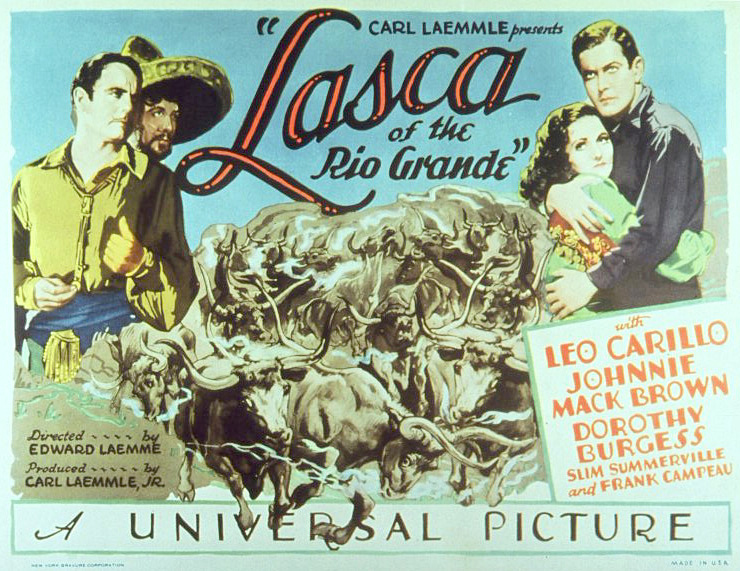 Poster for “Lasca of the Rio Grande,” 1931, starring Dorothy Burgess as Lasca.
Matthews co-opted the story’s setting as his own. In 1906, he told a reporter that “he and his family own about 1,500 acres of land, way down near the border, where the Rio Grande flows, each acre worth about 50 cents, and where splendid crops of mesquite and horned toads are raised.”
The story may have had a basis in fact. We have no idea of the provenance of Matthews’ father, known to us only as W. Wilson. He may have been a rancher “down near the border,” but it is more likely that the South Texas spread existed only in Matthews’ fertile imagination.
As Matthews recited “Lasca,” a remarkable young man named William Hill Ferguson sat in the audience taking notes on his paper program.
Ferguson was president of the Athletic Association, first vice president of the senior class, vice president of the YMCA, business manager of the Corolla, manager of the baseball team (he appears in the team picture with Matthews), captain of the gymnasium team, and manager of the track team. He later served on the university’s Board of Trustees. The University of Alabama student center, built in 1973, was named in his honor and was known to students as “The Ferg.”
Ferguson’s program from the Sophomore Exhibition, preserved in the university library, contains a few penciled comments, including fraternity affiliations. Ferguson marked James Waddell Little’s recitation of “The Roman Sentinel” as ΔKE Good. Mark Lyons, who presented “Bernardo Del Caprio,” belonged to ΦΔΘ.
George Gilmer Tait recited “The March to Appomattox” by Methodist minister James Walter Daniel. Ferguson’s judgment on Tait’s recitation has been preserved for posterity as Poor. When Tait died in 1948, his obituary maintained that he “had a gifted mind” and “possessed many excellent qualities.” No one remembered his inadequate rendering of “The March to Appomattox” a half-century before his death.
Ferguson did not comment on the quality of Matthews’ performance, but beside his name he scrawled The Duke.
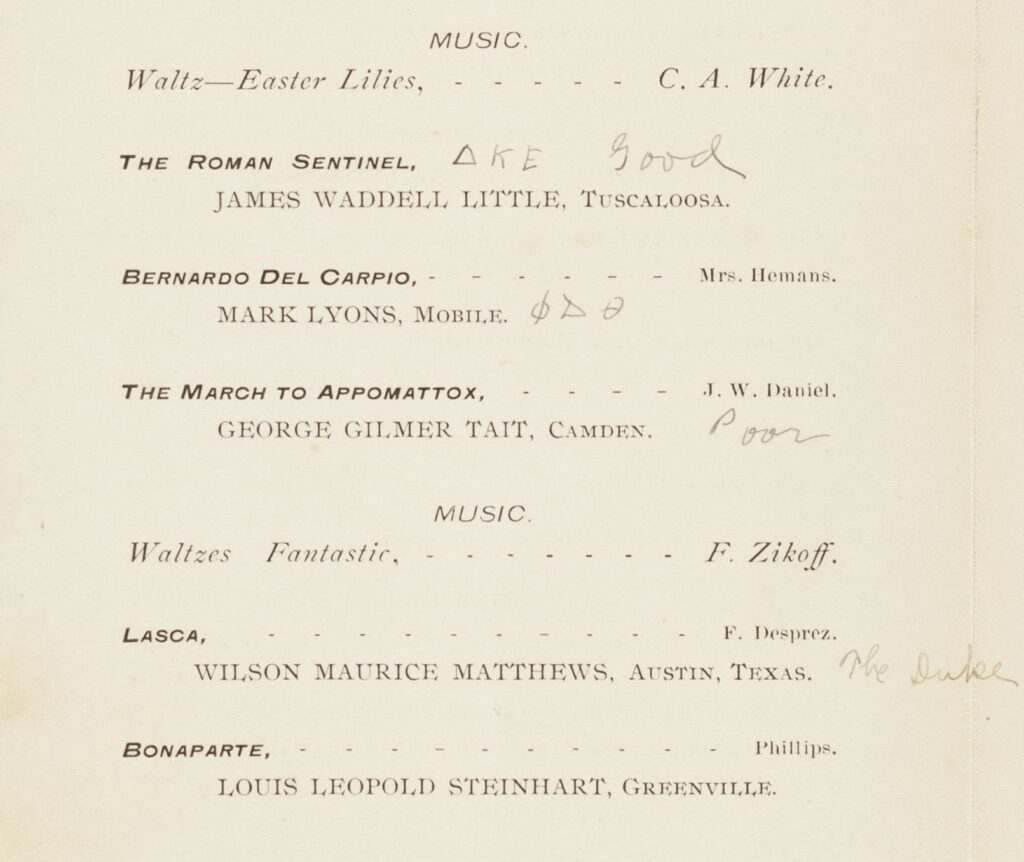 Program of William Hill Ferguson, University of Alabama Sophomore Exhibition, April 24, 1896.
Though at the university for less than five months, Matthews had already earned a nickname.
Matthews’ mother, Blanche Dumont, advertised herself as being English and Matthews had no reason to disbelieve the tale. In the 1900 census, Matthews said he was born in England, migrating to the New World when he was two years old.
Being a proper Englishman, Matthews adopted a nobleman’s manner, mimicking his mother’s “arrogant, haughty, and unreasonable” attitude. The cadets at College Station had teased that Matthews wanted to be the drum major.
Matthews must have maintained his regal posture in Tuscaloosa. A section of the 1896 Corolla, headlined Applied Titles of Books (example: “Much Ado About Nothing” – The law class election), includes “The Young Duke” – W.M. Matthews, a reference to the 1831 novel by Benjamin Disraeli.
The book may have inspired Matthews’ choice of Maurice as his middle name. The Duke’s scheming, dissolute relatives are named St. Maurice.
A royal comportment later became Matthews’ trademark as an umpire. In 1902, an observer wrote, “When Mr. Matthews walked out on the field he looked like a monarch of all he surveyed.”
Another writer, seeing Umpire Matthews in action for the first time but questioning his eyesight, asked, “Who is this self-important gentleman with the lordly air and bum lamps?”
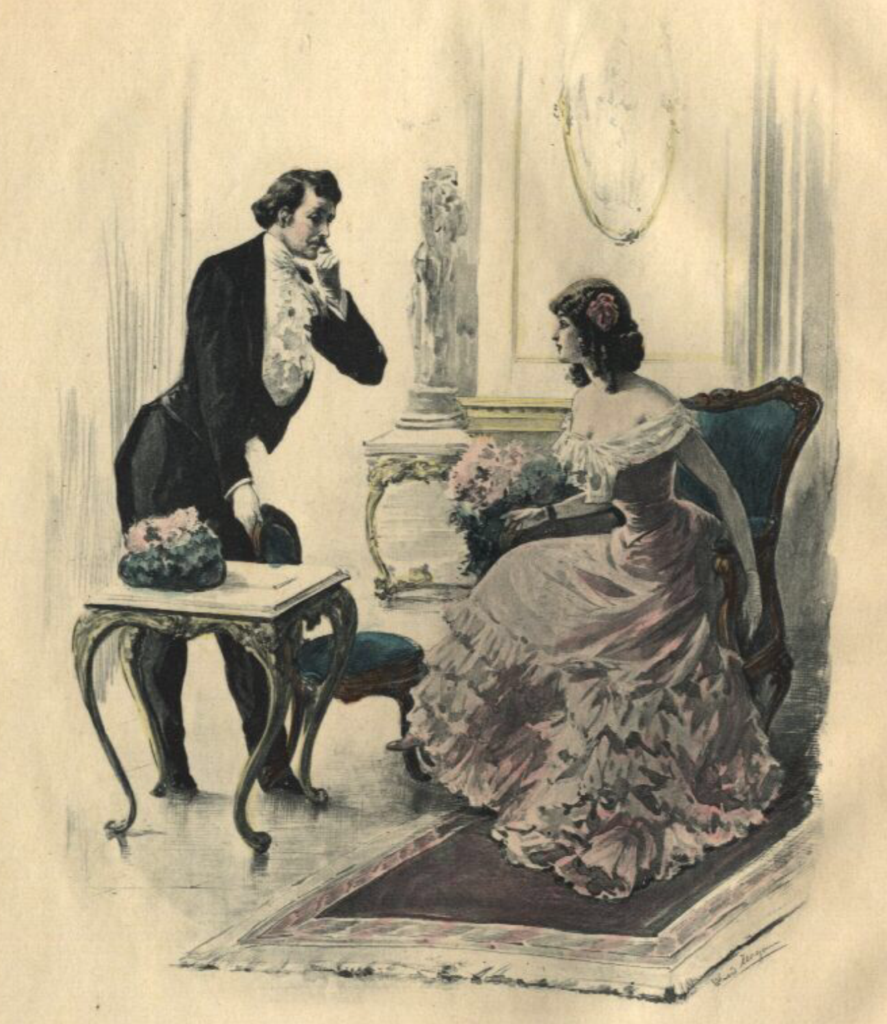 Illustration from The Young Duke “after an original drawing by Frederick Morgan.”
The day after the Sophomore Exhibition, Matthews and an informal team of University players and Tuscaloosa townies traveled 35 miles east to take on a team in Blocton. The locals were no slouches; they comprised the best amateur team in the state.
Matthews started the game on the bench, but took the mound in the sixth inning with the score tied at 9-9. He immediately yielded four runs and the Blocton boys went on to win, 14-10. The Birmingham News reported the results under the headline, Tuskaloosa Ball Players Found No Pie in the Blocton Club.
The University team met the boys from Mississippi A&M in Tuscaloosa on Friday, May 8. “It was a wee bit warm but a beautiful day and there was a goodly crowd in attendance,” the writer for the Tuskaloosa Gazette observed.
Matthews moved to third base. The A&M team included at least three players from the previous season who must have recognized their old captain. He had left his old team in good shape, as the Gazette’s writer said, “They seem to be first class players.”
The Alabama boys trounced their first-class competition 9-2 and received high marks from the Gazette: “The ‘Varsity is developing strength in several new quarters and the team is getting to be a corking good one.”
The University held its annual Field Day on Saturday. Matthews entered the “Throwing the base ball for distance” contest, the 440-yard dash, and the 120-yard hurdles, but failed to place in any of the events.
Another game against Mississippi A&M followed the field day competitions. Matthews moved over to shortstop, his position as a semi-pro player in Houston the previous summer. Alabama again snowed the Mississippians, 11-2.
In the sixth inning, A&M had the bases loaded and one out. The batter hit sharply to Matthews, who scooped up the ball and fired it home to force the lead runner. The catcher threw to first to nail the batter, and the inning ended. The Gazette’s man praised the double play as “a corker.”
(The Gazette’s typesetter, a practical joker who wished to create chaos among researchers 130 years in the future, set the dates shown on the banners of the May 7 and May 14 issues to April 7 and April 14.)
The following Friday, Alabama played a double-header in Auburn against Alabama A&M, known informally as Alabama Polytechnic. The University boys lost both, 9-13 and 6-14. Two weeks later they again played Blocton, this time winning 8-1.
The University held its commencement exercises on June 17. The program, rendered in an overflowing Clark Hall with temperatures approaching 90, must have seemed interminable to everyone in the audience.
The senior presentations included “Does the Increasing Greatness of Our Country Portend Its Downfall,” “Ought Alabama to Abolish the Death Penalty,” “The Sexes Intellectually Compared,” “The Drift of Society and Morals in the United States,” and an oration by Lucien Dunbibbib Gardner with the interesting title, “May the Coming Woman Never Come.”
William Hill Ferguson spoke on “The Majesty of the Law.” George Gilmer Tait, whose recitation at the Sophomore Exhibition had failed to meet Ferguson’s high standards, received recognition as a sophomore honor student in the Classical Course.
Alabama closed out its 1896 baseball season with two games against Sewanee.
Alabama took the first game, played in Tuscaloosa the day after commencement, 9-8. Matthews moved back to left field. Batting eighth, he doubled, reached twice on errors, stole a base, and tallied a run.
The second game took place the next morning at 10:30 a.m. Hugh Morrow, a legendary former Alabama pitcher, umpired the match. Sewanee won 5-4 in thirteen innings. “There was not much of a crowd,” the Gazette’s man wrote, “but they evinced a lot of enthusiasm.”
Matthews left Alabama after the Sewanee games. His stay in Tuscaloosa had lasted only six months. As with his previous departures from College Station and Starkville, we can only speculate about why he withdrew. Perhaps he had become an object of derision, The Duke who affected the mannerisms of a proper English gentleman.
Two journalists later provided very different recaps of Matthews’ days in Tuscaloosa.
In November 1901, Matthews visited the offices of the Montgomery Advertiser. With a reporter’s help, Matthews laid a whopper of epic proportions on the newspaper’s readers:
For the past few days there has been a man at one of the local hotels who in former years was a factor on several Alabama baseball teams. He is Wilson Matthews, who will be remembered by old-timers. Matthews was at Tuscaloosa and caught Hugh Morrow the year the latter pitched that phenomenal game against Auburn in Birmingham. He [Morrow] is now one of the prominent attorneys of Jefferson County, but it can safely be said that neither he nor his friends will ever forget that game.
The Advertiser’s man must not have been an “old-timer,” for he remembered nothing accurate about Matthews’ days in Tuscaloosa.
Matthews was not “a factor on several Alabama baseball teams.” He played only on the 1896 squad. In subsequent years, Matthews did not even mention his time in Alabama. Instead, he claimed that he attended Princeton in 1896.
He did not play on any teams with Hugh Morrow, one of the best college pitchers of his day. Morrow received his Bachelor of Arts degree from Alabama in 1893, and graduated with a law degree in June 1894, eighteen months before Matthews arrived in Tuscaloosa. Matthews came closest to being Morrow’s teammate when Morrow umpired Alabama’s final 1896 game against Sewanee.
The “phenomenal game” pitched by Morrow, and allegedly caught by Matthews, probably referred to a 16-inning game against Vanderbilt, played in Birmingham’s Lakeview Park on April 15, 1893, and described by the Birmingham News as “the most magnificent game of ball ever played at Lakeview Park.” Morrow pitched all 16 innings. The game ended tied 2-2 after “the mantle of darkness put an end to the stubborn contest.”
Morrow’s opponent in the “phenomenal game” could not have been Auburn. The Tigers did not field a baseball team until 1895, a year after Morrow left UA. But whatever game the writer held in the fuzzy orb of memory, the catcher was not Wilson Matthews. The writer had substituted Matthews for Burr Ferguson, Morrow’s catcher in ’92 and ’93.
It seems obvious that Matthews assisted the writer’s recall, feeding him “facts” and regaling him with fantastic tales of the Good Ol’ Days when he formed half of one of the greatest batteries in Alabama history. The effort represented an attempt by Matthews to retroactively place himself in the presence of wealthy, well-bred, and accomplished men.
Hugh Morrow, Matthews’ alleged batterymate, hailed from one of Birmingham’s most respected families. His grandfather was a Circuit Court Clerk for 25 years. His father joined the Confederate army as a first lieutenant and served as a probate judge for 19 years. After graduating from the University of Alabama, Morrow practiced law in Birmingham and was elected to the state senate in 1900. He was the type of man that Matthews imagined himself befriending.
Burr Ferguson, the catcher whose role Matthews usurped, was the older brother of William Hill Ferguson, the University of Alabama student who wrote The Duke beside Matthews’ name in the Sophomore Exhibition program.
Like Hugh Morrow, Ferguson was a high-born Alabama boy. He entered the University of Alabama in 1889, graduated in 1893, and received his medical degree from Columbia in 1896. Immediately after leaving Columbia, Ferguson joined Episcopal Bishop Henry Satterlee on a mission to Russia, where they appealed to the Czar to aid the Armenians who were being slaughtered by the Ottomans.
Matthews’ desire to associate with men such as Morrow, and to take Ferguson’s place in the tale of the Big Game, reveals a sad insecurity, the pathos of someone who will forever be the son of a brothel-keeper, but who went to great lengths to convince the world that he was a respected gentleman.
Five years later, in September 1906, a different reporter for the Advertiser provided a more realistic digest of Matthews’ days in Alabama.
The anonymous scribe obviously knew his subject, didn’t like him, and referred to The Duke, with unhidden sarcasm, as Wilson Maurice Matthews, Mr. Wilson Maurice Matthews, Wilson Maurice, and Mr. Matthews.
Writing a summary of Matthews’ career, the writer succinctly summed up his time in Tuscaloosa: “Old University men of more than a decade ago will remember him as a good infielder and a poor pitcher. He was one season with Alabama and the next season with the University of Georgia, pitching now and then and playing a good infield.”
He then dismissed the 1896 chapter of The Duke’s biography: “So much for the Alabama experience of Matthews.”
After leaving Tuscaloosa in June 1896, Matthews returned to Austin and won a roster spot with the Austin Senators of the Class C Texas League. The Senators had suffered a spate of injuries and needed some short-term help.
Matthews made his debut on July 23, 1896, in a 17-7 win over the Galveston Sand Crabs. The Austin Statesman enthusiastically reported on his performance:
Matthews, the new man, was in right field, and he did himself great credit. He covers a lot of territory and his straight and long throwing is superb. In practice, before the game, time and again he put the ball from deep right to the home plate on the fly. And, although nervous from being his first game, he handled the willow for two neat singles. In the ninth, when everything was safe for Austin, he was put in the box to pitch. Of course, he was wild, as he had no warming up or practice for the game, but he developed a great curve and struck out two of the five batsmen who faced him. He gave one base on balls and had but one hit, and that a single, made off him. He will prove a good addition to the team.
His pitching appearance had been a mixed bag. He faced five, struck out two, walked one, and gave up a single. The fate of the fifth man is unclear. The box score indicates that Matthews made two wild pitches in the inning, and the Sand Crabs scored a run.
Matthews moved to center field the next day as the Senators pounded the Houston Buffalos, 16-7. Batting ninth, Matthews had three singles and scored twice, but he failed to impress in the field.
In the second inning, he collided with the left fielder while chasing down a fly, allowing the ball to drop safely. Two frames later, on what should have been the third out, Matthews and the right fielder played you-take-it as the ball fell between them. One run scored on the play, and Houston tacked on three more before the inning ended.
On July 25, the Senators sent Matthews to the mound against Houston. With the team still short-handed, second baseman Joe Davis took over the catching duties. The “pony battery” – a poor pitcher paired with an infielder behind the plate – proved an unmitigated disaster with the Senators losing 0-12. The Statesman reported the results under the headline, IT WAS A REAL WATERLOO:
The runs were piled up because of twelve hits off our amateur pitcher, and because of the fact that his delivery was so slow and Davis’ getting the ball down to second and third so weak that bases galore were stolen with the greatest impunity. Toward the last of the game second base was not even covered to try to catch a runner, and he took the base in a walk. If ever a man got on first he immediately went around to third base and waited for a little hit or a passed ball to score, and he generally scored.
Twelve Buffalos reached base on hits, three on walks, and one on a hit-by-pitch. They parlayed the 16 runners into an improbable 21 stolen bases.
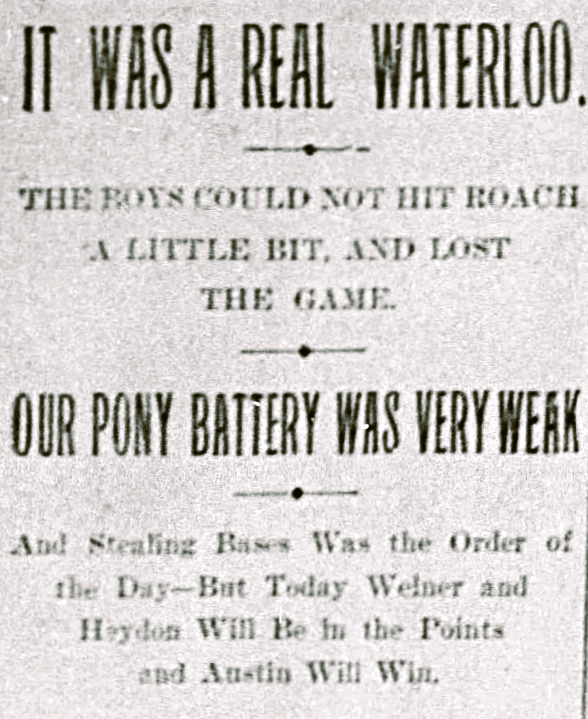 Austin Statesman, July 26, 1896.
Matthews joined the Senators for a road trip to Galveston where they played three games against the Sand Crabs. He manned center and left field, batted eighth, and hit poorly. He was released in Houston before a game against the Buffalos.
The statistics for his short 1896 stint in the Texas League do not appear in the Baseball Reference database.
Matthews remained in the Houston area, taking the field for any semi-pro team that needed help.
He played shortstop and batted cleanup for his old team, the Americans, as they humiliated the Auditoriums 20-2 on August 26.
Two days later, he joined the Auditoriums for a road trip to Beaumont. Taking the mound against a local team, Matthews gave up 10 runs on 15 hits, but the Auditoriums transformed 7 hits into 17 runs.
“The locals did fairly well until the fifth inning, when the team seemingly went to pieces, and as a result there were four wild throws, bases on balls, and a series of errors that gave the visitors six runs without their making a hit,” the Houston Post reported.
On the afternoon of September 3, Matthews participated in a bicycle race. He may have learned to ride while attending Alabama earlier in 1896.
Eli Abbott, the university’s Instructor of Physical Culture, learned to ride a bike in October 1891. Four weeks after first mounting the cycle, he rode from Tuscaloosa to Birmingham, covering the sixty miles of dirt roads in eight hours and forty minutes. “This included a stop at Bessemer for dinner, besides considerable time spent in the inspection of coal mines along the route and some other delays,” the Birmingham Post noted.
In August 1895, Abbott bicycled the 100 miles from Tuscaloosa to Starkville, where he may have met Matthews and convinced him to attend Alabama in 1896.
The course for the Houston race began at Anderson’s Store, located at the northeast corner of Harrisburg Road and Burr Street, then ran east down Harrisburg Road to the bridge over Bray’s Bayou, and back to Anderson’s. The distance was about 3.5 miles each way, seven miles total. First prize was a gold medal and a 12-month subscription to the Houston Post.
“For miles the road was lined with buggies and carriages and wheelmen. Almost every conceivable character of vehicle was seen, the occupants being ladies and gentlemen and children,” the Houston Post reported.
A judge handicapped the riders and specified a head start for each. The worst of the lot took a 3-minute, 30-second head start. Matthews started 2 minutes, 15 seconds before the “scratch men.” Of the 60 riders, Matthews was the 31st to leave the starting line.
Matthews finished sixth – a very credible showing – and won two years’ membership in the League of American Wheelmen.
On Friday, September 11, Matthews pitched for the Americans against a team called the UTDs. In one of his better outings, he yielded 5 runs on 4 hits, struck out 5, and walked 4 as the Americans won, 12-5.
Two days later he returned to Beaumont and pitched against the locals for the Warren-Hyatt team, surrendering 11 hits and losing 7-8. The Beaumont game represented Matthews’ last known appearance, diamond or otherwise, for 1896.
The 1896 season marked Matthews’ emergence as a pitcher or, more properly, a wannabe pitcher. Matthews 1896 pitching performances – covering college, the Texas League, and semi-pro – proved that he was barely adequate even as an amateur.
Taking the mound for Alabama against Howard, he gave up five runs in one inning. Against Blocton, he yielded four runs in an inning.
In his first appearance with the minor league Austin Senators, he faced five, struck out two, walked one, gave up a single, made two wild pitches, and allowed a run.
His next trip to the mound proved an unmitigated disaster. He allowed 12 hits, 12 runs, walked 3, and hit a batter. His slow delivery contributed to a fantastic 21 stolen bases. The fielders didn’t even bother covering the bags, and anyone who reached first walked to second, then third, at their leisure.
In semi-pro games, Matthews boasted an unimpressive 2-1 record.
Matthews possessed a strong arm, as evidenced by his postings at third base, short, and the outfield. On the mound, though, he lacked control and probably relied on a slow roundhouse curve that fooled no one.
Despite results that proved otherwise, Matthews attempted to portray himself as an accomplished pitcher. To compensate for reality, he padded his resumé with fictitious mound accomplishments.
According to a fanciful biography printed in the Birmingham Post in 1906, Matthews started his professional career in 1894, when he was 17. He pitched for an All-American college team in Atlantic City, pitched two years in the Eastern League, one of the country’s best minor leagues, and pitched one season in the Texas League.
A biography that appeared in the nationally read Sporting Life in 1907 was even more impressive. By this telling, Matthews pitched for Princeton from 1891 (when he was 14) through 1894. His Princeton experience included the factoid, “first game being victory from Cornell.” In subsequent seasons, he supposedly pitched for minor league clubs in Houston, Providence, Austin, Houston again, Austin again, and Patterson.
His fictional pitching credentials improved with every telling. A 1909 biography in the Macon Telegraph had him entering Princeton in 1890 (the bio pushed his birthday back to 1875 to make the tale more credible). He “tossed up his chances for a degree in the spring of 1893 to enter the professional base ball ranks as a pitcher with the Providence Eastern League club.” The following season, he moved up to the majors, joining the National League’s Boston Beaneaters for two seasons. In 1896 he was traded to the National League’s Louisville Colonels, where he remained a year before returning to the minors in 1897 “for lack of effectiveness.”
None of these biographies had the slightest semblance of reality, except that he had pitched two games for the Texas League’s Austin Senators in 1896. The rest had been spun up out of whole cloth. Even more impressive than his fictional credentials was his ability to induce sane sportswriters to print whatever he put in front of them.
Matthews was a perfectly adequate minor league position player, an effective on-field captain, and a successful manager who won two South Atlantic League pennants. It wasn’t enough. He needed to be known as a pitcher in the same manner that he needed to be known as a gentleman. The image of a gentleman pitcher, born in England, proudly taking the mound for Princeton and defeating Cornell in his first start, must have dazzled even Matthews himself.
After his semi-pro pitching appearance in Beaumont on September 13, Matthews managed the unusual – for Matthews – task of keeping his name out of the historical record for three months.
He next appeared at the University of Georgia, where he turned the neat trick of being both a junior named Wilson Maurice Matthews and a law student named Stilson Maurice Matthews.

Charles Norman is a writer and historian. Email: reverb.raccoon@gmail.com. Or follow on Instagram and Facebook.
Latest Posts
Here Lies Wilson Matthews – 1 Who Was W.M. Matthews?
But he wanted to get in. He wanted to be urbane and careless. He wanted to wear well-cut clothes. He wanted to be a gentleman.-- Thomas Wolfe, Look Homeward, Angel Part 1Who Was W.M. Matthews? Mississippi State University – then Mississippi A&M College – entered...
Here Lies Wilson Matthews – 2 Who Was Blanche Dumont?
Here’s what I want. I notice you changed your name. I want you to keep your new name. I guess you made up someplace you came from – well, that’s where you came from… You figure you died and now you’re somebody else and we’ll get along fine. -- John Steinbeck, East of...
Here Lies Wilson Matthews – 3 Guy Town
He was surrounded by a world that was both beautiful and terrifying, a land of secrets and shadows, where the line between civilization and savagery was thin and easily crossed--Joseph Conrad, Lord Jim Part 3Guy Town Miss Blanche Dumont became a sex worker in Austin,...
Here Lies Wilson Matthews – 4 Spaced Flashes
In probing my childhood (which is the next best to probing one’s eternity) I see the awakening of consciousness as a series of spaced flashes, with the intervals between them gradually diminishing until bright blocks of perception are formed, affording memory a...
Contact Reverb Raccoon
 |
 |
 |
 |
Archives