Here Lies Wilson Matthews – 10 The Ringer
It was the finest place with all its old provincialism, the bare austerity of its whitewashed dormitory rooms, its unfurnished spareness, its old brick and its campus well, its world remotion in the Piedmont uplands of an ancient state. It beat any other place “all hollow.” It beat Harvard, it beat Princeton, it beat Yale.
— Thomas Wolfe, The Web and the Rock
Part 10
The Ringer
The education of Wilson Matthews traced a series of eastward migrations. He attended Texas A&M from September 1892 to June 1894, Mississippi A&M from September 1894 to December 1895, and the University of Alabama from January 1896 to June 1896.
He continued his education with another trek towards the rising sun, surfacing at the University of Georgia in Athens in January 1897.
Matthews’ presence at Georgia was explained by a 1910 article in the Detroit Free Press: “It is whispered at times that he was a bit of a ringer, and that he was welcomed, in fact coaxed, to the college because of his baseball abilities.” The article did not elaborate on who did the coaxing or the nature of the incentives.
In Humorous Stories of the Ball Field (1903), Ted Sullivan explained what a baseball ringer represented:
About the last of the 70’s and early 80’s, there was a great practice amongst the smaller villages of the northwest to “ring in” on each other outside players from Chicago and other cities. There were two cities in upper Iowa that were bitter rivals in baseball, namely Decorah and Crescoe. The habit of one of those cities was to bring the players to their town, give them jobs temporarily, and then bet on their club against their rival city. Chicago was the market for this supply of “ringer-in players.”
Wilson Matthews could not have quibbled with the explanation. He had ghost-written the book for Sullivan after the 1902 season.
The Free Press article provided the extraordinary information that Matthews, a sophomore at the University of Alabama the previous year, was a law student at Georgia.
Matthews pulled off the neat trick of appearing in Athens as two different people. The 1897 edition of the Pandora, the University of Georgia yearbook, shows Stilson Maurice Matthews from Austin, Tex., in the Law Class. But 14 pages farther on, listed among the juniors, we find W.M. Matthews from Austin, Tex., seeking a Bachelor of Science degree.
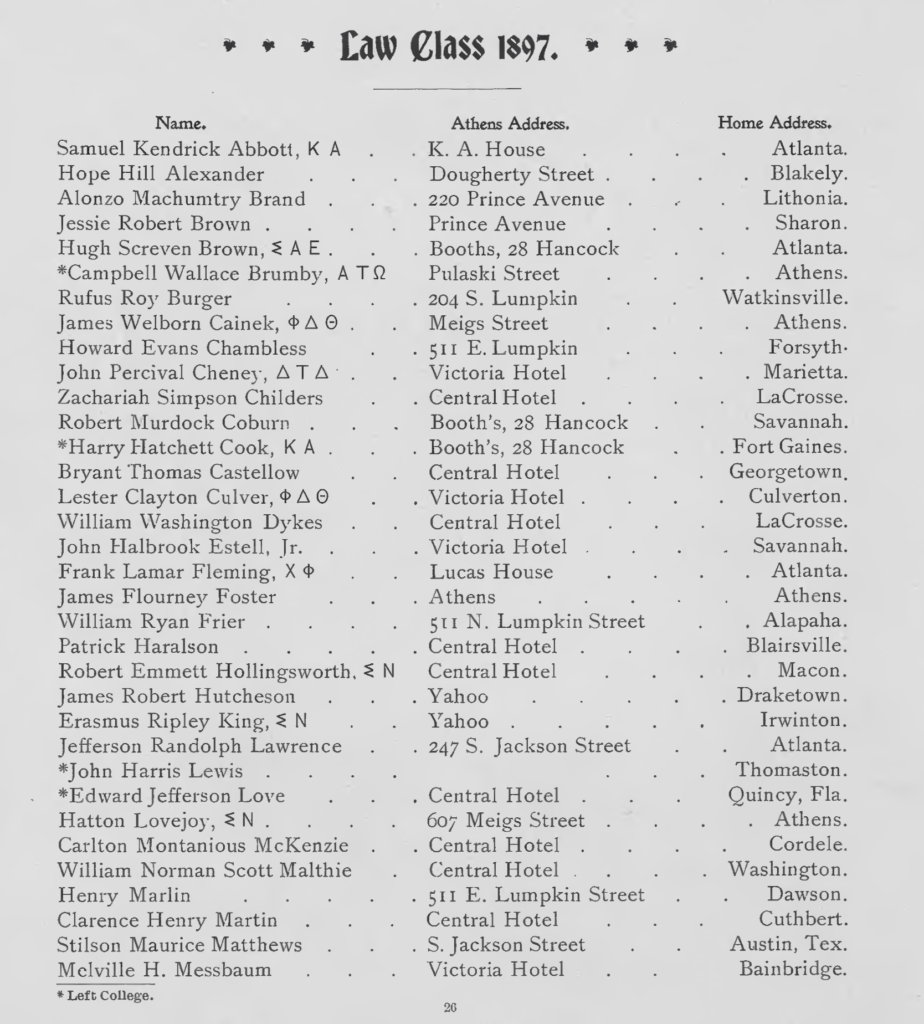 University of Georgia law class. Stilson Maurice Matthews is second from the bottom. Pandora, 1897.
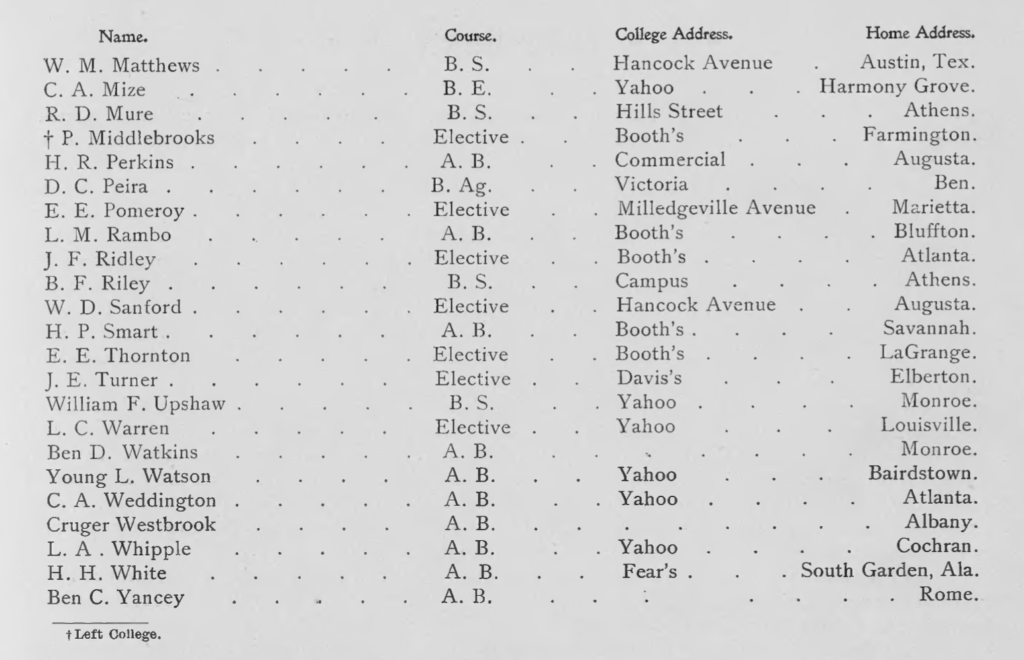 University of Georgia junior class (second page). W.M. Matthews is at the top of the page. Pandora, 1897.
The nudge-nudge wink-wink pseudonym must have been a source of hilarity among those in the know. The tricksters even took the time to create separate local addresses for the doppelgangers. The Pandora shows Stilson’s Athens address as S. Jackson Street, while W.M. lives on Hancock Avenue.
The University of Georgia athletics website lists S.W. Matthews as a baseball letterman for 1897, suggesting that Matthews played ball as Stilson. The catalog of University of Georgia students from 1785 to 1906 lists Matthews, Wilson M. from Austin, Tex., among the “matriculates” of 1897, but does not list a Stilson. He existed solely for baseball purposes.
The need for an alias was simple. The Southern Intercollegiate Athletic Association, the South’s dominant athletic conference, had cracked down on the use of professionals in college sports. Wilson Maurice Matthews, who had played professional ball for the Houston Mud Cats and the Austin Senators, and semi-pro ball with several teams, was ineligible to play college baseball. But Stilson Maurice Matthews, who had no prior record of even existing, was welcome to take the field.
Matthews wanted to have his cake and eat it too, extending Wilson Maurice Matthews’s educational record while also playing college baseball.
“There is no question that he was a faithful student, and took every advantage of his educational opportunities,” the Free Press reporter claimed in 1910. He failed to specify whether the “faithful student” was Stilson or Wilson. The latter, at any rate, enjoyed his time in Athens.
He joined the Thalians, a thespian group that still exists and is now the second-oldest collegiate drama club in the United States. The Thalians’ yearbook page listed him as Welson Maurice Matthews.
On Monday, February 22, 1897, the Thalians presented their annual performance at the Athens opera house, staged as a benefit to raise money for an improved athletic field.
Matthews appeared with a minstrel group, probably in blackface, singing “I’ll Make That Black Gal Mine” and playing the bones.
The bones help us link the Matthews who attended Georgia back to the Matthews who attended Texas A&M. The October 1, 1893 edition of A&M’s newspaper, The Battalion, lists Wm. Matthews playing the bones with the College String Band. How many bones-playing baseball players named W.M. Matthews or Wm. Matthews were wandering the South in the 1890s?
In a traditional minstrel show setup, the bones player was stationed at one end of the group. The opposite “end man” shook a tambourine. The two “funny men” would exchange wisecracks with an interlocutor, punctuating the punch lines with their respective instruments.
A couple of days before the show, the Red and Black, the University of Georgia newspaper, predicted that the funny men “will crack whole clusters of brand new, good jokes with the interlocutor.”
The Red and Black’s reviewer was pleased with the product. “Their rich and racy jokes afforded the audience much amusement,” he reported after the show. “Their songs were very catchy indeed, were well rendered and received much applause.”
The previous month, students at the Lucy Cobb Institute, a local preparatory school for women, had staged “King René’s Daughter” by Danish playwright Henrik Hertz. The Thalians parodied their effort, presenting “King Rainy’s Daughter” by “Henry Hurts.” Matthews played Bertrand, the palace gatekeeper.
More than half of Georgia’s 313 students belonged to fraternities. A natural-born GDI, Matthews joined the Non-Fraternity Club. He presents a dapper appearance in the group picture.
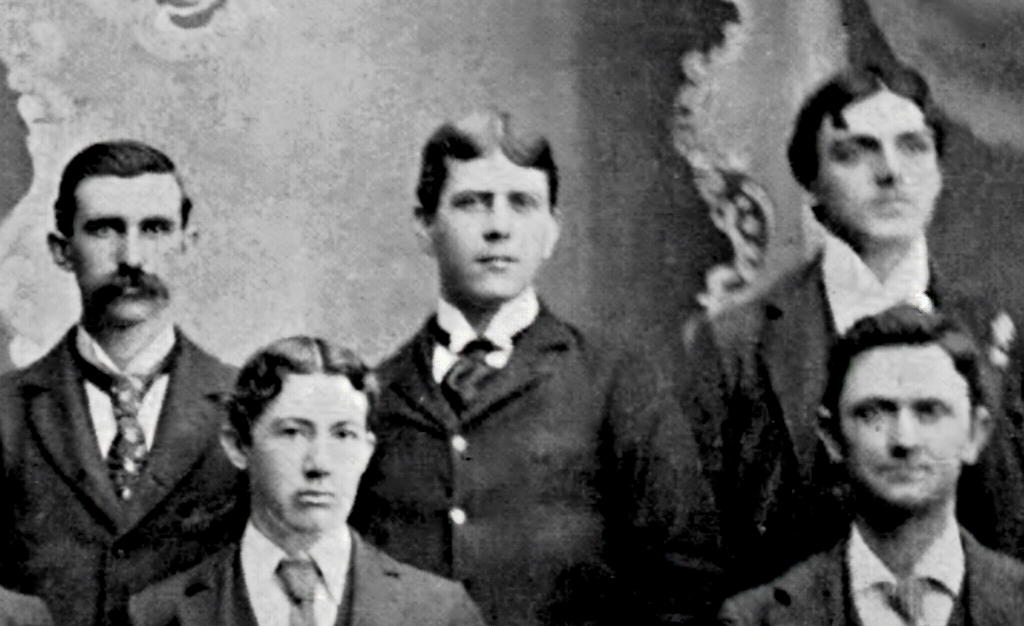 Matthews (center) in the Non-Fraternity Club. Pandora, 1897.
Matthews and ten other students founded the Old Dominion Club. The organization supposedly comprised “students who formerly attended schools in Virginia.”
Never missing a chance to enhance his primordial LinkedIn profile, Matthews claimed he was educated at Pantops Academy. One of the South’s most prestigious private schools, Pantops was built on land previously owned by Thomas Jefferson.
His name cropped up in a section of the Pandora dedicated to jokes and puns. Though he had changed his first name from William to Wilson, he was still Billy to his friends:
“I had my picture taken the other day,” said Billy Matthews.
“Oh, you didn’t really,” said one of the boys, just to see what was coming.
“Yes, I did,” said Billy, delightedly, “if you don’t believe it, I’ll show you the proof.”
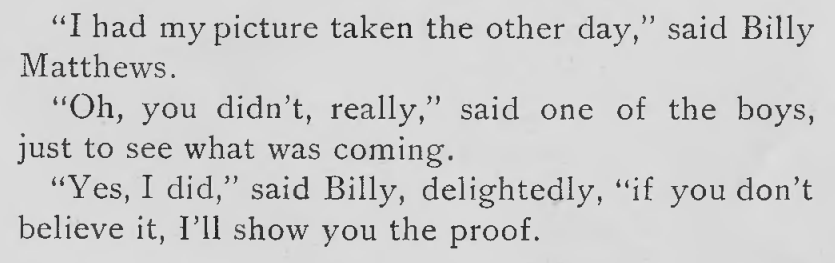 Pandora, 1897.
Matthews joined the junior class baseball team and accepted the catching duties, as he had for the sophomore team at Alabama the previous year.
“Matthews showed his adaptability in going behind the bat for the Juniors and did well considering the new position,” the Red and Black noted after the first game, taken by the Sophomores 12-7. He also pitched the last inning of the game, called after six innings as the sun was setting. He held the Sophs scoreless, but his effectiveness “could not be judged on account of the darkness.”
The five class teams, the four undergraduate groups plus the lawyers, played a round-robin schedule in the early spring. The Juniors compiled a 3-1 record, placing second to the Sophomores who won all four of their games.
Matthews made a good impression in the class games. In late February, the Red and Black included him among the players whose showing “has been so marked as to accord to them, in popular opinion, places on the [Varsity] team of ’97.”
Many colleges brought in professional players to coach the baseball team in preseason. Large schools employed major leaguers; smaller schools selected minor leaguers from nearby clubs.
The pro usually arrived on campus in March, often to great fanfare. He led the workouts, passed on some sage advice, and helped select the roster. He then departed for his own spring training, leaving the team in the hands of a student captain who made the on-field decisions and a manager who handled the off-field side.
Hughie Jennings, then a shortstop for the National League’s Baltimore Orioles (a franchise unrelated to the current American League club), coached the University of Georgia squad in the spring of 1897. He appeared in Athens on March 15.
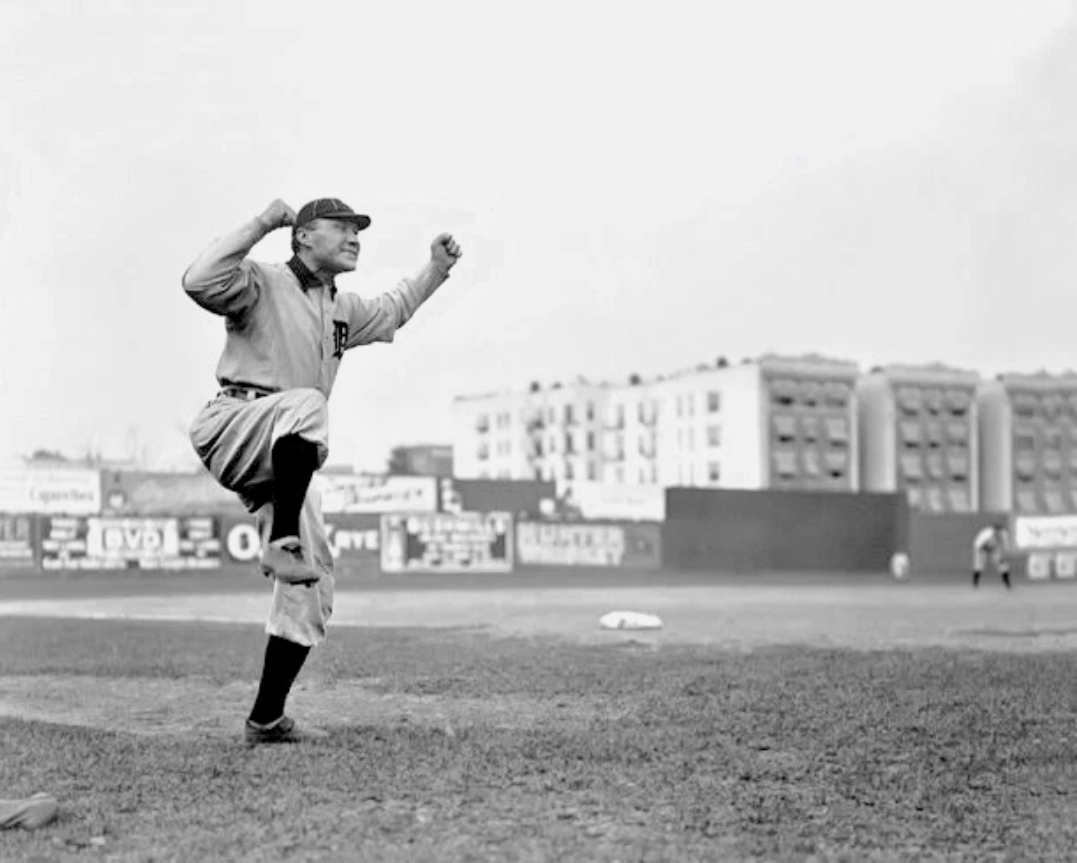 Hughie Jennings coaching third base for the Detroit Tigers in 1910.
Jennings put the players through their paces. “He has the boys out twice a day and runs them through a stiff practice after which they run a mile or so and are then rubbed down at the gymnasium,” the Atlanta Journal reported.
Years later, a letter to the Atlanta Georgian newspaper described Jennings’ method for curing batters of their tendency to step away from the plate, known as bailing out or stepping in the bucket:
He broke every Georgia player of the habit by throwing a pile of bats right at the batter’s box in practice. The result was that he who pulled back stepped into the bats and tumbled onto his head. Six days of this would cure any player of the habit, and so Jennings had a team of collegians who would hug the plate, choke the pitcher by forcing him to put ‘em over and sting the ball like professionals.
According to the Detroit Free Press article that labeled Matthews “a bit of a ringer,” Jennings took a shine to him, named him the starting third baseman, and gave him some authority: “Matthews was subcoach and third baseman that year and was regarded as the wily leader’s right bower all the time.”
As with almost everything printed about Matthews, the “subcoach” appellation was likely an exaggeration, if not an outright falsehood.
A March 1897 report in the Atlanta Constitution said R.B. “Cow” Nally, a former Georgia football and baseball star, was “helping Jennings to train the new men.” All other accounts make clear that team captain George Whitfield Price, the center fielder, ran the show when Jennings wasn’t around. No one mentioned Matthews doing any coaching.
Though not the team captain, Wilson Matthews’ Georgia teammates nicknamed him “Captain Dick.” The tag likely referenced Captain Dick Wilson, the longtime doorkeeper of the Georgia House of Representatives, whose death in February 1897 was front-page news statewide.
The Georgia boys played their first game on March 27, taking on a team from nearby Lexington said to include “all the leading ball players within a radius of a hundred miles.” The team featured a pitcher named Robert Quillian who had one arm amputated just below the elbow. According to the Atlanta Constitution, Quillian was an excellent all-around player:
It does not seem possible for a man with one hand to play baseball, but this man does, and plays it well. He has a terribly speedy ball and all the curves. Quillian not only can pitch, but he can and does play any position in the field. His strongest point is his batting. He is an unusually hard hitter and if he don’t put the ball over the fence this afternoon it will be because he does not get a chance to hit it.
Lexington’s lineup also included Cow Nally behind the plate and Carlton Beusse at first. Beusse and Matthews would cross paths again later that season.
The game inaugurated Georgia’s newly renovated Alumni Athletic Field. Now a greenspace known as Herty Field, the plot was a 350-by-450-foot expanse of hard-packed red clay with a struggling layer of patchy grass and a decided slope to the south. The school’s battalion had been drilling on it for a few weeks, tramping it to a hard surface advertised as “the fastest diamond in the south.”
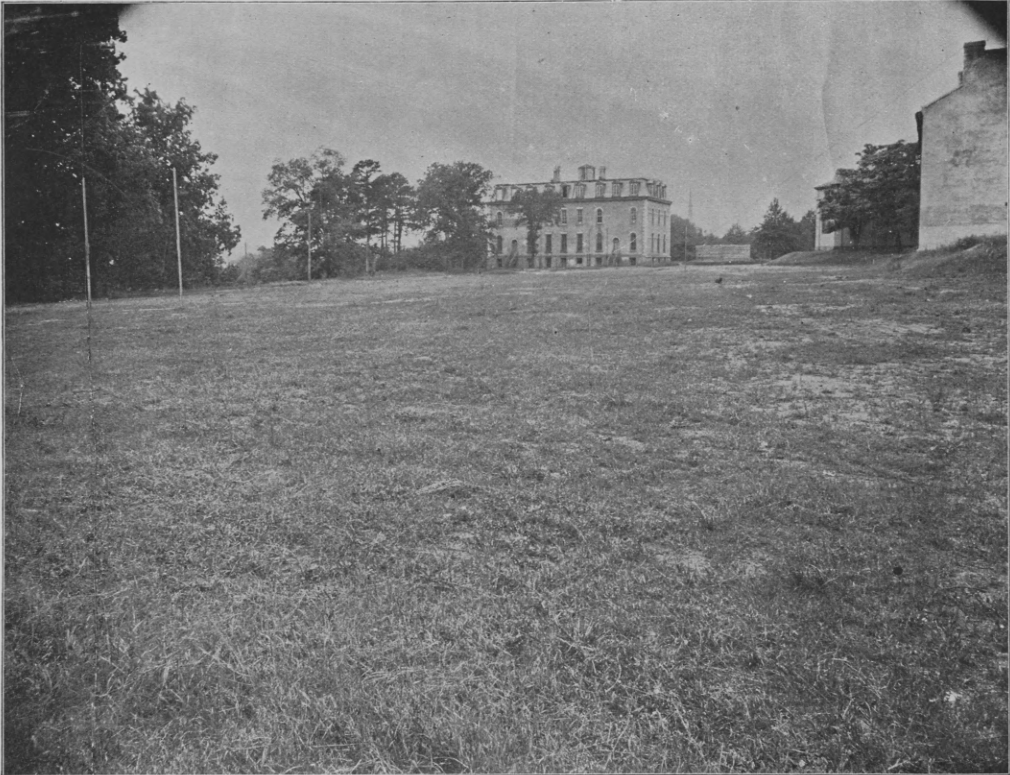 Alumni Athletic Field, looking north toward the Moore College building. The New College building is at the far right. Pandora, 1897.
Matthews held down third base. Coach Jennings stood beside him at shortstop and led his team to a 10-9 victory before 400 spectators.
Jennings completed his coaching duties on April 2. In appreciation of his efforts, the Varsity boys staged some musical entertainment in a hotel lobby and presented Jennings with a diamond stud and a $15 engraved meerschaum pipe.
The team had hoped to celebrate Jennings’ departure with a game against the National League’s Orioles, who had been training in Charlotte, North Carolina, but a hard rain ruined the plans. Instead, team manager Isaac Hofmayer arranged a game with a squad of local players. The Varsity took the April 6 contest, 7-6.
Next, the Georgia boys took on the Atlanta Crackers of the Southeastern League, an independent professional circuit that experienced a brief, unhappy life in the spring of 1897. “The Atlanta team is the strongest all-round lot of ball players she has known for years and they all laugh at the idea of going down before a college team,” the Atlanta Constitution noted.
The college boys put the pros in their place, winning 8-6. Matthews did not contribute to the effort. William Sanford, usually a pitcher, took his place at third.
The most important game of the year – one of the most important games in the history of Georgia athletics – took place on Thursday, April 15, when the Varsity met the University of Pennsylvania Quakers in Atlanta’s Brisbine Park.
Ivy League schools dominated the sports landscape in the late 19th century in both football and baseball. Before 1897, no northern school had lowered itself to take on a southern college, and Penn arrived in Atlanta confident of victory. They carried a 6-0 record, including a victory over the University of Virginia and two wins against North Carolina. In the six games, they outscored their opponents by a whopping 104-18, a per-game average of 17-3.
The men in the Penn team picture, staged in a photographer’s studio, epitomized the genteel Gentleman Sportsmen of the era. The thirteen players included three lawyers, two doctors, and two dentists. Coach Jesse Allen was a former major leaguer who later became an assistant professor of proctology.
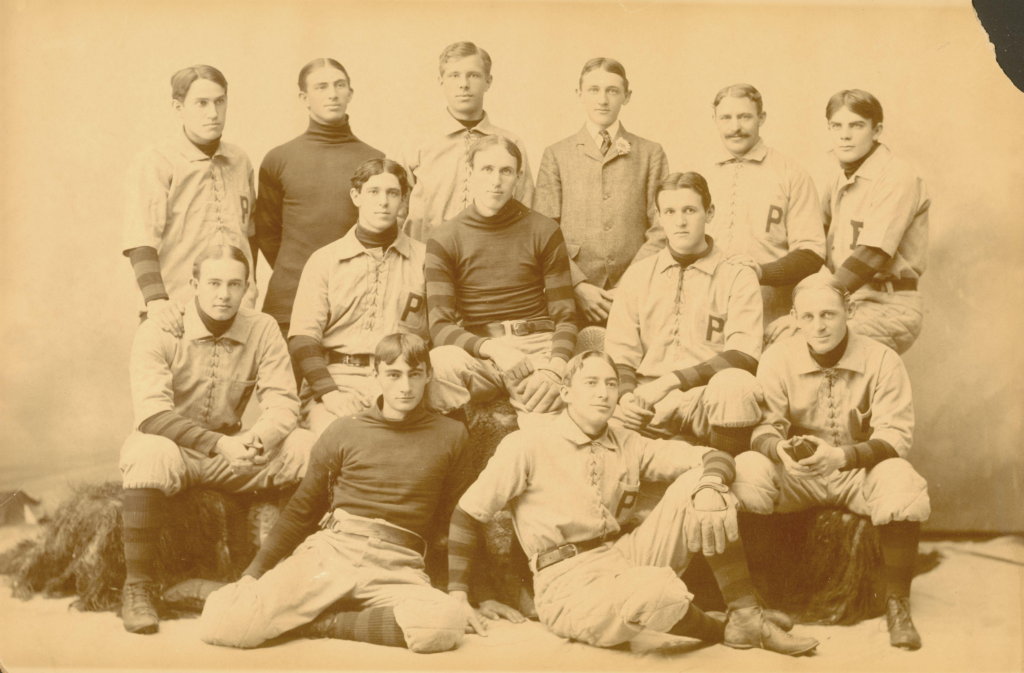 University of Pennsylvania baseball team, 1897. University photograph collection.
The Georgia team picture, by contrast, shows a no-nonsense bunch of rough southerners. Even the mascot, Morton Hodgson, looks like a tough little bugger (in 1908, Hodgson became the first University of Georgia athlete to letter in baseball, football, basketball, and track). Matthews sits on the left end of the front row, wearing a dark sweater and the padded pants popular among baseball players of the day.
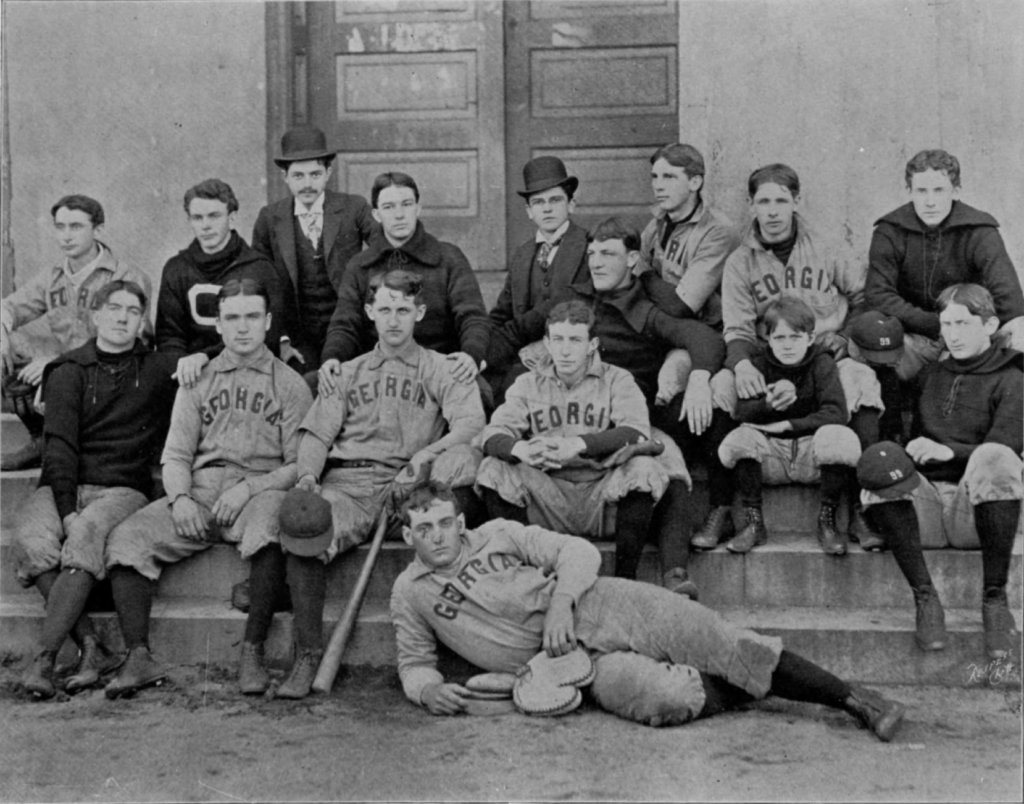 University of Georgia baseball team. Matthews sits at the left end of the front row. Pandora, 1897.
The Atlanta Constitution printed an artist’s rendition of the photograph on the day of the Penn game. The players look less like street toughs and more like ballplaying angels. Matthews appears as a cherub-faced young man, smiling wistfully at a distant memory.
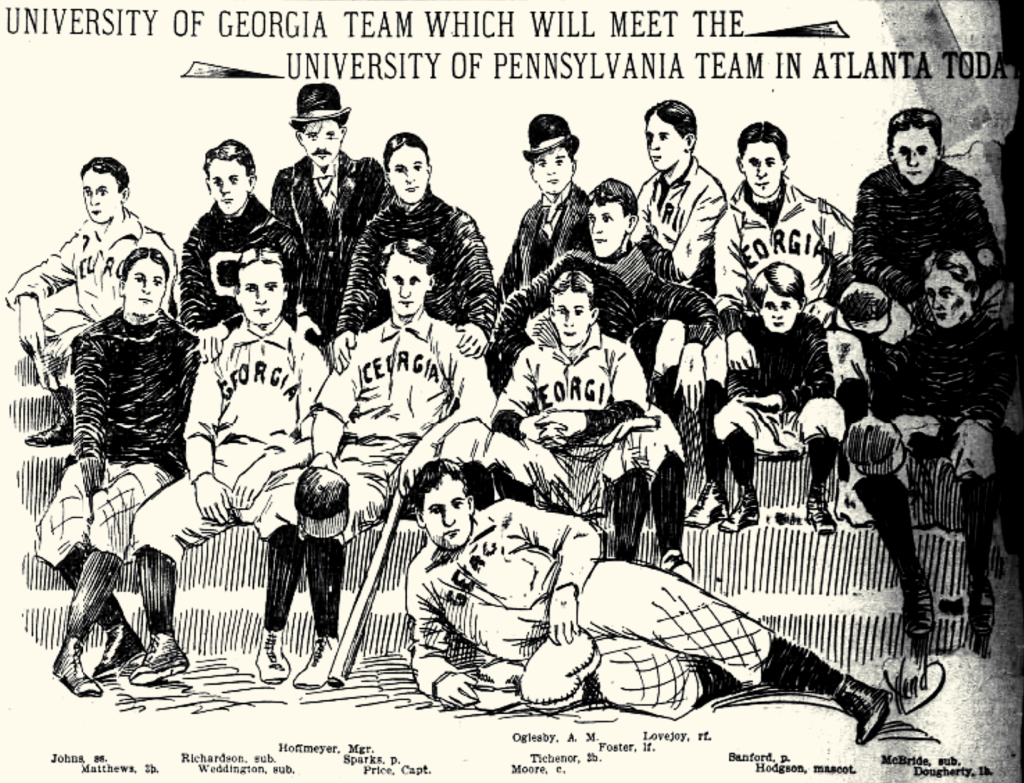 University of Georgia baseball team. Atlanta Constitution, April 15, 1897. Wilson Matthews sits at the far left of the front row in a dark sweater.
The Atlanta Journal published a description of the Georgia players in the run-up to the game. Matthews comes across as friendly and likable:
The smiling face of Matthus [sic], better known here as “Captain Dick,” will beam from the third bag and many a hard grounder will find a sudden termination in this jolly obstacle at third. His batting is fair and his fielding of the highest order.
An enormous crowd – possibly as many as 5000 fans – flocked to Brisbine Park on game day and began filling every available seat and space hours before the first pitch was thrown at 3 p.m. We tend to imagine such scenes in the somber shades of gray and sepia in which are rendered the old photos and newspaper clippings. But a writer for the Constitution painted a picture of a joyful and colorful spring afternoon:
The grand stand was a veritable sea of kaleidoscopic colors. Fair woman was there in all her glory. The new spring hat, with all the beautiful tints, served to enhance the coloring of the scene, the like of which is seldom ever witnessed. The red and black of Georgia filled the surrounding atmosphere, but Pennsylvania was not without supporters, and the red and blue showed up quite conspicuously in the general makeup of the large crowd.
In the great tradition of Southern athletics, sponsors – society girls who epitomized the ideal of Southern Womanhood – supported each team. Penn’s sponsors and their escorts arrived in a carriage draped in red and blue and “drawn by four magnificent white horses.” Georgia’s sponsors and their escorts rode a carriage “drawn by four coal black horses” and swathed in red and black. “During the progress of the game these carriages were surrounded by a crowd of players and other college men fortunate enough to be allowed within the lines,” the Constitution said.
The throng did not include a campus contingent. The Georgia students were required to remain in Athens “at their recitations.” To keep them informed, Southern Bell ran a special long-distance wire to the grandstand at Brisbine Park. A Bell man called out the result of each at-bat to the operator in Athens, who relayed it to the 1000 fans who stood on the street outside the telephone office, cheering on the Varsity boys.
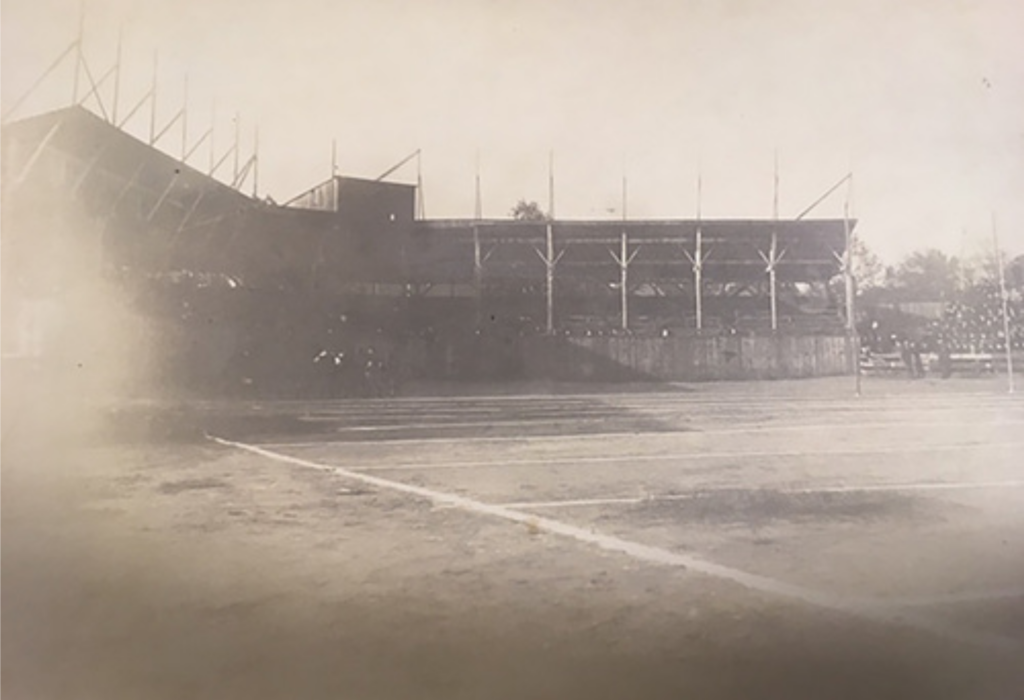 Brisbine Park, lined off for football in 1899. Photo by Atherton Seidell, UGA Special Collections Library Online Exhibitions.
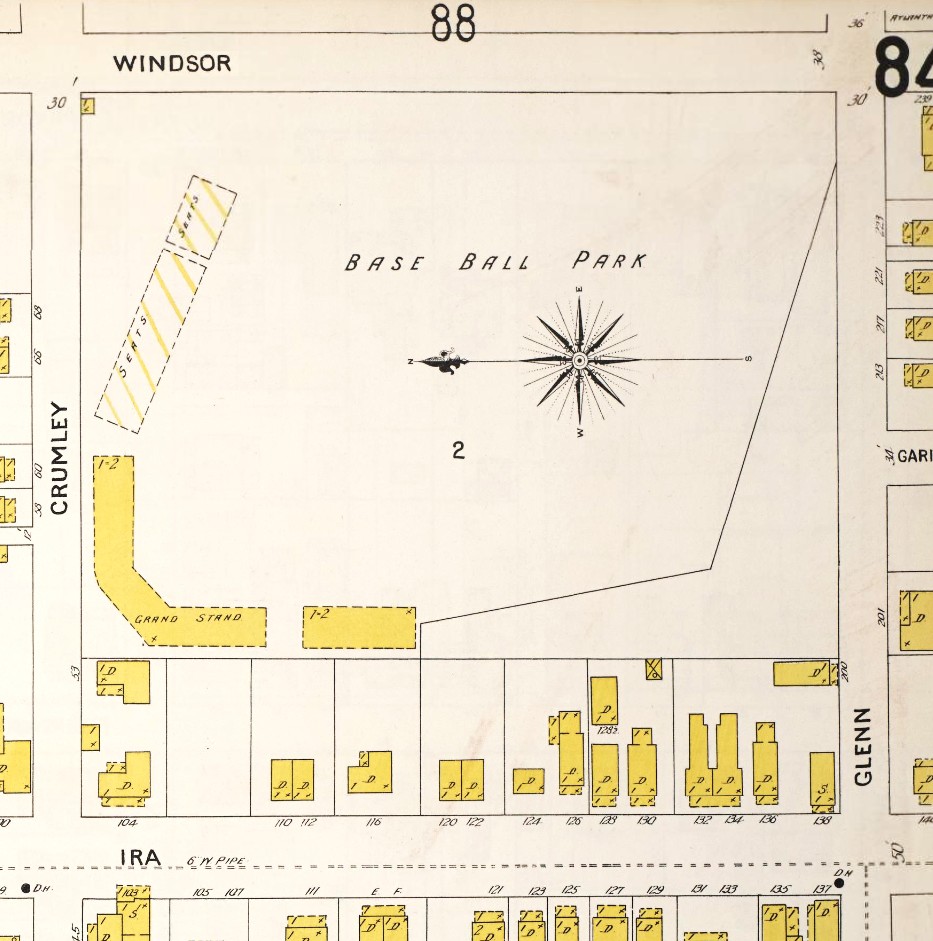 Brisbine Park. Sanborn Fire Insurance map, 1899. The tract is now in the southeast corner of Rosa L. Burney Park.
Few of the fans in Atlanta or Athens expected Georgia to win. They hoped only for a decent showing against the Ivy League powerhouse. But when the red dust had settled, the southerners stood victorious, 4-0.
The Constitution’s writer searched his battered briefcase for clichés and piled them into the lede of his front-page story:
Nine big, strapping Quakers from the Keystone State, with the scalps of all the big northern and southern college baseball teams dangling at their belts, came to Atlanta yesterday only to meet their Waterloo.
Nine unassuming little fellows, reared amidst the old red clay hills of Georgia, jumped into the team from Pennsylvania, and before they had finished the giants had bit the dust. And there is joy in the camp of the Athenians.
But away up in Philadelphia there is wailing and gnashing of teeth, for the heretofore invincible “Pennsy’s” have been defeated by a southern college. And to add to the ignominy, the defeat was a shut-out from start to finish. Only a scratch bunt saved the men from Pennsylvania from being thrown down without a base hit.
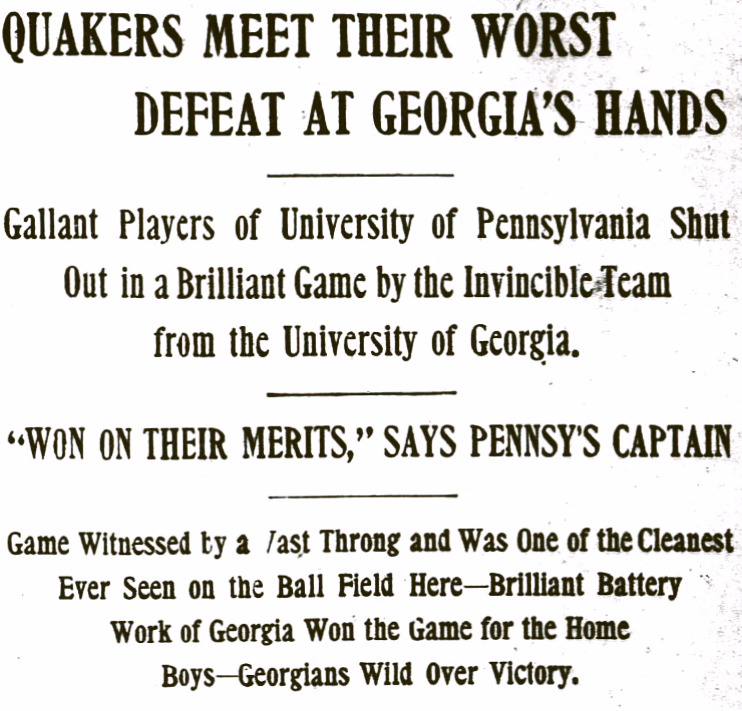 Atlanta Constitution, April 16, 1897.
Georgia pitcher William Sanford worked through the Quakers with “wide inshoots and well timed drops.” He walked two, hit one batter, and one reached after dribbling a bunt down the third-base line to Matthews.
The Atlanta newspapers marked the bunt as a hit, with the runner beating the throw. The Philadelphia Times, however, said the runner reached after a wild throw, and charged Matthews with an error. By Philly standards, Sanford had pitched a no-hitter. The term was not in vogue back then; the Times said only that Sanford “pitched a steady game and shut out his opponents without a hit.”
Sanford started the Georgia scoring in the second inning by ripping a solo homer to deep left field. The score remained 1-0 until the seventh when Georgia catcher Jon Moore tripled and came home on a sacrifice fly.
Before 1950, the home team had the choice of batting at the top or bottom of the inning. In baseball’s early days, the advantage of batting last was not universally accepted. Many thought scoring first gave a greater advantage. Georgia captain George Price had elected to bat first. His team added its final runs in the top of the ninth.
Right fielder Hatton Lovejoy tripled. Sanford sent Lovejoy home with a clean single, stole second, went to third on a passed ball, and scored on a single by freshman shortstop Homer Johns.
Sanford retired the Quakers in the bottom of the ninth with three straight grounders back to the mound, sealing the 4-0 win.
Immediately after the final out, several hundred men rushed from the grandstand and crowded around Sanford, all attempting to shake the hero’s hand. The Quakers gathered around the Georgia boys and gave three cheers for the winners.
The players then surrounded the carriages bearing their sponsors and “gave cheer after cheer to the health of their fair admirers and thanked them graciously for their support.”
Penn captain John Blakely accepted defeat graciously. “Georgia undoubtedly won today’s game on its merits,” he said. “To Pennsylvania’s inability to hit Sanford she must attribute her defeat. He was cool, steady, effective, and was ably supported by the whole Georgia team.”
The Philadelphia Times sportswriter was less complimentary. While admitting that “the game was won and lost upon its merits,” the writer complained that “the decisions of the umpire were very questionable at times.” And, being a proper Philadelphian, he cast aspersions on his own team, blaming “the poor batting exhibition given by the Quakers” along with “two misjudgments in the outfield and a stupid infield play.”
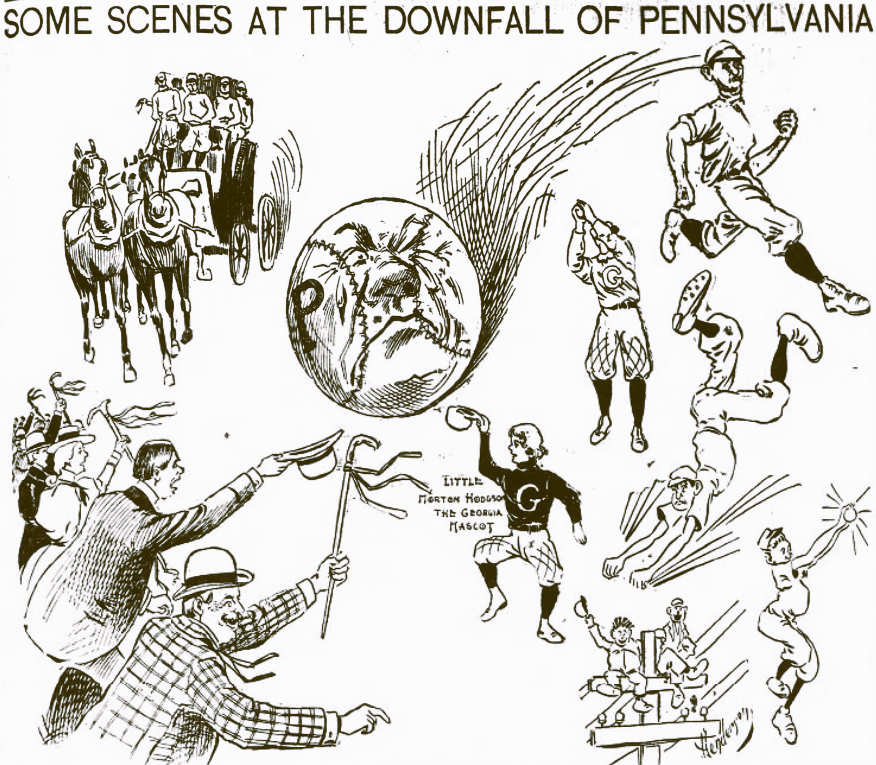 Atlanta Constitution, April 16, 1897.
While the fans in Philadelphia responded to the loss in their usual fashion, overturning outhouses and setting carriages ablaze, the Georgia students staged a truly unhinged party.
After celebrating at Atlanta’s Aragon Hotel, the team departed for Athens at 7:50 p.m. on the Central of Georgia Railway. They arrived in Athens at 10 p.m. and were greeted at the station by every one of the university’s 300 students and a great deal of the townsfolk.
The crowd had already cheered itself hoarse, but when the players appeared they redoubled their efforts, hailing the boys with wild yells and applause while three cannon on a hill above the depot – “loaded to the muzzle” – fired off a deafening volley.
Students carried the players to the campus on their shoulders and placed them before an enormous bonfire, accompanied by a brass band belting out “Dixie.” Many great speeches ensued, described by the Atlanta Journal as “a regular love feast.”
Afterward, hundreds of young men took possession of the town, wandering about yelling, singing, giving their college cheers, and serenading the girls at the Lucy Cobb Institute. Someone grabbed the chapel bell rope, and the bells pealed for seven straight hours.
“Nobody in Athens slept last night. It was useless to try to catch a wink when three hundred students were howling, shooting off cannon and marching about the streets in noisy exuberance,” the Journal reported. “It was a night long to be remembered there.”
The single baseball game opened a new chapter in southern sports. From that day forward, southern colleges considered themselves on an equal athletic footing with the great northern schools. The writer for the Constitution explained the game’s importance the following day:
The boys at Athens, as well as here and all over the south, realize that the game yesterday marked a new era in baseball. It was the first time in history that a team from a southern college has defeated a team from one of the large northern colleges.
The result of the game taught one lesson which the boys of this state will treasure. It showed that the south has as fine men in her college as has the north, and that the southern colleges are forging ahead in athletics until they are getting on a level with the leading colleges in America.
An editorialist for the Atlanta Looking Glass expressed a more belligerent posture:
Heretofore the haughty athletes of the great universities of the North have labored under the delusion that their Southern brethren were “farmers.” They have declined to believe that a Georgia team could play a good enough game of ball to make it interesting, and even last Thursday the partisans of the Quaker club went out to the grounds with a premonition that they would be bored and that the contest would prove too one-sided for actual sport.
It did prove one-sided, but not in the manner anticipated. In shutting out their famous antagonists, the University of Georgia nine covered itself with glory and has accomplished an important work in establishing a standard for Southern sport that will command respect all over the land.
The morning after the game, captain George Price called the team together and reminded them that they had a game with Wake Forest the next day. He urged them to keep their heads, as they still faced a hard schedule.
Price’s words went unheeded, and Georgia lost to Wake Forest, 11-12, in ten innings. Every Georgia player except second baseman Walker Tichenor committed at least one error.
Two incidents of unsportsmanlike conduct marred the game. Matthews, playing third base, grabbed a runner who was attempting to score, and Hatton Lovejoy threw his cap into the air to distract a Wake Forest fielder chasing down a fly (whether Lovejoy was on base, on the bench, or in a coaching box was not recorded).
It was a disappointing development, given the goodwill generated by the win over Penn. Matthews and Lovejoy had proven that the southern players were still an unruly lot of unsophisticated and unprincipled farmers.
The University of Georgia Athletic Council passed a resolution denouncing the players’ actions without specifically naming either Matthews or Lovejoy:
Resolved, first, that the athletic council wishes to put itself on record as deploring and condemning in the strongest manner any and all practices which have a tendency to lower and degrade athletic amateur sport; that we renew our allegiance to all that is highest and best in athletics, believing all our contests should be above suspicion of unfair methods and dishonorable practices and that fair play and clean manly sport should characterize all the actions of this team.
Team manager Isaac Hofmayer alluded to Matthews’ experience in the low minor leagues of Texas with a sniff that can be heard from 129 years away: “You see, some things are not allowed in college ball that are tolerated in professional ball.”
Though they had not been named in the resolution, Matthews and Lovejoy took offense at the athletic council’s action and quit the team.
The withdrawal characterized Matthews’ method of dealing with the world. For the remainder of his life, he was forever throwing up good billets over slights, real or imagined. He not only burned bridges behind him, but sometimes set them afire while he was still standing on them.
Seventy-five students signed a petition repudiating the council’s actions. Many signers later said they were misinformed about the petition’s wording and meant only to support Matthews and Lovejoy, described as “two of the best players on the team, as well as two of the most popular young men of the university.”
The conflict resolved itself after a few uncomfortable days. Individual members of the athletic council said that they intended to condemn unsportsmanlike play, but did not mean to insult the players.
Lovejoy and Matthews maintained that they had been treated shabbily, but admitted that “in the excitement of the game, they may have played wrong.” They resolved to set aside their grievances for “the good of the team.”
On Saturday, April 24, the reunited team traveled to Auburn, Alabama, to take on the Polytechnic boys. The Georgians swamped the Alabamians, 20-2, before a crowd of 600. Lovejoy hit a home run and a single, and scored three runs. Matthews contributed a single.
The Varsity next hosted Vanderbilt for a three-game series.
Vandy squeaked out a 1-0 win in the first game, played April 30 on Alumni Field. Matthews doubled, walked, stole two bases, and helped turn a double play. The Constitution credited him with making “several extremely difficult catches.”
The teams played a double-header the following day.
Georgia had an easy time in the morning game, winning 12-4. Matthews tallied a single and scored a run, but committed an error.
The Tennesseans won the afternoon game, 3-1. Matthews failed to contribute. He made no hits or runs, and kicked in two errors.
The game against Vanderbilt was Matthews’ last with Georgia. He did not play in subsequent games against North Carolina (May 7 and May 8), Mercer (May 22), the Augusta YMCA (June 11), and Virginia (June 16 and June 17).
Matthews’ performance to date had been less than stellar. He fielded his position adequately, but batted poorly. After the Vanderbilt games, his average was a measly .214, ranking him 9th out of the 10 regulars.
In the latter part of the season, William Sanford’s arm began to fade, and A.S. Richardson took over the pitching duties. Sanford, the team’s best batter with a .366 average, moved to third base, sending the weak-hitting Matthews to the bench.
Though he was not playing, Matthews remained with the team through the end of May.
On June 4, Matthews, Sanford, second baseman Walker Tichenor, and left fielder Stewart Foster traveled to Augusta and took the field for the Christian Library Association team against a team from Washington, Georgia.
Despite its somewhat unassuming name, the CLA team was a good semi-pro outfit. “Cow” Nally, the former Georgia player who had helped coach the Varsity in the preseason, was their regular catcher. Nally had no doubt lured Matthews and the others down to Augusta.
The Varsity boys failed to ensure a victory as CLA lost to Washington 1-7. Sanford pitched the final three innings.
The University of Georgia administration reacted quickly, kicking the four players off the team. In a statement that seemed aimed directly at Matthews, the school said it wished “to discourage the coming or importation here of young men who come primarily not to study, but for the purpose of participating in athletics.”
Matthews did not stay around to fight the charges. He left school as soon as the suspension was announced, eleven days before the term ended.
Matthews entered the University of Georgia in January 1897 and left in early June. His five months in Athens offered a mixed bag.
He played in only 8 of the baseball team’s 15 games, hit poorly, and lost his starting role in the season’s final month. The athletic council censured him for unsportsmanlike play and finally suspended him for appearing with a semi-pro team.
On the plus side, he befriended major leaguer Hughie Jennings, fielded well, lettered in baseball (as S.W. Matthews), participated in one of the most important games in Georgia athletic history, appeared in a theater production, was a popular student, and had fun pretending to study law.
Overall, Matthews must have considered his Georgia days a positive experience. He usually listed the University of Georgia in future resumés, even expanding his five months into a fictitious two years. On the other hand, he completely deleted Texas A&M and Alabama from his CV, and changed Mississippi A&M to the University of Mississippi before ultimately deleting that school as well.
Matthews apparently felt no ill will towards the University of Georgia. The school’s records indicate that he re-enrolled in 1898. He did not attend any classes, but at some point he must have intended to return to Athens and continue his studies.
In October 1906, a letter signed U. OF GA. ALUMNUS appeared in the Atlanta Georgian. The writer remembered Matthews as a member of the Georgia team that “licked the University of Pennsylvania.” Matthews, the old alumnus recalled, “played third base part of the season, subsequently going to Princeton.”
Matthews may have told the former student that he was bound for Princeton, but – in what became a characteristic Matthews maneuver – his actual travels took him in a different direction entirely. One who tries to trace Matthews’ movements learns that if he told someone he was going north, he would invariably turn up somewhere south.
On June 6, the day after he was suspended, the Daily Times of Eufaula, Alabama, 175 miles southwest of Athens, listed Matthews on the roster of a newly formed semi-pro team called the Giant Champions.
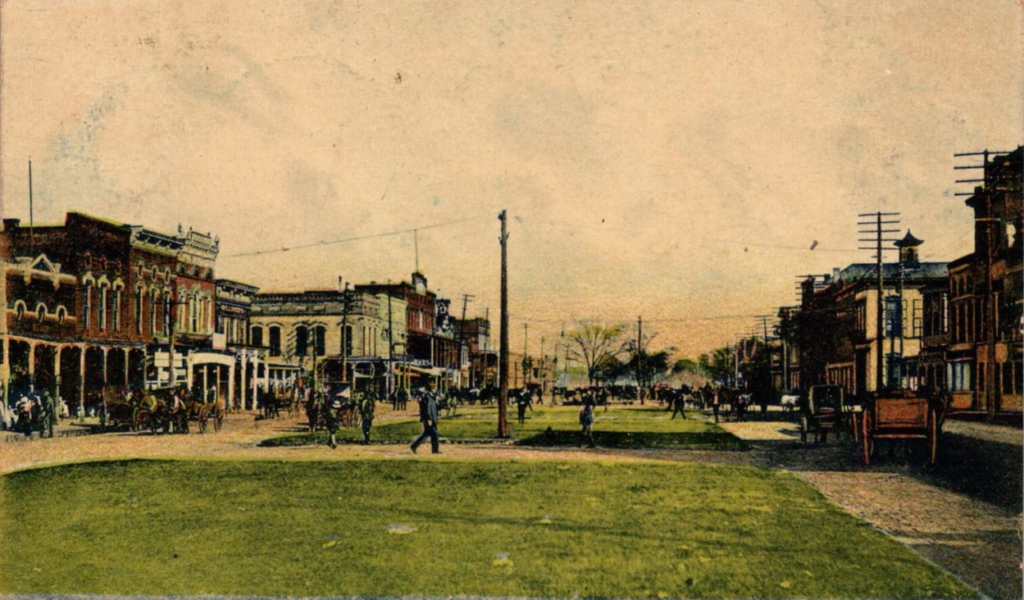 Eufaula, Alabama, in the early 1900s.
The little town of 4500 had put together a strong squad. First baseman Frank Field, a 40-year-old bookkeeper and cotton trader, managed and captained the team. The lineup included catcher Carlton Beusse and his younger brother, infielder Fred Beusse. Carlton later toiled eight seasons in the low minors, managing for parts of six. Fred spent parts of three seasons in the minors.
Carlton Beusse was on the Lexington team that had faced the Georgia Varsity back in March; he may have helped bring Matthews to Eufaula.
The team practiced every day and usually played three games each week. The heavy schedule suggests the players were paid a regular salary or collected a good share of the gate receipts.
The Giant Champions’ opponents included teams from Montgomery, Alabama; Pensacola, Florida; and Georgia outfits from Columbus, Montezuma, and Quitman. The latter team had some familiar faces: Cow Nally, Hatton Lovejoy, Walker Tichenor, and one-handed Robert Qullian.
The Giant Champions opened their season on June 7 and closed it out on August 11. They compiled a 19-5-2 record, and declared themselves “The Champions of the South.”
Matthews played third base, usually batted second, and achieved some success as a pitcher. He pitched three games, winning all three. He benefitted from great run support. In his three mound appearances, Eufaula outscored its opponents 47-15, an average score of 16-5.
Just 20 years old, Matthews impressed his teammates, even the veterans like Frank Field, and became the Giant Champions’ third base coach. Nine years later, a writer for the Montgomery Advertiser recalled Matthews’ days in Eufaula:
The town was baseball mad that year and the fans down there have a vivid recollection of Billy Matthews. As a player, Matthews didn’t star in that company, but he was good and he knew the game a whole lot better than the old professionals on the team. Where he did star was in his knowledge of the game and on the coaching line. Down in Eufaula the fans are willing to bet that he was the best coacher the game has ever brought out. He has a big, fog-horn voice, a quick wit, and fierce, aggressive airs that disconcert a young player and he is quick enough to watch every opening that shows itself in the complex game of baseball.
Around this time, Matthews began to impress listeners with his voice, described by one writer as “like the bull of Bashan,” a reference to one of the Four Beasts described in Psalm 22:
12 Many bulls have compassed me: strong bulls of Bashan have beset me round.
13 They gaped upon me with their mouths, as a ravening and a roaring lion.
After a game in early July, an item in the Eufaula Daily Times implied that Matthews’ voice was a constant presence during games, absent only when its owner was ill. “Billie was not bad, but for some reason did not open up his bazoo after about the fifth inning,” the Times noted. “He grew quiet which led some people to suppose that Billie was not at all well.”
William Jelks, a future governor, owned and edited the four-page Daily Times and covered the Giant Champions. Jelks took a shine to Matthews and developed a borderline creepy man-crush on the young player.
Jelks wrote a multi-stanza poem about the team. The first verse implied that Matthews was a handsome lady-killer:
We have a team in our town.
And if you’ll kindly come around
We will show you a game of ball –
Our boys are all right, you know.
With the girls they’re all the go.
And at the feet of Matthews they all fall.
The editor seemed deeply smitten by his third baseman. “Mathews is lovable and has a pair of the most eloquent base-ball legs on him we have seen,” he wrote.
In early July, Matthews and Carlton Beusse took a few days’ leave from the Giant Champions to play for a team in Albany, Georgia. After Matthews had been absent for an entire day, Jelks cranked up the Wayback Machine as if summoning the specter of a long-passed lover:
Mathews was a lovely coach. We took pride in Mathews, not because he could stop a ball or throw a ball or catch a ball, nor yet, because he could hit the ball. We loved Mathews because he could dance on the third base and look pleased all the time. He was always the most interesting player on the diamond.
The next day, Jelks anticipated Matthews’ return to Eufaula with the excitement of a middle-aged man awaiting his mail-order bride:
Mathews and Beusse were expected on the afternoon freight this afternoon. It was understood they would certainly be here. And we are glad of it. We want to see dear old Mathews’ face on the diamond.
Jelks’ enthrallment with Matthews was extreme, but not an isolated case. Throughout his career, Matthews successfully cultivated the affection of fawning sportswriters across the South. The writers swallowed his lies and willingly spread tales of Matthews’ mythical accomplishments.
In late July, the Giant Champions departed on a road trip, playing in Fort Valley, Savannah, and Columbus. As the team traveled east, Matthews went the other way.
By mid-August, Matthews was 530 miles west of Eufaula in Washington, Louisiana, billed as “the star twirler” for the local nine. A month later, he turned up down the road in Lafayette, playing center field for a semi-pro team called the Lafayette Dixies and acting as the team’s captain.
Matthews developed an affinity for Louisiana. The state became an anchor to which he returned throughout his life. Lafayette, New Orleans, and especially Shreveport became his off-season haunts. He managed a season in Baton Rouge, where he married a local girl. But he never put down permanent roots in Louisiana, or anywhere else.
In 1897, Matthews embraced the role of “baseball soldier of fortune.”
He began the season playing for the University of Georgia as Stilson Matthews, an alleged law student. He was rumored to be “a bit of a ringer.” Near the end of the academic year, he joined a semi-pro team in Augusta, which led to his suspension from the Georgia Varsity.
He left Georgia before the term ended, and joined a fast semi-pro team in Eufaula, Alabama. He stayed in Eufaula less than two months, then jumped to another semi-pro team in Washington, Louisiana. In September, he joined a semi-pro team in Lafayette, Louisiana.
Matthews continued this pattern until his death, constantly moving, sometimes changing jobs multiple times in a single season, throwing up good billets for unexplained and inexplicable reasons.
Matthews remained in Lafayette until mid-November. Then thespian Matthews took on the role of his lifetime, the Gentleman Sportsman that the son of a brothel-keeper dreamed of being. He became the Princeton Football Star.

Charles Norman is a writer and historian. Email: reverb.raccoon@gmail.com. Or follow on Instagram and Facebook.
Latest Posts
Here Lies Wilson Matthews – 1 Who Was W.M. Matthews?
But he wanted to get in. He wanted to be urbane and careless. He wanted to wear well-cut clothes. He wanted to be a gentleman.-- Thomas Wolfe, Look Homeward, Angel Part 1Who Was W.M. Matthews? Mississippi State University – then Mississippi A&M College – entered...
Here Lies Wilson Matthews – 2 Who Was Blanche Dumont?
Here’s what I want. I notice you changed your name. I want you to keep your new name. I guess you made up someplace you came from – well, that’s where you came from… You figure you died and now you’re somebody else and we’ll get along fine. -- John Steinbeck, East of...
Here Lies Wilson Matthews – 3 Guy Town
He was surrounded by a world that was both beautiful and terrifying, a land of secrets and shadows, where the line between civilization and savagery was thin and easily crossed--Joseph Conrad, Lord Jim Part 3Guy Town Miss Blanche Dumont became a sex worker in Austin,...
Here Lies Wilson Matthews – 4 Spaced Flashes
In probing my childhood (which is the next best to probing one’s eternity) I see the awakening of consciousness as a series of spaced flashes, with the intervals between them gradually diminishing until bright blocks of perception are formed, affording memory a...
Contact Reverb Raccoon
 |
 |
 |
 |
Archives