Here Lies Wilson Matthews – 11 The Paper Tiger
It is my belief no man ever understands quite his own artful dodges to escape from the grim shadow of self-knowledge.
— Joseph Conrad, Lord Jim
Part 11
The Paper Tiger
Wilson Maurice Matthews, just 20 years old, possessed an impressive resumé in November 1897.
He began playing semi-pro baseball in Austin, Texas, when he was 14 years old. In subsequent years, he played for several semi-pro teams in Texas, Georgia, Alabama, and Louisiana.
He entered Texas A&M in September 1892 when he was 15. He quarterbacked the football team during the 1893-1894 academic year, the season before they entered intercollegiate competition, and captained the baseball team in the spring of 1894.
He enrolled at Mississippi A&M (now Mississippi State) in September 1894. He coached the freshman and sophomore class football teams that fall. He captained the Varsity baseball team in the spring of 1895. In July, he played his first professional baseball game with the minor league Houston Mud Cats.
In the fall of 1895, he captained and quarterbacked the Mississippi A&M football team in its first official intercollegiate game, a loss to Southwestern Baptist, and chose the maroon and white colors that still represent Mississippi State University.
He entered the University of Alabama in January 1896 and played on the Varsity baseball team. He played a few games with the minor league Austin Senators that summer.
In 1897, he played third base for the University of Georgia baseball team that defeated the University of Pennsylvania, the first victory of a southern athletic team over one of the major northern schools.
After leaving Georgia, he played third base for the semi-pro Eufaula Giant Champions, who claimed the title of “Champions of the South.” Later that season, he captained the semi-pro Dixies of Lafayette, Louisiana, and manned center field.
None of Matthews’ accomplishments, save his time in Georgia, where he pretended to study law, mattered to him.
Wilson Matthews, the low-born son of Blanche Dumont, an infamous Austin madam, needed to be a gentleman. His deepest desire was to be a genteel Gentleman Sportsman, like the lawyers, doctors, and dentists on the Penn baseball squad that he and the Georgians had defeated on the red clay diamond of Atlanta’s Brisbine Park. To that end, Matthews erased his past and recast himself as the Famous Princeton Football Player.
Early in November 1897, the Southern Athletic Club of New Orleans, a private association not affiliated with any university, began planning for the upcoming football season. New Orleans was under quarantine due to a yellow fever outbreak, but the club had already started lining up players.
An item in the November 6 edition of the New Orleans Times-Picayune announced that Matthews, the former Princeton player of ‘95, would join the Southerns as soon as possible:
There is another new member of the club who will doubtless prove a star this season. Matthews, of Princeton’s 1895 eleven, has recently joined the club, and will play here until after the holidays. He weighs 165 pounds, and during 1895 was a substitute for Garrat (sic) Cochran, the present captain of Princeton’s great team. During that season he played right end, besides being the substitute. At present he is in Lafayette, La., and will come to New Orleans as soon as the quarantine has been raised.
The next day the Times-Picayune restated the news, but tacked five pounds onto Matthews’ frame: “Matthews, of Princeton’s 1895 team, with a weight of 170, will be one of the stars of the season.”
The New Orleans States picked up the story, with a few alterations. The States shaved Matthews’ weight back to 165, but expanded his Princeton experience to include 1896, referring to him as “Matthews (Princeton – ’95 and ’96)” and “the old Princeton player, Matthews, ’96.” The States added that Matthews would coach the Tulane football team in addition to playing for the Southerns:
Matthews, the Princeton man, played sub-end to Captain Cochran of the champion Tiger eleven of last year and the year before. He weighs 165 pounds stripped and is said to be a crack-a-jack all round athlete and football player. He will also coach Tulane and will come to the city from Lafayette in a few days.
The claim to have played end in ’96 held a tiny grain of truth. In early 1896, Matthews played right end on the University of Alabama’s sophomore class team. The part about coaching Tulane was totally untrue, since Tulane did not field a football team in 1897. The Southern Inter-Collegiate Athletic Association had suspended Tulane’s football program for playing an ineligible man in 1896.
Over in Lafayette, the Lafayette Gazette reprinted part of the States story, along with some details of interest to the local readers, and confirmed that the Matthews in question was indeed Wilson Matthews:
The gentleman mentioned in the foregoing item is Mr. Wilson Matthews who has been in Lafayette since about two months. During his short stay here Mr. Matthews has made a large number of friends, who, though pleased that he has secured a desirable position in New Orleans, will regret to see him leave. Being a clever young man as well as a good football player, The Gazette has no doubt that he will have both a pleasant and profitable time in the Crescent City.
Where did the sportswriters in New Orleans and Lafayette, and the recruiters at the Southern Athletic Club, get the idea that Wilson Matthews had played for Princeton? The information obviously originated with Matthews himself.
Matthews had been telling people that he was a Princeton Man since as early as 1895.
In December 1895, the Mississippi A&M team, captained and quarterbacked by Matthews, played its second official football game against the Memphis Athletic Club. As related by David Smale in They Bled Maroon, “there was a hint of a recruiting scandal for the Memphis game as the Memphis Evening Scimitar claimed the ‘Mississippi team’ was coached by a Princeton man ‘who might even play with them.’”
The “Princeton man” in question could only have been Matthews, who no doubt spread the rumor. He may even have laid it on his own teammates, bragging that he had previously attended Princeton instead of lowly Texas A&M.
As it happened, the alleged Princeton player was nowhere near Memphis when his team hit the gridiron. On game day, the Galveston Daily News reported Matthews’ presence in Austin, Texas, “on a pleasure trip.”
In June 1897, Matthews left the University of Georgia under sketchy circumstances. While still on the Varsity baseball team, he and three other Georgia players took the field for a semi-pro outfit. The administration kicked the players off the team, but did not suspend them from the university.
Matthews immediately left school, telling at least one student that he was “going to Princeton.” Instead, he joined the roster of a semi-pro baseball team in Eufaula, Alabama.
It’s easy to understand why Matthews cast himself as a Princeton Man. None of the four state institutions Matthews actually attended could match an Ivy League school in either size or prestige. Though he kept Georgia on his future resumés, he replaced Texas A&M, Mississippi A&M, and Alabama with the magnificent Princeton.
Princeton carried even more status when it came to football. Playing for the Princeton Tigers placed one in the upper echelon of college football’s hierarchy. While most southern programs were still crawling from football’s primordial ooze, Princeton was an established powerhouse.
Over the 1895-1897 seasons, Princeton compiled a 30-2-2 record, outscored its opponents 846-46, and shut them out 28 times. Their two ties had ended 0-0. The Princeton-Yale game drew over 35,000 fans to Manhattan Field in 1895 and 1896.
An official “national champion” did not exist in those days, but in 1942 the Helms Athletic Foundation retroactively named Princeton the National Champions of 1896.
Garrett Cochran starred at right end for the Princeton Tigers. He captained the team in 1896 and 1897, and was named to the Harper’s Weekly All-America team in those years. He died in 1918, two months before Matthews, and was posthumously elected to the College Football Hall of Fame in 1971.
In 1897, Cochran was a name familiar to football fans nationwide. Any player who shared a field with Cochran, even as a substitute, gained instant credibility.
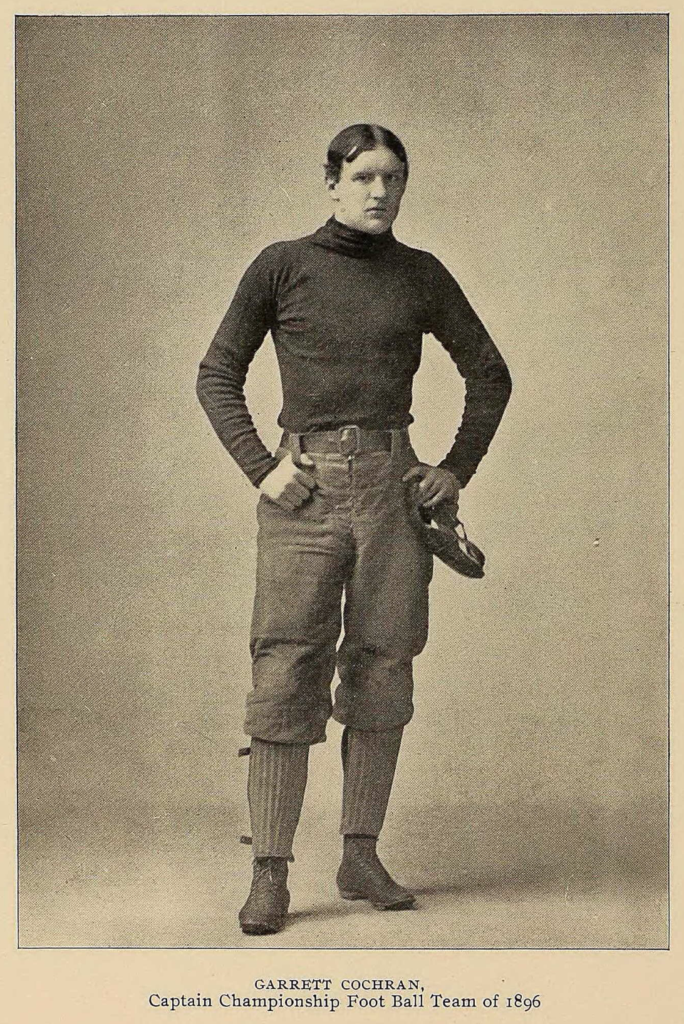 Garrett Cochran in 1896. Princeton Bric-A-Brac, 1899
When Matthews left Lafayette on Monday, November 22, the Gazette again reported that he was bound for New Orleans to coach the non-existent Tulane football team.
His arrival in New Orleans on Monday evening, November 22, was reported in the next day’s Times-Picayune along with more details about the player, his days at Princeton, and his first impression of the Southerns:
Mathews, who played end on the great Princeton team of 1895, and was substitute for Princeton’s captain in 1896, reached the city yesterday from Lafayette, La., where he has been visiting friends for several weeks. Mathews is an athletic-looking man of some 5 feet 11 inches in height and 170 pounds in weight, and when a college man he was looked upon as a great player. Although he had just arrived in the city, he visited the club and looked at the men working. He was greatly surprised to see exactly what kind of material the Southern can turn out, and he believes that the Southern can be made into a great eleven.
The Times-Picayune continued to enthuse over Matthews in Wednesday’s edition: “Mathews is one of the best-posted players in the country, and he has already given the local players a world of very valuable information.”
At this point, reading that Matthews was “one of the best-posted men in the country,” the researcher wonders whether he has entered an alternative universe in which Wilson Matthews really did star for Princeton, with his exploits eagerly reported in newspapers across the country. Or perhaps he played for Princeton under an assumed name.
But… no. We know who played end for the Princeton Tigers in 1895 and 1896 because newspapers published the players and substitutes for each game, as did the Bric-A-Brac, Princeton’s yearbook. The listed players were real people, not Matthews playing as a ringer.
Princeton’s right ends in 1895 were Garrett Cochran (9 games) and William Prettyman Hearn (3 games). Cochran missed two games due to “delinquent” schoolwork, and one because of illness. Hearn filled in effectively. One reviewer enthused that Hearn “did as well as Cochran.”
Princeton’s left end position was in flux throughout the 1895 season. Its occupants included James Carnahan Knight (6 games), Gordon Johnston (3 games), Samuel Huston Thompson (3 games), John Leonard Hynson (2 games), Langdon Lea (1 game), and William Hearn (1 game).
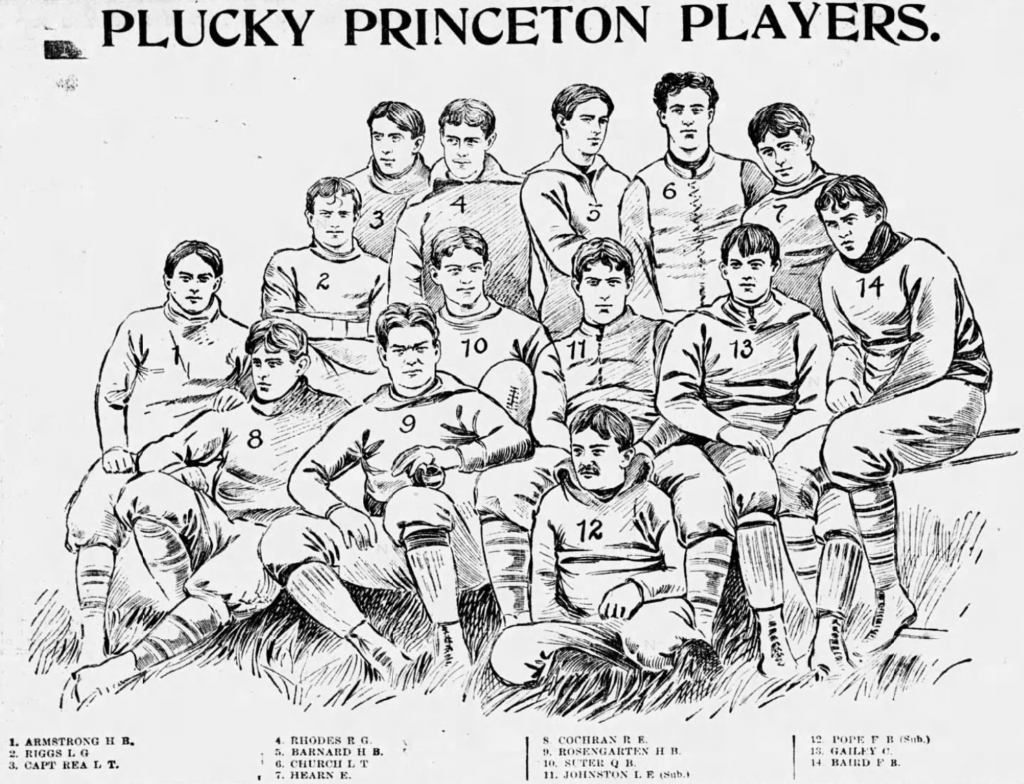 Princeton’s 1895 football team showing Lea (3), Hearn (7), Cochran (8), and Johnston (11). Boston Globe, November 2, 1895.
In 1896, Cochran started all of Princeton’s eleven games at right end. The substitutes were Howard Crosby Brokaw (3 games) and Samuel Huston Thompson (1 game). Brokaw and Thompson also held down the left end. Thompson started six games, subbed by Brokaw in one. Brokaw started five games, subbed by Thompson in one.
William Prettyman Hearn, Cochran’s substitute at right end in 1895, was the son of a prominent Philadelphia surgeon. He graduated from Princeton in 1896, then returned for a Master’s degree. His thesis was titled “Morphology of the Brain of Lower Vertebrates.”
Hearn followed his father into medicine and served as a professor of surgery at Jefferson Medical College, chief of surgery at Philadelphia General Hospital, and medical director of the Philadelphia Electric Company.
Among the left ends of 1895, Gordon Johnston jumps out as epitomizing the Gentleman Sportsman envied by Matthews.
A well-bred Alabama boy, the son of a Confederate general, Johnston graduated from Princeton in ’96 and coached the University of North Carolina football team.
When the Spanish-American War commenced, Johnston enlisted in the 2nd Mississippi Infantry, then transferred into the 1st US Volunteer Cavalry, known to history as Col. Teddy Roosevelt’s Rough Riders.
Johnston did not serve in Cuba but was sent to New York to attend to some of the Rough Riders’ horses. While stationed there after the fighting in Cuba ceased, Johnston met Col. Roosevelt. The two became friends, and Johnston served as Roosevelt’s mounted orderly. He was promoted to lieutenant on Roosevelt’s personal recommendation.
Johnston fought in the Philippine-American War and earned a Distinguished Service Cross in 1900.
Fighting against the Moros in 1906, Johnston was severely wounded in an action that earned him the Medal of Honor. Roosevelt, then President, cabled Johnston to inquire of his friend’s health. The exchange made headlines all over the country:
How are you? THEODORE ROOSEVELT
Fine, thanks. JOHNSTON
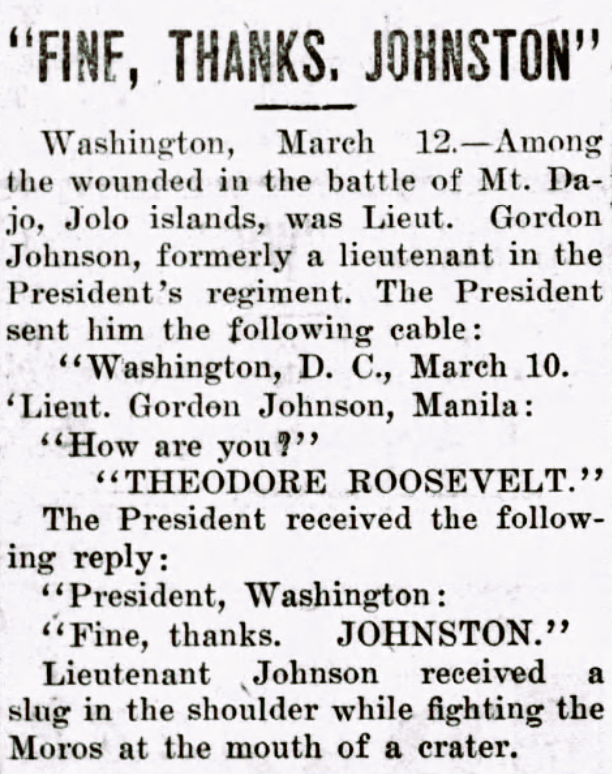 Richmond (Indiana) Palladium, March 13, 1906.
Johnston became a career officer and reached the rank of colonel. He died in 1934 after his pony fell and rolled over on him during a polo match in San Antonio. He was buried in Arlington National Cemetery. His Medal of Honor is housed in the Princeton University Library.
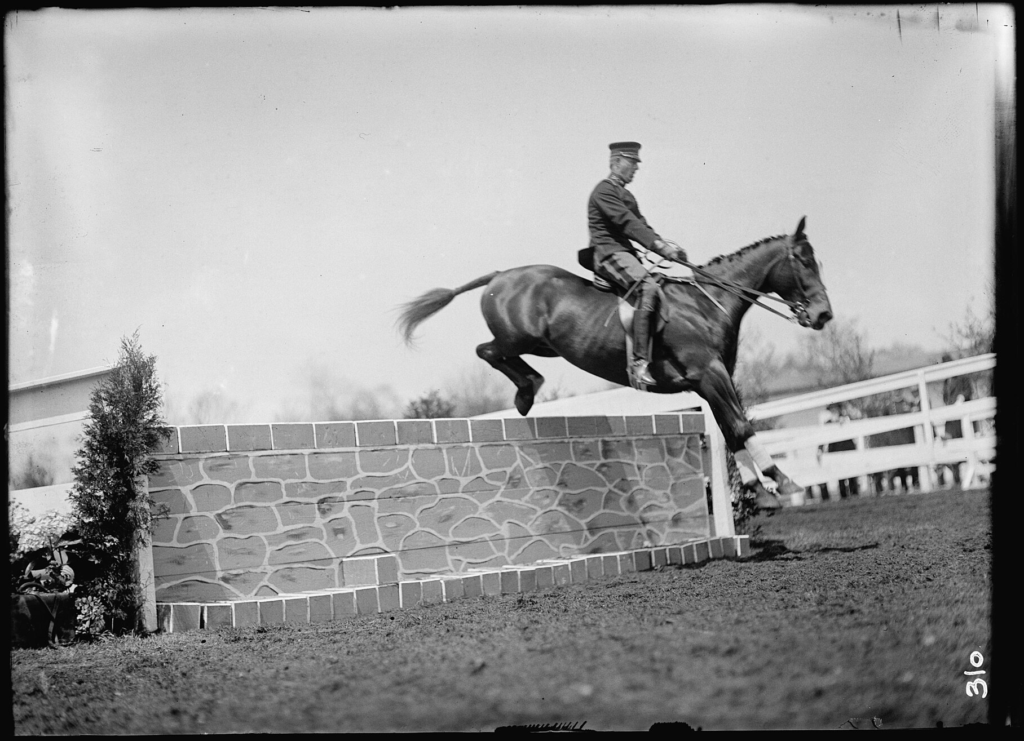 Lt. Gordon Johnston in an equestrian event, 1911.
Howard Crosby Brokaw, Cochran’s main substitute at right end in 1896, was the son of a wealthy New York City clothing merchant named Isaac Vail Brokaw. The family lived in a mansion at the corner of 5th Avenue and East 79th Street facing Central Park.
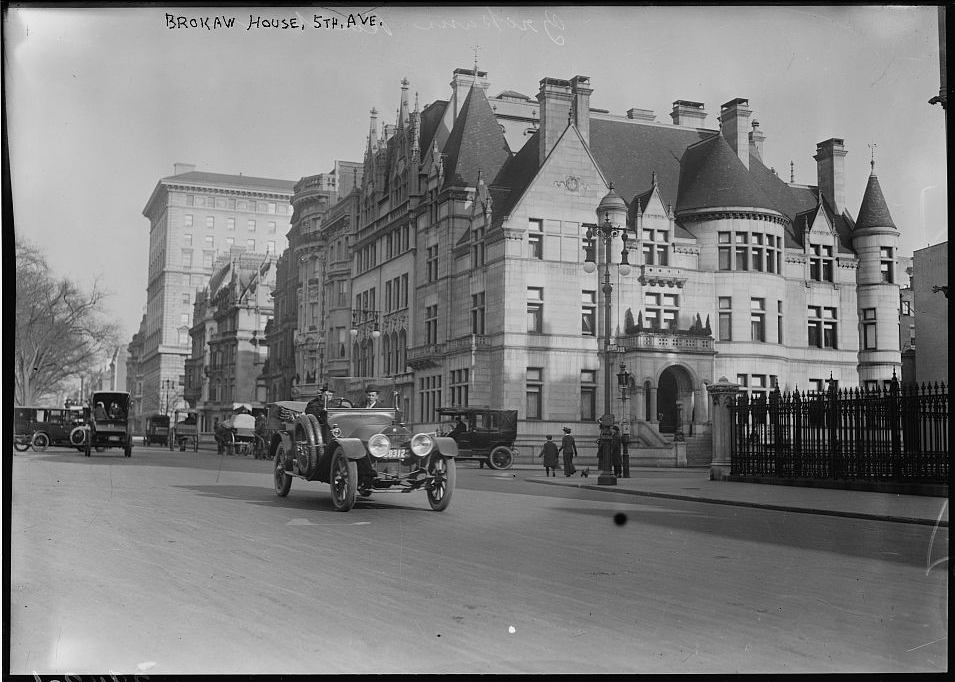 Brokaw House circa 1913.
Howard Brokaw’s older brother, Fred, had starred on the Princeton baseball team as a catcher.
In June 1891, Fred and a doctor named Ferris were lounging on the beach in front of the family’s summer cottage near Elberon, New Jersey. Three servant girls employed by a neighbor were playing in the surf when a swirling current known as a “sea puss” began carrying them out to sea. Brokaw and Ferris immediately leaped into the ocean and swam to the girls’ aid.
One girl made it to shore on her own. Ferris saved a second. Brokaw caught up with the third girl 80 yards offshore. She struggled until both were exhausted. They sank beneath the waves while Brokaw’s parents watched from the shore.
To honor Fred Brokaw’s memory, the family built a magnificent field house at Princeton, dubbed the Brokaw Memorial Field House. The adjacent athletic field was improved and renamed Brokaw Field. The field house and the field upgrades were completed in early 1896 in time for the football season.
Matthews claimed that he subbed for Cochran in 1896. The actual sub, Howard Brokaw, played on a ground named for his own brother.
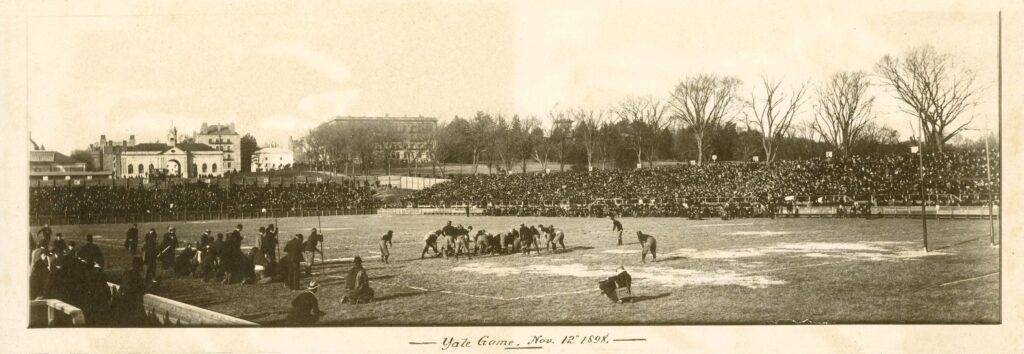 Princeton and Yale playing on Brokaw Field, November 12, 1898. Brokaw Memorial Field House is in the background on the left.
William Hearn, Gordon Johnston, and Howard Brokaw represented everything Matthews desired to be but could never become: wealthy, well-educated, successful gentlemen. And yet, for many years, from 1895 until he died in 1918, Matthews convinced some people that he, too, was a Princeton Man who belonged in their company.
Perhaps in Matthews’ mind he actually rubbed shoulders with intellectuals, rich men, and future war heroes. Perhaps, as George Costanza said, “It isn’t a lie if you believe it.”
Matthews cannot be blamed for creating an alternative universe for himself. If one grew up in a Victorian-era whorehouse, a falsified resumé was required to get ahead in life. He had nothing to lose and everything to gain by persuading gullible sportswriters that he was a famous Princeton athlete.
The researcher is struck by the Costanza-esque enormity of Matthews’ lies. He could have claimed to have attended a lesser-known school, one whose games were not covered in newspapers across the country. Instead, Matthews inserted himself onto one of the nation’s best teams. He cast himself as a substitute for the great Cochran, one of the most famous players of his time.
The fact that Matthews got away with his lies is simultaneously mystifying, hilarious, and admirable.
The phrase “one of the best-posted players in the country,” used by the Times-Picayune sportswriter after meeting Matthews, provides a clue to a possible method for hoodwinking journalists.
Matthews could easily walk into a newspaper’s print shop with some self-written copy celebrating his play as a sub-end backing up the great Cochran, and walk out with a clipping documenting his days as a Princeton Tiger.
Repeat a few times at newspapers around the South, and Matthews owns a scrapbook full of clippings he can shove under the nose of a sports editor desperate for copy to fill his page.
It is telling that Matthews’ Princeton tale grew richer and more detailed after his summer in Eufaula, Alabama, where William Jelks, editor and publisher of the Daily Times, fawned over the young man to a borderline creepy degree.
When Matthews left Eufaula for a few days to help out a team in Georgia, Jelks pined away as if the temporarily absent ballplayer was a long-lost lover:
Mathews was a lovely coach. We took pride in Mathews, not because he could stop a ball or throw a ball or catch a ball, nor yet, because he could hit the ball. We loved Mathews because he could dance on the third base and look pleased all the time. He was always the most interesting player on the diamond.
Jelks would have been happy to write whatever copy Matthews wanted and print as many clippings as he needed to fill a scrapbook.
Speaking through the newspapers gave Matthews the shield of plausible deniability. He never said he played for Princeton. If called out for the falsehood, Matthews could say that the sportswriters were mistaken. But the writers were getting their incorrect information from someone, and that source could only have been Matthews.
Whatever his methods, Matthews succeeded in building a fictional, though extremely fluid, personal and professional history. Today we can only laugh and admire his chutzpah. There’s no point in moralizing too much over a man who is not only dead but completely forgotten.
Matthews’ lies amounted to nothing. They hurt no one and provided Matthews no permanent gain. Both Matthews and his mother, Blanche Dumont, died penniless. Dumont was buried in a Potter’s Field in Fort Worth. Matthews was buried in an unmarked grave in an unknown location.
When Matthews showed up for his first practice at the Southern Athletic Club, his teammates noticed that his weight was significantly less than advertised. Matthews explained it away as the result of a recent illness.
“Formerly Mathews weighed in the neighborhood of 170 pounds, and was strong as an ox, but recent sickness has brought down his weight, and temporarily decreased his strength.,” the Times-Picayune reported.
The States concurred, finding Matthews “wholly out of condition, due to a recent spell of illness which brought him down to very near a lightweight limit.”
Matthews may very well have been ill. For the remainder of his life, he periodically suffered the effects of an unknown malady, possibly syphilis, that put him out of action and sapped his strength. But the more likely explanation is that he never weighed 165 or 170 in the first place.
When Matthews enlisted in the army in July 1898, his weight was recorded as 140½ pounds, consistent with the “lightweight limit” noted by the States.
Just three days after Matthews arrived in New Orleans, on Thanksgiving Day, the Southerns played their first game. They took on the Omegas, a team comprising men who had tried out for the Southerns and been rejected. The Southerns won easily, 17-0.
The game took place on the Tulane University football field before several hundred spectators. Although Matthews had claimed that he would be coaching the Tulane team, using the school’s field was as close as he came to any activity involving the university.
Matthews played left end against the Omegas, and impressed observers and the opposing players. The Times-Picayune reported that he performed well, despite his alleged recent illness:
The players did not expect a great deal of the old college man, but they found that Mathews was a football player all the way through. He followed the ball closely, and managed to get into almost every play. He played on the end, his old position, and that point was safe. His tackling was always low and generally hard, much harder than the lighter men on the opposite side cared to come in contact with.
The Times-Democrat praised “Matthews, the ex-Princeton man, who was the best player on the field.”
He “put up a fine game,” the States concurred, “tackling well and following the ball closely.”
Matthews was, regardless of his origin, a good football player, at least against a squad of barely trained amateurs.
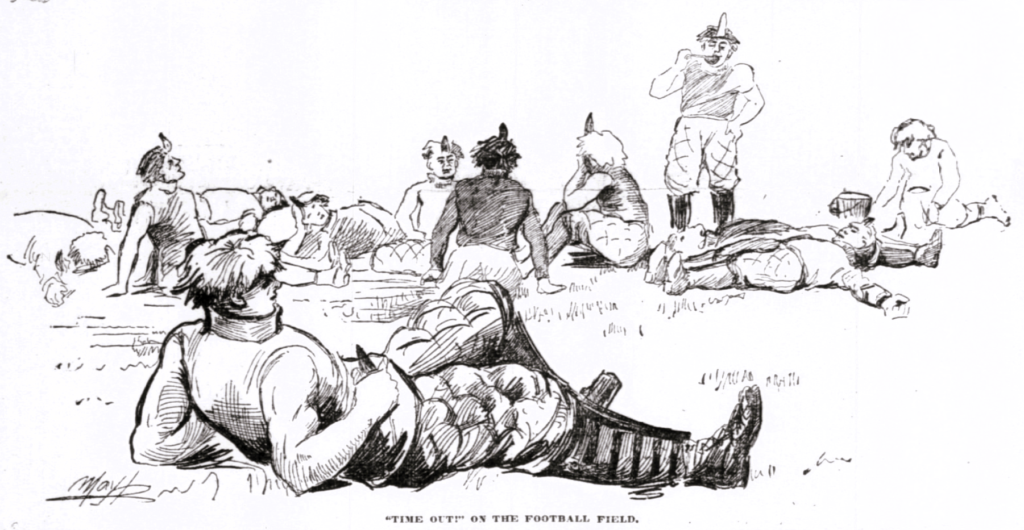 Time out during the Thanksgiving Day game. The “horns” are nose guards that the players flipped up during breaks in play. New Orleans Times-Democrat, November 26, 1897.
The sportswriter for the States was unimpressed with the Southern’s blocking, known then as interference. “There was almost an entire lack of team work behind the S.A.C.’s line,” he wrote. “There was no interference for the runner to speak of, so his gains were generally all to his own credit.”
Matthews took over the team’s coaching duties and spent long hours improving the Southerns’ interference.
He had probably read A Primer of College Football (1896) by William H. Lewis, a former Harvard player and coach. The book is helpfully illustrated with play diagrams and “instantaneous photographs.”
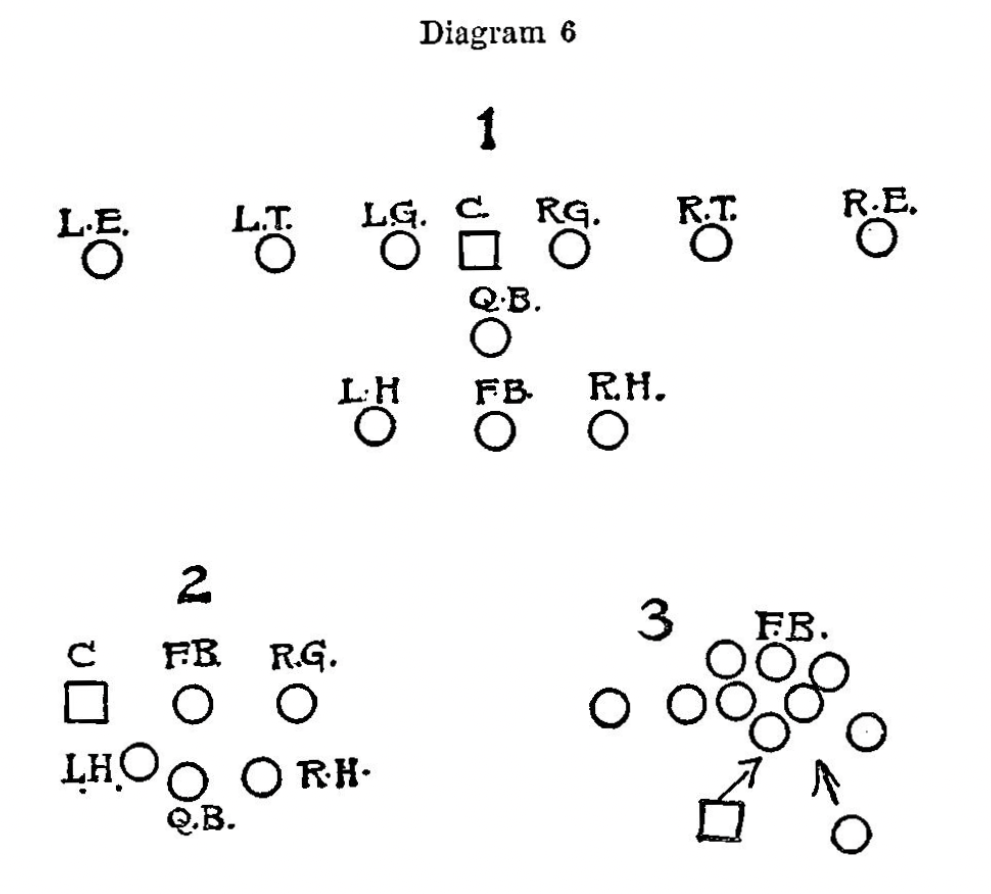 “Full-Back through Right Guard and Centre.” The fullback takes the snap and rushes the line. The other backs get behind him and push him forward. W.H. Lewis, A Primer of College Football, 1896.
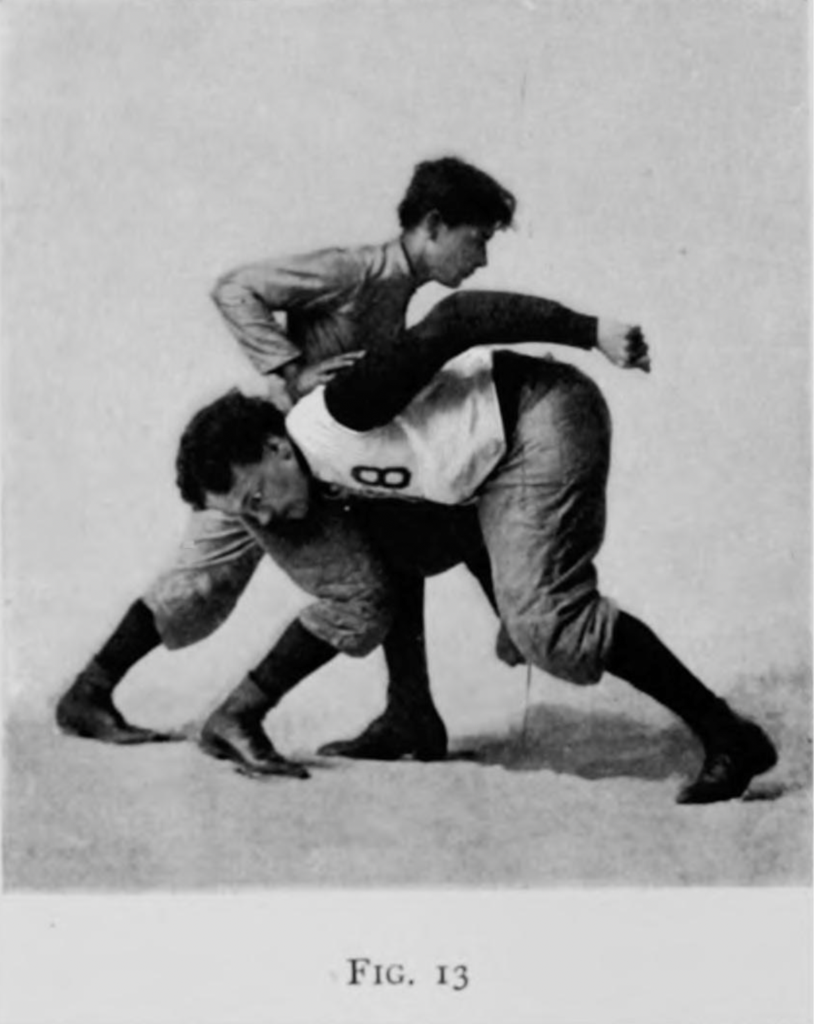 “A rough idea of good blocking.” W.H. Lewis, A Primer of College Football, 1896.
Matthews had likely also read Walter Camp’s American Football (1896), a text-heavy tome that reads like a college freshman trying to make the minimum word count on a term paper.
Camp’s book covered everything from how to call signals (“The important fact to be remembered in selecting a system of signals is that it is bad policy to confuse your own team in an attempt to mystify your opponents.”) to player hygiene (“It is well to mention also that a fortnightly warm bath may be indulged in to advantage.”).
Matthews may have gotten some advice from Eli Abbott, his baseball coach at Alabama. Abbott played football for Penn and Alabama and coached the latter squad.
On the real-world side, Matthews had quarterbacked the Texas A&M team, coached the freshman and sophomore class teams at Mississippi A&M, quarterbacked and captained the Mississippi A&M Varsity, and played on the sophomore class team at Alabama.
With a mix of book knowledge and on-field experience, backed by an impressively falsified resumé and delivered with the unwavering confidence of the practiced liar, Matthews passed as an accomplished football coach.
Matthews likely would have failed miserably on an Ivy League stage, but he could at least get a motley lot of players into a formation and run a few basic plays. The Southerns, at any rate, were happy with their new coach.
On December 5, the States reported that good progress had been made since the Thanksgiving Day game against the Omegas:
Last week the team practiced several nights and under the coaching of Matthews they have developed splendidly. He has the confidence of the players and his knowledge of the game, instilled into him under the eye of famous Captain Garratt (sic) Cochran of the Orange and Black, is working greatly to the advantage of the Southern’s players.
The team named as their field captain Matthews, on account of his superior knowledge of the game and his recent return from the theatre of football in the East.
Matthews understood the class basis of Victorian leadership principles. If he had told the Southerns that his mother ran a brothel, and his football experience amounted to some scrimmages in College Station and a couple of games in Starkville, they would have laughed in his face. But if he told them he was a gentleman from the East, mentored by the great Garrett Cochran, they would willingly follow him onto the gridiron, or into battle.
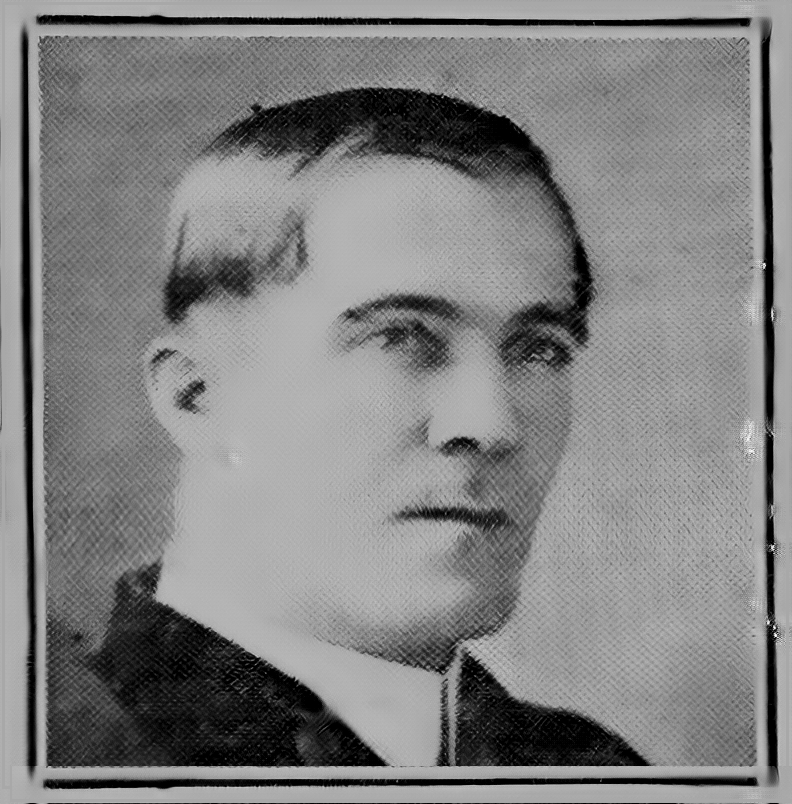
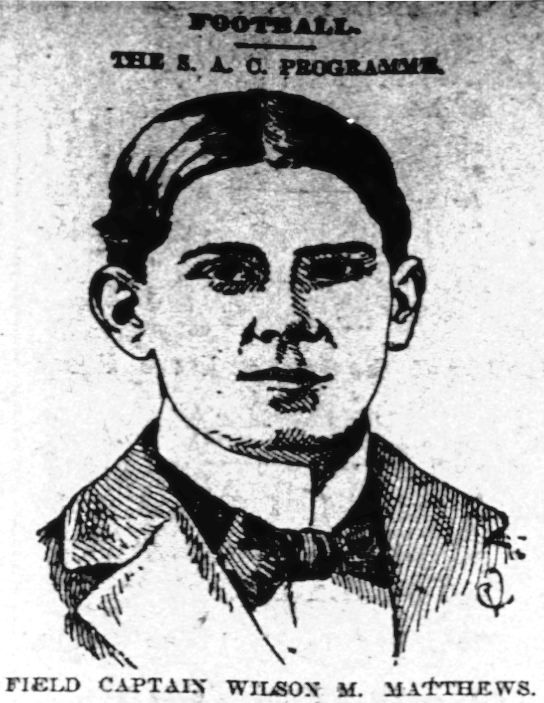 Wilson M. Matthews, probably 20 years old. New Orleans Times-Picayune, December 5, 1897.
Like the States, the Times-Picayune raved about the Southerns’ new coach and captain. Its December 5 edition featured a drawing of Matthews, probably 20 years old, and some fascinating, but totally fictitious, details about the young man’s past:
The team has selected Wilson M. Matthews as the field captain and coach. Matthews is one of the best players in the south, having begun his training in the University of Georgia. He entered that institution in 1894, and the following year went to Princeton. During the season of 1895 he played end on the eleven in the great game against Yale, and in the ’96 season he was a substitute for the present captain of the Tigers.
Our man had made some major revisions to his biography. He completely deleted the fine institutions of Texas A&M, Mississippi A&M, and the University of Alabama. He moved his University of Georgia enrollment from 1897 back to 1894, then sent himself to Princeton in 1895.
One of Matthews great failings as a liar was his inability to tell the same story twice. When he enlisted in the army just seven months later, he claimed that he spent four years at Georgia before enrolling at Princeton.
The “great game against Yale,” in which Matthews allegedly played, took place on November 23, 1895, about a week after Matthews and the Mississippi A&M boys took a 20-0 drubbing from Southwestern Baptist.
The Times-Picayune devoted nearly a full column to the game, taken by Yale 20-10, and dubbed it “one of the greatest football games ever played on any field.” The article included the Princeton lineup. Garrett Cochran played right end on every play. Langdon Lea started at left end, subbed by Samuel Thompson.
And yet, just two years later, the Time-Picayune sportswriters seemed unable to remember the game, or check the lineups reported in their own past issues. Like William Jelks in Eufaula, the New Orleans scribes seemed completely under the young man’s spell.
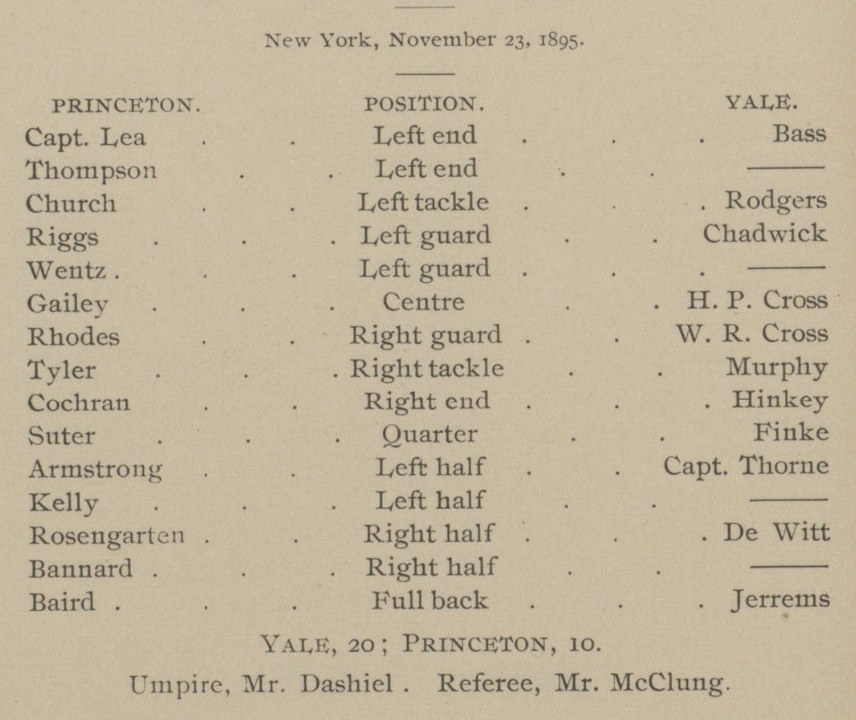 Lineups for the Yale-Princeton game, 1895. Princeton Bric-A-Brac, Volume XXII.
The Times-Picayune article of December 5 praised Matthews’ knowledge of Princeton’s offense:
Having been among football men for the past few years, Matthews has naturally become thoroughly acquainted with all the modern plays. At the Southern he has introduced a system of interference which has made Princeton famous, and half a dozen fine tandem plays have been added.
Matthews had no special knowledge of the Princeton playbook, but the Tigers’ basic offensive scheme was well known. They relied heavily on a play called the revolving tandem. The ends were positioned behind the line in the backfield. After the snap, the players formed a tight circle around the ball carrier and moved either left or right en masse, plowing through the defenders.
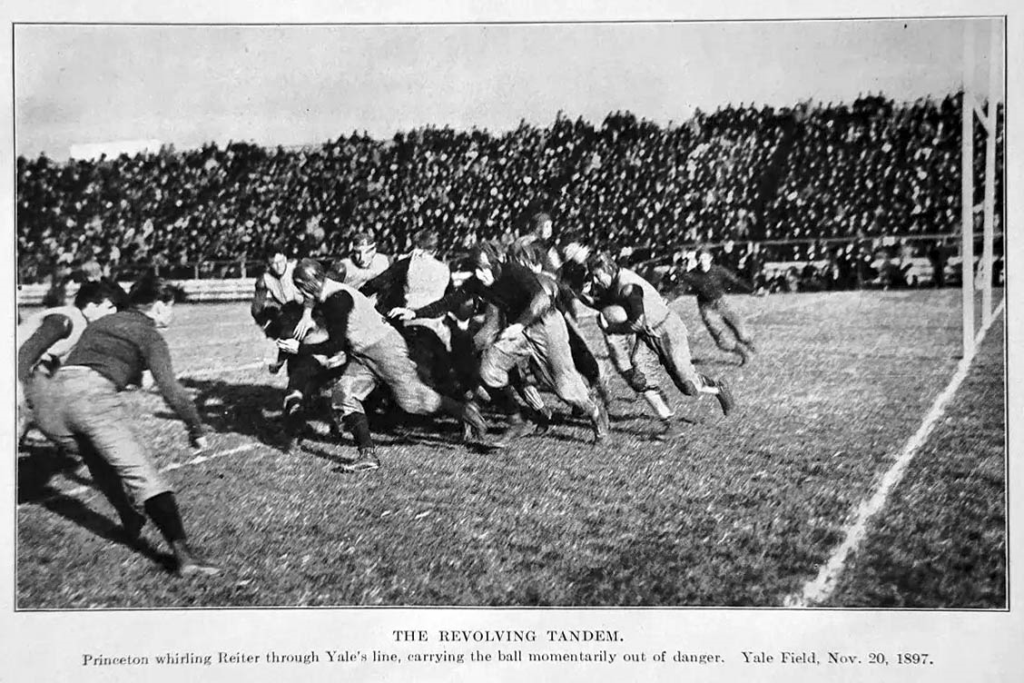 Princeton running the revolving tandem against Yale, November 20, 1897
Harry O. Robinson, a former Tufts player, brought the revolving tandem to Austin in 1896 when he coached the University of Texas. The Austin Statesman described Robinson’s system as utilizing “Princeton’s new revolving tandem plays and Pennsylvania’s center wedges.”
On December 8, Harry W. Baum joined the Southerns as a player and second coach.
Baum was an Illinois native, the son of a prominent livestock breeder. Baum’s great-grandfather was allegedly a surveyor who helped Daniel Boone establish his claims in Kentucky. His great-grandfather’s grandmother was thought to be a first cousin to George Washington’s mother. It was a tenuous claim to American Royalty, but it beat anything in Matthews’ known lineage.
Baum had played halfback and quarterback on the University of Illinois football team, lettering in ’93, ’94, and ’95. He earned baseball letters in ’94 and ’95.
After graduating, Baum came south and coached the Tulane football team in 1896. He returned to the University of Illinois in 1897 and served as an assistant coach. After the season ended in late November, he came back to New Orleans to join the Southerns. He was 23, three years older than Matthews.
Matthews never played well with other authority figures, and it’s unlikely that he enjoyed sharing coaching duties with Baum, especially given the new man’s verifiable credentials as a player and coach. Baum probably had serious doubts about Matthews’ supposed expertise.
A week after Baum’s arrival, Time-Picayune reported that he and Matthews were still working together, but the signs of a fissure were easily detected:
Baum has taught the men several of the successful tandem plays and systems of interference used by the Illinois University, while Mathews has taught several of the great plays made by Princeton during the season he played with the Tigers.
The Southerns had difficulty finding opponents. Plans to play Vanderbilt and the Vicksburg Athletic Club fell through. They finally arranged a match with the Montgomery Athletic Club, to be played December 18.
Three days before the game, the Times-Democrat listed Matthews among the probable starters at end. The next day he was gone.
“Yesterday Mathews, the player from Princeton, left the city for the north,” the Times-Picayune reported. “His position as field captain is now being filled by Baum.”
The northern destination to which Matthews allegedly journeyed turned out to be Austin. A month after leaving Louisiana, he was in St. Mary’s church, where he formerly attended school and engaged in oratorical exercises, joining in an evening of “musical selections, songs and recitations” to celebrate the election of new officers to the Ancient Order of Hibernians.
The New Orleans newspapers did not explain Matthews’ sudden departure. He probably got crossways with Baum. In the article that announced Matthews’ exit, the Times-Picayune hinted at the conflict:
He [Baum] has been working the Southerns for a week, and under his training the men have greatly improved. One of the great weaknesses has been left behind. Formerly the men were slow in getting started, but now they work with a snap, and there is an air of liveliness throughout their struggle which will doubtless carry success.
Yesterday afternoon the entire team reported at Athletic park for practice, and for two hours they trained hard and fast. The work was extremely satisfactory, especially the interference and team work.
Matthews was, evidently, a players’ coach, content to let the Southerns loaf through practice. Baum brought the snap of a disciplined college program. The two cooks could not co-exist in the same kitchen.
It’s also possible that Matthews split town after a Princeton fan or alumnus called someone’s attention to the bogus Tiger. A local lawyer named James Porter Parker is the likely suspect.
James Porter Parker (not to be confused with a cousin of the same name) was born in Mississippi but grew up in New Orleans. His father, John Milliken Parker, graduated from Princeton in 1860, served in the Civil War, and became a prominent New Orleans businessman engaged in cotton trading and wholesale groceries. James Parker’s older brother, also named John Milliken Parker, served as governor of Louisiana from 1920 to 1924.
James Parker followed his father into Princeton. He served as treasurer of the baseball team in 1891, when Fred Brokaw starred at catcher. He graduated in the spring of 1892 with a degree in civil engineering.
The following fall, Parker entered the University of Virginia to study law. He played fullback on the 1892 football team and second base on the 1893 baseball team. He graduated with a law degree in 1894.
Parker returned to New Orleans to practice law, and joined the Southern Athletic Club. He played fullback for the Southerns in 1894, 1895, and early 1896.
On November 7, the day the Times-Picayune announced that “Matthews, of Princeton’s 1895” would play for the Southerns, the States printed part of “a very newsy and entertaining letter” Parker sent to “the editor of the football department.”
Parker had journeyed to Princeton to visit “his old college chums and brothers in football,” and had attended the games against the Elizabeth Athletic Club and Dartmouth (both won by Princeton by a combined score of 42-0). Parker said the team had experienced “very hard luck in injuries” but showed “marked improvement the past week.”
Parker, then, was a Princeton alumnus who avidly followed the team. He may have known Garrett Cochran. He would definitely have known that no one named Matthews had played for Princeton. Parker also knew the Southerns and was well acquainted with the sports editor of the States. There is no doubt that Parker could have blown the whistle on the alleged Princeton end, resulting in Matthews’ sudden departure from New Orleans.
The newspapers never mentioned Matthews again. In the writeups of the Southerns’ game against Montgomery, none of the New Orleans papers – the Times-Picayune, the States, or the Times-Democrat – devoted a single slug of Linotype to the late great Princeton end. After he left, it was as if he was never there in the first place.
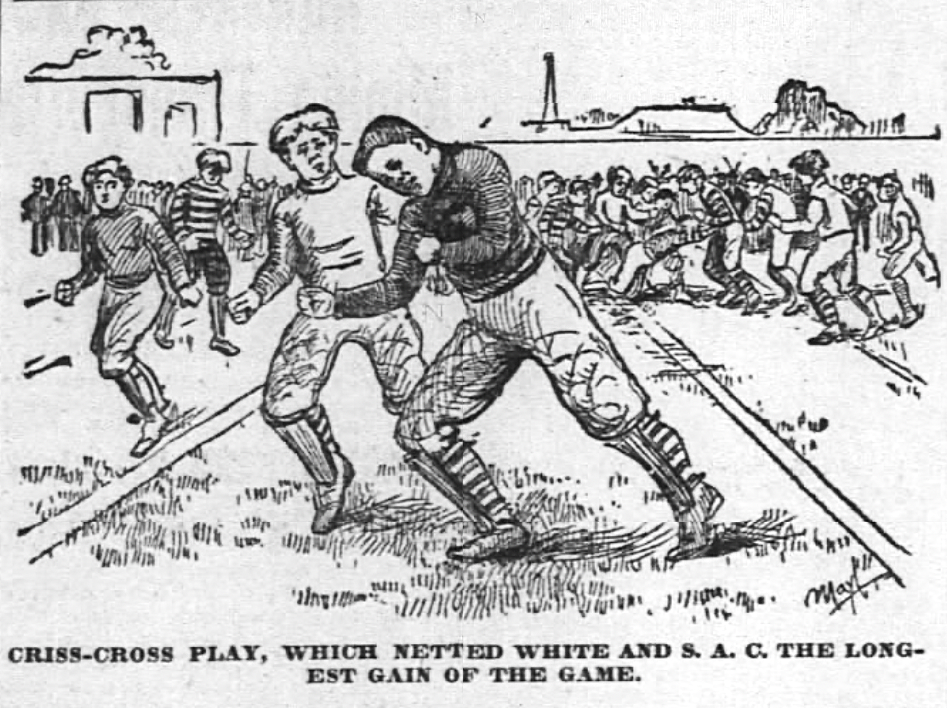 Southern Athletic Club in action against the Montgomery Athletic Club. New Orleans Times-Democrat, December 19, 1897.
Matthews continued to claim that he had attended Princeton, and his story kept changing.
When he enlisted in the army in 1898, he said that he had logged six years of military school, four years at the University of Georgia, and two at Princeton.
After joining the Texas League as an umpire in 1899, he said that he attended Georgia in 1894, coached the University of Mississippi football team in 1895, and played for Princeton in 1896.
Later in 1899, he told a reporter in Waco, Texas, that he played for Princeton in 1897 and “was honored by being one of the All America team that year.”
In 1902, he told a reporter for a Memphis newspaper that he had graduated from Princeton in 1894. Totally hoodwinked, the reporter described Matthews as “a man of culture and refinement” from a “highly respected” Austin family.
Around 1903, Matthews began to speak less about his Princeton gridiron experience, and recast himself as a member of the baseball team. One reporter labeled him “the old Princeton university ball player.”
In 1905, a reporter for the New Orleans Times-Picayune, unaware of Matthews’ 1897 claim that he had subbed for Cochran, said Matthews “covered third base for Princeton during his college days.”
The following year, Matthews added some extraordinary details to his biography. He had prepared for college at St. John’s Military School in Ossining, New York. His parents wished him to attend Georgetown University “as he is a Roman Catholic by faith.” Instead, he enrolled in Princeton, “that stronghold of Presbyterianism.” He later studied law at Georgia for two years.
A 1907 profile in Sporting Life pushed Matthews’ Princeton enrollment all the way back to 1891, made him a pitcher, and added a fascinating factoid: “First game being a victory from Cornell.”
By 1909, Matthews had pushed his Princeton enrollment back another year, to 1890. He claimed he studied there three years, then “tossed up his chances for a degree in the spring of 1893 to enter the professional base ball ranks.”
Matthews created his most preposterous – and most revealing – concoction in 1911. He told a reporter that he had attended a Princeton alumni banquet “several years ago” and had been called upon to address the affair.
According to Matthews, he stood up and told a story about a Jewish ballclub owner who had only one eye. The owner, Matthews supposedly told the distinguished guests, “Watches the money with the good eye and the game with the bad one.”
Matthews failed to keep his coarse origins under wraps, even when portraying himself in a tall tale. Given the chance to create a story of eloquently addressing the wealthy, successful Princeton alums, Matthews cast himself as a bumpkin ballplayer whose contribution to the banquet comprised an off-color joke.
Even in his own work of fiction, Matthews could not become the gentleman he so desperately wished to be.

Charles Norman is a writer and historian. Email: reverb.raccoon@gmail.com. Or follow on Instagram and Facebook.
Latest Posts
Here Lies Wilson Matthews – 1 Who Was W.M. Matthews?
But he wanted to get in. He wanted to be urbane and careless. He wanted to wear well-cut clothes. He wanted to be a gentleman.-- Thomas Wolfe, Look Homeward, Angel Part 1Who Was W.M. Matthews? Mississippi State University – then Mississippi A&M College – entered...
Here Lies Wilson Matthews – 2 Who Was Blanche Dumont?
Here’s what I want. I notice you changed your name. I want you to keep your new name. I guess you made up someplace you came from – well, that’s where you came from… You figure you died and now you’re somebody else and we’ll get along fine. -- John Steinbeck, East of...
Here Lies Wilson Matthews – 3 Guy Town
He was surrounded by a world that was both beautiful and terrifying, a land of secrets and shadows, where the line between civilization and savagery was thin and easily crossed--Joseph Conrad, Lord Jim Part 3Guy Town Miss Blanche Dumont became a sex worker in Austin,...
Here Lies Wilson Matthews – 4 Spaced Flashes
In probing my childhood (which is the next best to probing one’s eternity) I see the awakening of consciousness as a series of spaced flashes, with the intervals between them gradually diminishing until bright blocks of perception are formed, affording memory a...
Contact Reverb Raccoon
 |
 |
 |
 |
Archives